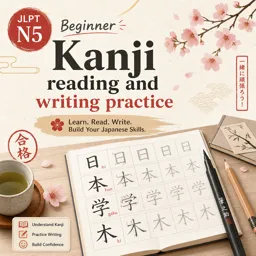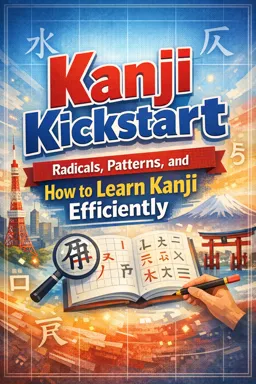

Free ebook on Japanese kanji radicals, patterns, readings, stroke order, and high-utility characters for efficient study.
Free ebook content
-

Kanji Kickstart: What Kanji Are Made Of (Radicals and Components)
+ Exercise: When breaking down a kanji that has three or more chunks, what is the recommended first step for segmentation?
-
Kanji Kickstart: The Most Useful Radicals and What They Signal
+ Exercise: When you see the radical 辶 as a trailing “road” shape on the right side of a kanji, what is the best first meaning category to predict?
-
Kanji Kickstart: Common Component Patterns (Left-Right, Top-Bottom, Enclosures)
+ Exercise: When rewriting a kanji with a full outer enclosure pattern (like 国), what is the recommended order for processing its components?
-
Kanji Kickstart: Stroke Order and Shape Rules That Prevent Mistakes
+ Exercise: When practicing a kanji with an enclosure (like a box shape), which sequence best prevents the inside strokes from becoming cramped or uneven?
-
Kanji Kickstart: How Meaning Works in Kanji (Semantic Hints and Word Meanings)
+ Exercise: Which approach best follows the recommended method for understanding a new kanji compound you haven’t seen before?
-
Kanji Kickstart: How Readings Behave (On Readings, Kun Readings, and Patterns)
+ Exercise: When you see a 2+ kanji word with no kana between the kanji (a multi-kanji compound), what is the best default guess for the reading type?
-
Kanji Kickstart: Visual Discrimination of Similar Kanji (Avoiding Confusions)
+ Exercise: When using the method “Shared Frame → Differentiator → Anchor Check,” what is the one-second anchor check that helps you distinguish 口 from 日?


-
Kanji Kickstart: High-Utility Kanji Set — Numbers and Counting Foundations
+ Exercise: Which kanji expression correctly writes 23,000 using the rule of splitting at 万 and building (digit + unit) chunks?
-
Kanji Kickstart: High-Utility Kanji Set — Time and Calendar Kanji
+ Exercise: Which schedule string follows the standard Japanese date order that uses the unit kanji year → month → day (〜年〜月〜日)?
-
Kanji Kickstart: High-Utility Kanji Set — People, Roles, and Social Basics
+ Exercise: When you see the left-side component 亻 in a kanji, what is the best first recognition strategy?
-
Kanji Kickstart: High-Utility Kanji Set — Nature and Places
+ Exercise: When you see the kanji 水 on a sign, which interpretation best matches how it is typically used compared with 川?
-
Kanji Kickstart: High-Utility Kanji Set — Movement and Everyday Actions
+ Exercise: In short instructions, what is the most reliable way to quickly interpret the pair 入口 and 出口 on signs?
About the free ebook
Kanji Kickstart: Radicals, Patterns, and How to Learn Kanji Efficiently
Build a practical foundation for reading and remembering Japanese kanji. This free ebook explains how kanji are constructed, how their parts offer useful clues, and how to study them as meaningful patterns rather than isolated drawings.
See the structure behind each character
Learn to identify radicals and components, recognize left-right, top-bottom, and enclosure layouts, and apply reliable stroke-order and shape principles. These skills make unfamiliar kanji less intimidating and help prevent common writing errors.
Use clues without relying on guesses
Kanji components can suggest meaning, while readings often follow patterns shaped by vocabulary. The ebook introduces semantic hints, on and kun readings, and practical ways to connect a character to words you will actually encounter.
Focus on useful Japanese from the start
Practice with high-utility kanji for numbers, time, calendars, people, places, nature, movement, and everyday actions. Short texts bring recognition and writing together, helping you notice kanji in context.
What you will strengthen
- Recognition of common radicals and component arrangements
- Visual comparison of similar-looking kanji
- More accurate stroke order and character proportions
- Vocabulary-based approaches to meanings and readings
- Confidence with frequently used kanji in everyday Japanese
Use this ebook as a clear starting point for building a study routine that combines observation, writing, review, and real-word recognition.
What are kanji radicals used for?
Radicals organize kanji and often provide clues about a character's meaning or category.
What is the difference between on and kun readings?
On readings are Chinese-derived pronunciations, while kun readings are native Japanese readings often used in Japanese words.
How can I tell similar kanji apart?
Compare their radicals, component positions, stroke details, and the vocabulary in which they appear.
This ebook includes:

13 content chapters

Digital certificate of course completion (Free)

Exercises to train your knowledge

100% free, from content to certificate
Ready to get started?

 recommended
In the app you will also find...

Over 5,000 free courses
Programming, English, Digital Marketing and much more! Learn whatever you want, for free.

Study plan with AI
Our app's Artificial Intelligence can create a study schedule for the course you choose.

From zero to professional success
Improve your resume with our free Certificate and then use our Artificial Intelligence to find your dream job.
You can also use the QR Code or the links below.