Water is the example everyone learns first: ice, liquid water, steam. Same substance, three completely different behaviors. Nothing was added or removed — only the temperature changed. Understanding why that happens takes you straight into one of the most useful ideas in physics: matter’s state is determined by a tug-of-war between energy and attraction. This article explains how that works.
The idea behind every state: particles in motion
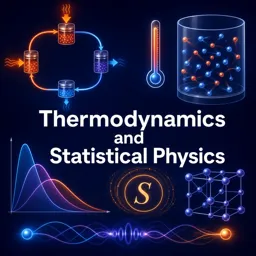
All matter is made of particles — atoms or molecules — and those particles are never still. They vibrate, slide, and fly around. This is the kinetic theory of matter, and it rests on two competing factors:
- Kinetic energy: the energy of motion. Temperature is essentially a measure of the average kinetic energy of the particles. Hotter means faster.
- Intermolecular forces: the attractions pulling particles toward each other, trying to hold them in place.
That’s the whole story. When attraction wins, you get a solid. When they’re roughly balanced, a liquid. When motion overwhelms attraction, a gas. Every phase change is just one side of that contest gaining the upper hand.
Solids: locked in place
In a solid, particles are packed closely and held in fixed positions. They still vibrate, but they can’t travel past one another. That’s why a solid has both a definite shape and a definite volume — a brick stays brick-shaped no matter what container you put it in.
Solids come in two broad flavors. In crystalline solids like salt, ice, or metals, particles sit in an orderly repeating lattice, which is why they have sharp, specific melting points. In amorphous solids like glass, the arrangement is disordered, so they soften gradually over a range instead of melting at one clean temperature.
Liquids: touching but mobile
In a liquid, particles still touch, but they have enough energy to slide past each other. The result is a substance with a definite volume but no definite shape — pour a litre of water into any container and it’s still a litre, but it takes the container’s shape.
This mobility explains familiar behaviors. Surface tension arises because particles at the surface are pulled inward by neighbors below with no counterbalancing pull from above, creating a kind of elastic skin — enough to let a small insect stand on a pond. Viscosity, meanwhile, measures how much a liquid resists flowing: honey has strong internal attractions, water has weak ones.
Gases: mostly empty space
In a gas, particles have so much energy that attractions barely matter. They fly apart, moving fast and independently, colliding occasionally. A gas has neither definite shape nor definite volume: it expands to fill whatever container it’s in.
The striking thing about a gas is how empty it is. The particles occupy a tiny fraction of the total volume; the rest is space. That’s precisely why gases can be compressed while liquids and solids essentially cannot — there’s room to squeeze. Pressure itself is nothing more than countless particles drumming against the container walls, which is why heating a sealed container raises the pressure inside.
Plasma: the fourth state
Push a gas to extreme temperatures and something new happens. Collisions get violent enough to knock electrons off atoms, leaving a mix of free electrons and positive ions. That’s plasma — and because it’s full of charged particles, it conducts electricity and responds to magnetic fields, which ordinary gases don’t.
Plasma feels exotic, but it’s the most common state of ordinary matter in the universe: stars, including the Sun, are made of it. Closer to home, you’ll find it in lightning, neon signs, and fluorescent lamps.
Comparing the four states
| Property | Solid | Liquid | Gas | Plasma |
|---|---|---|---|---|
| Definite shape | Yes | No | No | No |
| Definite volume | Yes | Yes | No | No |
| Particle spacing | Very close | Close | Far apart | Far apart |
| Compressible | Barely | Barely | Easily | Easily |
| Conducts electricity | Only if metallic | Only if ionic | Normally no | Yes |
Phase changes: the names and directions
Every transition has a name, and they come in pairs — one adding energy, one removing it:
- Melting (solid → liquid) and freezing (liquid → solid)
- Vaporization (liquid → gas) and condensation (gas → liquid)
- Sublimation (solid → gas, skipping liquid) and deposition (gas → solid)
- Ionization (gas → plasma) and recombination (plasma → gas)
Sublimation is the one that surprises people, but it’s easy to observe: dry ice turns straight into carbon dioxide gas with no puddle, and frost disappearing on a cold dry morning is the same process. Deposition running in reverse is how frost forms in the first place.
The counterintuitive part: heat without temperature change
Here’s the detail that trips up most students. Put a thermometer in a pot of ice water and heat it. The temperature climbs to 0 °C — and then stops, even though the burner is still running. It won’t budge until every last piece of ice has melted.
Where is the energy going? Into breaking the attractions holding the lattice together, not into speeding the particles up. Energy absorbed during a phase change without a temperature rise is called latent heat. Only once the ice is fully melted does further heating start raising the temperature again.
This also explains why steam burns are worse than boiling-water burns at the same temperature. Steam at 100 °C carries all that extra latent heat, and it dumps that energy into your skin as it condenses — on top of the heat from cooling down.
Pressure matters too
Temperature gets the attention, but pressure is the other control knob. Water boils at 100 °C at sea level. Up a mountain, where atmospheric pressure is lower, it boils at a lower temperature — which is why food takes longer to cook at altitude: the water is boiling, but it’s simply not as hot. A pressure cooker does the opposite, raising pressure so water can exceed 100 °C before boiling and cook food faster.
Because both variables matter, scientists map substances on a phase diagram, with pressure on one axis and temperature on the other. Every point on the map corresponds to a state, and the lines between regions mark the transitions.
Conclusion
Solid, liquid, gas, and plasma aren’t four unrelated categories to memorize. They’re four outcomes of the same underlying contest between particle motion and particle attraction, with temperature and pressure deciding the winner. Once that clicks, phase changes stop being vocabulary and start being predictable — and details like latent heat and altitude cooking follow naturally.
If you’d like to go further into kinetic theory, thermodynamics, and how energy moves through physical systems, it’s worth exploring the free physics and basic studies courses available on Cursa.