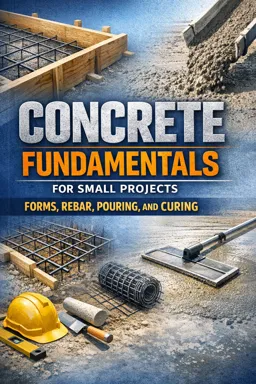

Free ebook on concrete fundamentals for small projects, covering forms, rebar, mixing, pouring, finishing, joints, and curing.
Free ebook content
-

Concrete Fundamentals for Small Projects: Safety, Tools, and Job Setup
+ Exercise: Which practice best helps ensure rebar actually reinforces a small concrete slab instead of remaining ineffective?
-
Subgrade and Base Preparation for Concrete Slabs, Pads, and Walkways
+ Exercise: Which approach best helps prevent settlement and random cracking in a small concrete slab by improving subgrade and base performance?
-
Layout, Grade, and Form Building for Straight and Curved Concrete Work
+ Exercise: When laying out a small concrete slab, what is the main advantage of using batter boards with stringlines instead of driving stakes at the slab edges?


-
Reinforcement Basics: Rebar, Wire Mesh, and Proper Placement
+ Exercise: Why should welded wire mesh or rebar be supported in the middle to upper third of a slab instead of left on the subgrade?
-
Concrete Mix Selection, Estimating, and Ordering vs. Bag Mixing
+ Exercise: When estimating concrete for a slab, why should you add allowances beyond the basic Length × Width × Thickness calculation?
-
Placement and Consolidation: Getting Concrete into Forms Correctly
+ Exercise: During a small concrete pour, what is the best way to reduce segregation and end up with solid edges and corners?
-
Screeding and Bull Floating for Flatness and Correct Elevation
+ Exercise: After screeding, you notice a true low spot (a hollow/shadow) behind the screed board. What is the best immediate action?
-
Edges, Joints, and Surface Finishes: Broom, Trowel, and Decorative Options
+ Exercise: You want to start edging and tooling control joints on a small slab. Which condition best indicates the concrete is ready?
-
Control Joints, Expansion Isolation, and Crack Management
+ Exercise: Which joint layout principle best helps manage cracking at an inside (re-entrant) corner in a slab?
-
Curing Methods for Durable Concrete: Moisture, Temperature, and Protection
+ Exercise: Which practice best supports durable curing of a small concrete slab by controlling moisture loss and protecting vulnerable areas?
-
Hot Weather Concreting: Preventing Rapid Set, Cracking, and Weak Surfaces
+ Exercise: During hot-weather finishing, what is the best response when the slab surface starts drying too fast (dulling/crusting) before you are done finishing?
-
Cold Weather Concreting: Avoiding Freeze Damage and Slow Strength Gain
+ Exercise: In cold weather concreting, which approach best reduces the risk of early-age freeze damage and delayed strength gain?
-
Diagnosing and Fixing Common Problems: Cracks, Scaling, Dusting, and Unevenness
+ Exercise: A slab develops a crack with noticeable vertical offset (one side higher) creating a trip hazard. Which repair approach best matches the likely root cause?
About the free ebook
Concrete Fundamentals for Small Projects: Forms, Rebar, Pouring, and Curing
This free ebook provides practical construction guidance for producing durable concrete slabs, pads, walkways, and other small-scale flatwork. It explains how careful preparation, accurate layout, sound forming, correct reinforcement, and disciplined finishing work together to improve strength, appearance, and service life.
Build from a stable foundation
Learn how jobsite safety, tool selection, subgrade evaluation, and compacted base material affect the finished pour. The ebook emphasizes checking grade, drainage, dimensions, and form stability before concrete arrives or mixing begins.
Place and finish concrete with control
Understand how to select a suitable mix, estimate material quantities, compare ready-mix delivery with bag mixing, and place concrete without segregation. Clear guidance covers consolidation, screeding, bull floating, edging, jointing, and choosing a finish appropriate for traction and appearance.
Use reinforcement and joints correctly
Discover the practical role of rebar, welded wire reinforcement, control joints, and isolation joints. The ebook explains why reinforcement must be positioned at the proper elevation rather than left on the base, and how planned joints help manage normal concrete shrinkage cracking.
Protect strength during curing
Concrete performance depends heavily on early moisture retention and temperature control. Explore curing methods, protection strategies for hot and cold conditions, and ways to reduce rapid drying, surface weakness, freeze damage, and uneven strength development.
Troubleshoot common concrete defects
Use practical observations to identify likely causes of cracks, scaling, dusting, and uneven surfaces. This resource helps small-project builders make informed decisions, recognize when conditions require extra precautions, and create safer, more reliable concrete work.
How deep should a base be under a small concrete slab or walkway?
Base depth depends on soil, load, climate, and local requirements; it must be stable, properly graded, and compacted.
Should rebar or wire mesh sit on the ground before concrete is poured?
No. Reinforcement should be supported at the specified elevation so it is embedded in the concrete, not resting on the base.
Why are control joints cut into concrete slabs?
Control joints create planned weak planes that help direct shrinkage cracking into less noticeable locations.
This ebook includes:

13 content chapters

Digital certificate of course completion (Free)

Exercises to train your knowledge

100% free, from content to certificate
Ready to get started?

 recommended
In the app you will also find...

Over 5,000 free courses
Programming, English, Digital Marketing and much more! Learn whatever you want, for free.

Study plan with AI
Our app's Artificial Intelligence can create a study schedule for the course you choose.

From zero to professional success
Improve your resume with our free Certificate and then use our Artificial Intelligence to find your dream job.
You can also use the QR Code or the links below.