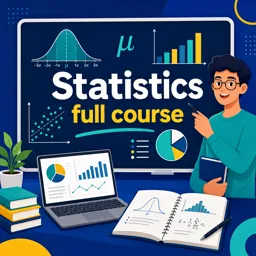


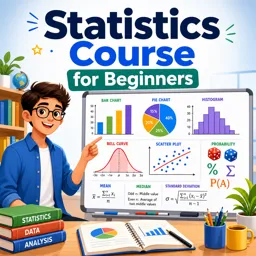

Statistics is the science of collecting, organizing, analyzing, and interpreting data to make informed decisions.

4


Exercises
Test your inferential statistics knowledge with questions on hypothesis testing, confidence intervals, p-values, sampling, and statistical errors.
Start exercisesTest your descriptive statistics skills with questions on mean, median, mode, range, variance, standard deviation, and skewness.
Start exercisesTest your statistics basics with questions on mean, median, range, probability, graphs, samples, standard deviation, and normal distribution.
Start exercisesTest basic probability and statistics skills with questions on coins, dice, normal distributions, p-values, averages, outliers, and hypotheses.
Start exercisesTest advanced probability skills with dice, cards, coin flips, expected value, distributions, independence, and variance questions.
Start exercises
Sampling and Study Design: How to Collect Data You Can Actually Trust
Learn sampling and study design fundamentals to collect reliable data and avoid bias in statistics, research, and real-world analysis.

Hypothesis Testing Without the Headache: p-Values, Confidence Intervals, and Common Pitfalls
Learn hypothesis testing with p-values, confidence intervals, and key pitfalls using a clear, exam-focused statistical framework.

Understanding Social Stratification: Class, Status, and Power in Everyday Life
Understand social stratification through class, status, and power, and learn how inequality shapes everyday life and opportunities.

Understanding Statistical Models in Applied Statistics
Descubra como modelos estatísticos ajudam a interpretar dados e tomar decisões práticas em áreas como saúde, engenharia, negócios e ciências sociais.

Real-World Applications of Applied Statistics: Solving Everyday Problems
Explore como a estatística aplicada resolve problemas reais em saúde, negócios, educação e meio ambiente com técnicas como regressão e análise de séries temporais.

Key Techniques in Applied Statistics: Data Analysis in Action
Explore how applied statistics helps solve real-world problems through data analysis, regression, ANOVA, and software tools like R and Python.

An Introduction to Applied Statistics: Principles and Practice
Learn how applied statistics turns raw data into real-world decisions using descriptive, inferential, and predictive techniques across industries.

Essential Building Blocks of Statistics: Types, Data, and Measures Explained
Learn the essential types, data forms, and statistical measures to interpret information and make better decisions in any field.
Build essential data literacy with our collection of free online courses in Statistics basics. Designed for beginners, students, professionals, and lifelong learners, these educational courses introduce the fundamental concepts used to collect, organize, analyze, and interpret data. Study at your own pace, complete practical exercises, and earn free certification to demonstrate your new knowledge.
Statistics is an important field for education, research, business, economics, science, technology, and everyday decision-making. These free Statistics basics courses offer accessible lessons that help learners understand statistical terminology, numerical information, and common analytical methods. No advanced background is required, making this course selection an excellent starting point for anyone seeking introductory Statistics training.
Course topics may include:
Each course combines clear educational content with exercises that reinforce important concepts. Practice activities allow you to apply formulas, analyze datasets, compare statistical measures, and develop problem-solving skills. This learning approach supports better retention and helps prepare students for academic assessments, workplace tasks, research projects, and more advanced courses in data analysis.
All courses listed on this page are free and provide an opportunity to obtain free certification. A course certificate can support your educational portfolio, complement your resume, and document your commitment to professional development. You can choose the lessons that match your learning goals and progress through the material according to your own study schedule.
To access these free online courses, complete the exercises, and obtain free certification, it is necessary to install the Cursa application. Android users can install it through Google Play by selecting Download for Android. iPhone users can install it through the App Store by selecting Download for iOS / iPhone.
Explore the available Statistics basics classes and begin developing practical quantitative skills. With free educational content, flexible online study, guided exercises, and free certification, you can create a strong foundation for further learning in mathematics, data science, research methodology, analytics, and related disciplines.
What is statistics?
Statistics is the science of collecting, organizing, analyzing, and interpreting data to make informed decisions.
What are descriptive statistics?
Descriptive statistics summarize data using measures such as the mean, median, mode, range, variance, and standard deviation.
What is the difference between a population and a sample?
A population includes every member of a group, while a sample is a smaller subset used to study that group.
How do mean, median, and mode differ?
The mean is the average, the median is the middle value, and the mode is the most frequent value.
What is hypothesis testing in statistics?
Hypothesis testing is a method for using sample data to evaluate a claim about a population.
What is ANOVA used for?
ANOVA, or analysis of variance, tests whether the average values of three or more groups differ significantly.
What is regression analysis?
Regression analysis examines the relationship between variables and can be used to explain or predict an outcome.

Complete any course and issue your certificate via the app — at no cost.

Download the app! to have access to more than 4,000 Online Courses + Certificate, all free!
Download the app! 100% free courses.


Carry knowledge in your pocket.
Download the Cursa app.
There are hundreds of free courses available, with a free certificate of completion that is saved in your mobile image gallery.
Download the app to access the Course Completion Certificate for Free.


+ 10 million
students

Free and Valid
Certificate

60 thousand free
exercises

4.8/5 rating in
app stores

Free courses in
video and ebooks