
Exercises
Explore the fundamentals of astrophysics with this Introduction to Astrophysics Knowledge Test. Challenge yourself with questions about the Sun’s composition, stellar energy, light-years, lunar eclipses, the Milky Way, redshift, black holes, the Big Bang, and planets such as Mars and Venus. Whether you are a student, space enthusiast, or curious beginner, this quiz offers a clear way to check your understanding of key astronomy and cosmology concepts. Discover how much you know about the universe and build a stronger foundation for further space science learning.
Answer the questions below and check the explanation for each answer.
0/10 answered
Auto audio on: the next questions will be read aloud when you click Continue.
The majority of the Sun's mass is composed of Hydrogen, making up about 74% of the Sun's elemental mass.
A light-year is a unit of distance. It represents the distance light travels in one year, which is about 5.88 trillion miles (9.46 trillion kilometers).
A lunar eclipse occurs when the Earth comes between the Sun and the Moon, and the Earth's shadow falls on the Moon.
The Milky Way is a Spiral galaxy, characterized by its flat, rotating disk containing stars, gas, and dust, and a central bulge with spiral arms.
'Redshift' refers to the phenomenon where the light from an object increases in wavelength, or shifts to the red end of the spectrum, usually indicating that the object is moving away from the observer.
The Big Bang Theory is a scientific explanation for the origin of the universe, proposing it expanded from a hot, dense initial state about 13.8 billion years ago.
A black hole is a region of space where the gravitational pull is so strong that nothing, not even light, can escape from it.
Despite Mercury being closer to the Sun, Venus has the highest surface temperature due to its thick, toxic atmosphere which traps heat in a runaway greenhouse effect.
Mars is often referred to as the Red Planet due to its reddish appearance, which is caused by iron oxide, also known as rust, on its surface.
The primary source of energy in stars is nuclear fusion, where hydrogen atoms combine to form helium, releasing energy in the process.
Free CourseRelativity Course: Special and General Relativity, Tensors, Black Holes, Gravitational Waves and Cosmology
5

(3)

19h01m

39 exercises
Free CourseIntroduction to Thermodynamics
5
(1)
1h48m
9 exercises
Free CourseNuclear and Radiochemistry
5
(1)
31h56m
31 exercises
Free CoursePhysics for beginners
5
(1)
1h57m
2 exercises
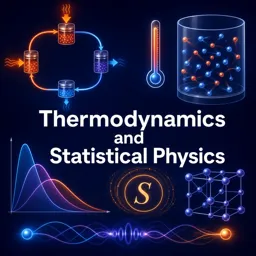
Free CourseThermodynamics and Statistical Physics
5
(1)
14h53m
23 exercises
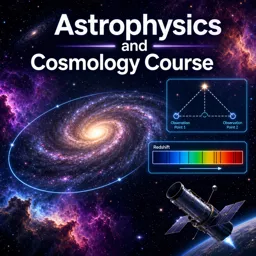
Free CourseAstrophysics and Cosmology Course
5
(1)
1h24m
5 exercises
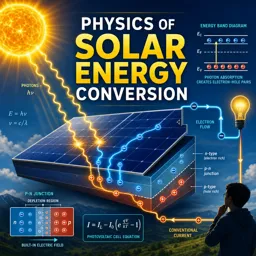
Free CoursePhysics of Solar Energy Conversion
5
(4)
4h59m
16 exercises
Free CourseQuantum Physics
5
(1)
24m
4 exercises
Thousands of online courses in video, ebooks and audiobooks.
To test your knowledge during online courses
Generated directly from your cell phone's photo gallery and sent to your email

Download our app via QR Code or the links below:.



Carry knowledge in your pocket.
Download the Cursa app.
There are hundreds of free courses available, with a free certificate of completion that is saved in your mobile image gallery.
Download the app to access the Course Completion Certificate for Free.


+ 10 million
students

Free and Valid
Certificate

60 thousand free
exercises

4.8/5 rating in
app stores

Free courses in
video and ebooks