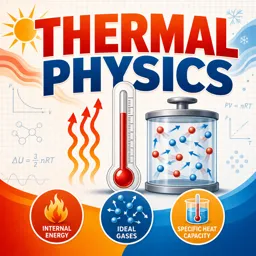


On a hot summer day, the sand at the beach can be painful to walk on, yet the sea right next to it feels refreshingly cool. Both have been under the same sun for the same number of hours. So why the huge difference? The answer lies in a property called specific heat capacity. Understanding it explains everyday experiences — from cooking pasta to why coastal cities have milder climates — and it is a core topic in any introductory physics course.
Heat and temperature are not the same thing
Before defining specific heat, it helps to separate two ideas that people often mix up:
- Temperature measures how hot or cold something is. At the microscopic level, it is related to the average kinetic energy of the particles in a substance. It is measured in degrees Celsius (°C), Fahrenheit (°F) or kelvin (K).
- Heat is energy that flows from one object to another because of a temperature difference. It is measured in joules (J), although calories are still common in nutrition and some older textbooks.
A bathtub of warm water and a cup of boiling water show the difference clearly. The cup has the higher temperature, but the bathtub holds far more thermal energy simply because it contains much more water.
What is specific heat capacity?
Specific heat capacity (usually written as c) is the amount of energy needed to raise the temperature of 1 kilogram of a substance by 1 degree Celsius (or 1 kelvin, which is the same size step). Its SI unit is joules per kilogram per kelvin: J/(kg·K).
A substance with a high specific heat needs a lot of energy to warm up — and releases a lot of energy as it cools down. A substance with a low specific heat changes temperature quickly with relatively little energy.
Typical values for common materials
The values below are approximate, standard textbook figures at room temperature:
| Substance | Approx. specific heat (J/kg·K) |
|---|---|
| Liquid water | 4,186 |
| Ice | about 2,100 |
| Aluminum | about 900 |
| Glass | about 840 |
| Iron / steel | about 450 |
| Copper | about 385 |
| Lead | about 130 |
Notice how water stands far above the metals. It takes roughly ten times more energy to heat a kilogram of water by one degree than to heat a kilogram of copper by the same amount.
The key equation: Q = mcΔT
The relationship between heat and temperature change is described by one of the most useful equations in thermal physics:
Q = m × c × ΔT
- Q = heat energy transferred (J)
- m = mass of the substance (kg)
- c = specific heat capacity (J/kg·K)
- ΔT = change in temperature (final − initial), in °C or K
If ΔT is positive, the object gained heat. If it is negative, the object lost heat.
Worked example 1: heating water for tea
How much energy does it take to heat 0.5 kg of water from 20 °C to 100 °C?
- m = 0.5 kg, c = 4,186 J/kg·K, ΔT = 100 − 20 = 80 K
- Q = 0.5 × 4,186 × 80 = 167,440 J, or about 167 kJ
Worked example 2: the same energy in copper
Suppose you put those same 167,440 J into 0.5 kg of copper. Rearranging the formula gives ΔT = Q ÷ (m × c) = 167,440 ÷ (0.5 × 385) ≈ 870 K. The same energy that only brings water to a boil would raise the copper’s temperature by hundreds of degrees. That is why a metal spoon left in a hot pan gets hot so quickly.
Why does water have such a high specific heat?
Water molecules are attracted to each other by hydrogen bonds. When you add energy to water, a significant part of it goes into stretching, bending and breaking these attractions rather than only making the molecules move faster. Since temperature reflects the average kinetic energy of the particles, water’s temperature rises more slowly than that of substances where most of the added energy goes straight into faster motion.
Specific heat in everyday life
- Coastal climates: oceans absorb huge amounts of heat in summer and release it slowly in winter. This is why seaside cities generally have smaller temperature swings than places far inland.
- The beach paradox: sand has a much lower specific heat than water, so under the same sunlight it heats up faster — and also cools down faster at night.
- Engine cooling: car engines use a water-based coolant because it can carry away a lot of heat without its own temperature climbing too fast.
- Cooking: pans are made of metals that heat quickly, while the water inside takes much longer to boil. A heavy cast-iron pan, thanks to its large mass, holds heat well even though iron’s specific heat is low.
- Hot water bottles: they stay warm for a long time because the water inside releases its stored energy gradually.
- The human body: our bodies are mostly water, which helps buffer us against rapid temperature changes.
Specific heat vs. heat capacity
You may also see the term heat capacity (without “specific”). Heat capacity, often written as C, refers to a whole object: the energy needed to raise that object’s temperature by 1 K. It depends on both the material and the amount: C = m × c. Specific heat capacity, on the other hand, is a property of the material itself, independent of how much you have. A swimming pool and a glass of water have the same specific heat, but the pool’s heat capacity is enormously larger.
Common mistakes to avoid
- Mixing units: if c is in J/kg·K, mass must be in kilograms, not grams.
- Forgetting the sign of ΔT: always calculate final minus initial temperature.
- Using Q = mcΔT during a phase change: while ice melts or water boils, temperature stays constant. Those stages require latent heat calculations instead.
- Confusing high specific heat with “being hot”: a high value means a material resists temperature change, not that it is warmer.
Conclusion
Specific heat capacity tells us how stubbornly a material resists changes in temperature. With a single equation, Q = mcΔT, you can predict how much energy a heating task requires or how hot something will get. And once you know that water sits near the top of the scale, many everyday mysteries — cool seas, scorching sand and slow-boiling pots — suddenly make sense.
If you enjoyed this explanation and want to build a solid foundation in thermodynamics, mechanics and more, explore the free physics and basic studies courses available on Cursa.