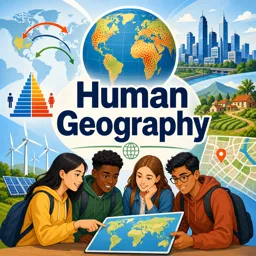
Human geography explains how people shape places—and how places shape people. While physical geography focuses on natural processes, human geography zooms in on patterns like migration, urban growth, inequality, cultural identity, and the way economies connect across borders. These topics show up frequently in exams because they help you interpret real-world data, evaluate causes and impacts, and write balanced answers.
If you’re building foundational skills, start with the broader category and then narrow your focus into geography-specific modules. Browse https://cursa.app/free-online-basic-studies-courses and jump into the dedicated https://cursa.app/free-courses-basic-studies-online to organize your learning path from essentials to exam-ready practice.
1) Place, space, and scale: the three ideas examiners love
Many students lose marks not because they don’t know content, but because they don’t frame answers geographically. Use these three lenses to level up your responses:
Place: What makes a location unique (identity, function, meaning)?
Space: How are things distributed (clusters, corridors, cores and peripheries)?
Scale: How do processes differ from local to national to global?
In exam questions, try explicitly naming scale in your introduction (for example: “At the urban scale…”) and linking it to outcomes (“…this concentrates jobs, which attracts in-migration”). That single move often turns a descriptive paragraph into an analytical one.
2) Population patterns: why people live where they do
Population distribution is never random. It reflects physical constraints (relief, climate) and human factors (jobs, services, conflict, policy). In exams, you’ll often be asked to interpret a choropleth map, a population pyramid, or a dataset showing change over time. Train yourself to answer three questions quickly:
What pattern do you see? (clustered, linear, dispersed)
What factors explain it? (push/pull, opportunity, accessibility)
What are the consequences? (housing pressure, labor supply, service strain)
To practice, pick any country and compare its capital region with a rural region: differences in age structure, employment sectors, and access to healthcare often provide ready-made evidence for longer answers.
3) Migration and identity: push–pull factors plus lived experience
Migration is a core human geography theme because it links economics, politics, culture, and environment. For exam success, avoid listing push–pull factors without evaluation. Instead, connect drivers to outcomes:
Drivers: conflict, jobs, education, environmental risk, family networks, policy
Short-term impacts: labor changes, pressure on services, remittances, cultural exchange
Long-term impacts: diasporas, bilingual communities, shifting demographics, political debate
Where possible, include at least one point about identity: how migrants maintain, adapt, or blend cultural practices. This brings depth to essays and helps you address “to what extent” questions.

4) Urban geography: understanding cities as systems
Cities are perfect exam case studies because they are systems: inputs (people, resources), processes (transport, land use change), and outputs (growth, inequality, pollution, innovation). Make sure you can explain these commonly tested ideas:
Urbanization: why cities grow (industrialization, services, rural change)
Land use patterns: CBD, residential zones, suburbanization, regeneration
Urban challenges: housing affordability, congestion, informal settlements, segregation
Urban opportunities: jobs, education, healthcare, culture, connectivity
A strong technique is to pair each challenge with a realistic strategy (for example: “congestion” + public transit investment, road pricing, or mixed-use planning). That moves your answer from problems to solutions—often the difference between mid-level and top marks.
5) Development geography: measuring inequality beyond income
Development is about more than GDP. Exams frequently test your ability to interpret multiple indicators and explain why they don’t always align. Learn to compare measures such as:
Income (GDP/GNI per capita), health (life expectancy), education (literacy, years of schooling), and composite indices (like HDI).
To add evaluation, discuss limitations: averages can hide regional inequality, informal economies may be undercounted, and rapid growth can increase environmental pressure. For broader context on how development is measured globally, explore https://hdr.undp.org/ and practice summarizing what one indicator reveals—and what it misses.
6) Globalization and trade: the geography of connections
Globalization is geography in motion: goods, money, information, and people moving through networks. Instead of memorizing definitions, focus on spatial ideas that exams reward:
Supply chains: where materials come from, where value is added, where products are sold
Core–periphery patterns: how wealth and decision-making concentrate in certain regions
Winners and losers: job creation vs. job displacement, growth vs. inequality
To write stronger answers, include at least one specific “flow” (for example, container shipping routes, foreign direct investment, or digital services) and explain how it reshapes places—ports, manufacturing zones, or tech corridors.

How to revise human geography efficiently (and score higher)
Use this simple routine to convert content into exam performance:
1) Learn one concept (e.g., gentrification, informal economy).
2) Attach evidence: a statistic, a named place, or a clear trend from a graph.
3) Practice one exam skill: describe, explain, compare, evaluate, or justify.
4) Write a mini-conclusion that answers the command word directly.
For structured learning and topic-based practice, explore the https://cursa.app/free-courses-basic-studies-online. If you want to branch into nearby geography areas for a fuller syllabus, you can also navigate to https://cursa.app/free-online-courses/world-geography or https://cursa.app/free-online-courses/uk-geography for additional regional context and examples.
Key takeaways
Human geography helps you explain patterns in population, cities, development, and globalization using the core lenses of place, space, and scale. For exams, the goal is not just knowing terms, but using evidence, linking cause to consequence, and evaluating trade-offs. Build your answers like a geographer: identify the pattern, explain the drivers, and judge the impacts.