

World geography is the study of Earth’s places, landscapes, people, environments, and the connections between regions.

2

2


Exercises
Test your knowledge of Middle East geography, including countries, capitals, deserts, rivers, seas, languages, and major oil fields.
Start exercisesTest advanced world geography knowledge with questions on mountains, deserts, oceans, islands, climates, rainforests, and global records.
Start exercises
Map Skills for Exam Success: Scale, Coordinates, Contours, and Real-World Interpretation
Master map skills for geography exams with clear practice on scale, coordinates, contours, gradients, and real-world map interpretation.

An Introduction to Physical Geography: Understanding Earth’s Natural Processes
Discover physical geography’s role in understanding Earth’s landforms, climates, water, and ecosystems, and how they shape our environment.

Climate, Water, and Ecosystems: The Interconnected Worlds of Physical Geography
Explore how climate, water, and ecosystems interact in physical geography, shaping landscapes, biodiversity, and environmental health.

Landforms and Earth’s Surface: Exploring Physical Geography’s Core Elements
Discover the core elements of physical geography, from landforms and climate to water systems, and understand their importance for life on Earth.

Understanding the Earth’s Major Landforms: Mountains, Plateaus, Plains, and Valleys
Explore how mountains, plateaus, plains, and valleys shape Earth’s geography and influence culture, climate, and human settlement.

Understanding World Geography: Continents, Oceans, and Population Patterns
Discover how continents, oceans, and population patterns shape our world and influence global culture, economy, and human interaction.

The Impact of Climate Change on World Geography: Melting Ice Caps and Rising Sea Levels
Climate change is altering world geography through melting ice caps and rising sea levels, threatening ecosystems, coastal cities, and freshwater supplies.

The Seven Continents: Exploring the Diverse Landscapes of the World
The seven continents showcase diverse landscapes and climates, from Africa’s deserts and jungles to Antarctica’s ice, each contributing uniquely to Earth’s geography.
Explore our selection of free online World Geography courses and develop a deeper understanding of the planet, its regions, cultures, environments, and spatial relationships. These educational courses are ideal for students, teachers, professionals, travelers, and lifelong learners who want to improve their geographic knowledge through accessible online learning. Every course is free, includes exercises to reinforce learning, and offers free certification upon completion.
World Geography examines how people, places, climates, landscapes, and natural resources are connected. Through structured lessons, learners can study continents, countries, capitals, oceans, rivers, mountains, borders, ecosystems, population patterns, and cultural regions. The courses also introduce essential educational concepts such as physical geography, human geography, political geography, economic geography, cartography, demographics, globalization, and environmental studies.
Interactive exercises help you review important topics, assess your progress, and retain geographic facts. Whether you are preparing for an academic examination, supporting classroom instruction, expanding your general knowledge, or building skills for a career, these free geography courses provide a flexible study opportunity.
Geographic education strengthens critical thinking, map-reading ability, cultural awareness, and understanding of global events. You can study at your own pace, repeat lessons, and complete course exercises from a mobile device. After completing the educational requirements, you can obtain a free course certificate to demonstrate your learning and support your academic or professional profile.
To access these free online World Geography courses, complete the exercises, and receive free certification, it is necessary to install the Cursa application. Android users can install it through Google Play: Download for Android. iPhone users can install it through the App Store: Download for iOS / iPhone.
Choose a free World Geography course, study essential geographic concepts, practice with educational exercises, and earn free certification. Begin learning today and gain a broader, more informed perspective on our diverse and interconnected world.
What is world geography?
World geography is the study of Earth’s places, landscapes, people, environments, and the connections between regions.
What topics are covered in an online world geography course?
Courses commonly cover maps, continents, countries, landforms, climate, population, cultures, regions, and global patterns.
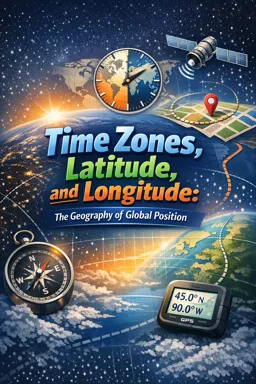
How do latitude and longitude help locate places?
Latitude measures distance north or south of the Equator, while longitude measures distance east or west of the Prime Meridian.
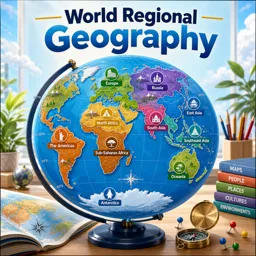
What are the major world regions studied in regional geography?
Major regions often include North America, Latin America, Europe, Africa, Southwest Asia, South Asia, East Asia, Southeast Asia, Oceania, and the polar regions.
Why are time zones important in geography?
Time zones show how local time changes across Earth as it rotates, helping people coordinate travel, communication, and global business.
How does climate shape world regions?
Climate influences vegetation, water supplies, agriculture, settlement patterns, economies, and everyday life in different regions.
Is world geography useful for travel and global awareness?
Yes. It helps learners understand maps, locations, cultures, climates, borders, and the relationships among places worldwide.

Complete any course and issue your certificate via the app — at no cost.

Download the app! to have access to more than 4,000 Online Courses + Certificate, all free!
Download the app! 100% free courses.


Carry knowledge in your pocket.
Download the Cursa app.
There are hundreds of free courses available, with a free certificate of completion that is saved in your mobile image gallery.
Download the app to access the Course Completion Certificate for Free.


+ 10 million
students

Free and Valid
Certificate

60 thousand free
exercises

4.8/5 rating in
app stores

Free courses in
video and ebooks




What are people saying about free online courses of World Geography
Safia Khalil Rahman
a very good video and use full full of education
CourseWorld Regional Geography