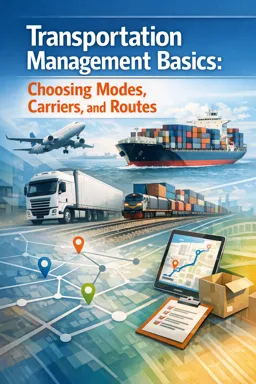

Free ebook on transportation management basics: compare freight modes, carriers, routes, costs, service levels, and shipment planning.
Free ebook content
-

Transportation Management Basics in Supply Chains: Roles, Flows, and Decision Points
+ Exercise: Which action best reflects the idea that transportation is a lever that trades money, time, and risk when planning a shipment?
-
Mode Selection: Road, Rail, Air, and Ocean—Capabilities and Constraints
+ Exercise: A shipper is considering an intermodal option (e.g., truck–rail–truck) instead of a single mode. Which action best reflects how handoffs should be managed to protect lead time and risk?
-
Carrier Types and Service Models: Selecting the Right Provider
+ Exercise: In a truckload carrier decision where a higher-priced option has better on-time performance, which approach best reflects a practical way to manage both reliability needs and capacity constraints?


-
Shipment Planning: From Order to Load Building and Tendering
+ Exercise: Which action best helps ensure a load is tender-ready and can be accepted by a carrier without follow-up questions?
-
Routing Concepts: Lanes, Networks, and Practical Route Design
+ Exercise: Why should feasibility checks (HOS, appointments, restrictions, cutoffs) be done before focusing on the cheapest route option?
-
Freight Terms, Responsibilities, and Core Documents
+ Exercise: A shipment is set up as freight collect. Which action best prevents billing problems at pickup and delivery?
-
Cost Drivers in Transportation: Rates, Accessorials, and Total Landed Cost
+ Exercise: When comparing two transportation quotes, which approach best reflects the true cost to deliver the product as required?
-
Transit Time, Variability, and Service-Level Tradeoffs
+ Exercise: When setting a reliable customer promise date, which approach best reflects how lead-time variability should be handled?
-
Reducing Delays and Damage Through Packaging, Handling, and Communication
+ Exercise: Which workflow best helps prevent appointment-related delays by ensuring the carrier and receiver have accurate, current delivery details?
-
Visibility, Tracking, and Performance Management in Daily Operations
+ Exercise: Which approach best improves operational visibility and performance management in daily transportation operations?
About the free ebook
Transportation Management Basics: Choosing Modes, Carriers, and Routes
This free ebook introduces the practical decisions behind moving goods efficiently through a supply chain. Learn how transportation managers balance cost, speed, capacity, reliability, risk, and customer expectations when planning shipments.
Make stronger transportation decisions
Explore the capabilities and constraints of road, rail, air, and ocean freight, then compare carrier types and service models for different shipment needs. The ebook explains how load building, tendering, lanes, and network design influence daily transportation performance.
Understand cost and service tradeoffs
Transportation spend is more than a quoted freight rate. Learn to recognize rate structures, accessorial charges, transit-time variability, and total landed cost. Use these factors to assess choices without focusing on price alone.
Improve operational control
Discover how freight terms, shipping documents, packaging, handling, communication, tracking, and performance measures support dependable delivery. Practical selection frameworks help connect mode, carrier, and route choices to shipment priorities.
What you will be able to assess
- Mode fit: Match shipment requirements to transport capabilities.
- Carrier fit: Evaluate providers by service, capacity, coverage, and reliability.
- Route fit: Design practical lanes that support cost and service goals.
- Execution risks: Reduce avoidable delays, damage, and communication gaps.
Designed for logistics and supply chain learners, this ebook provides a clear foundation for making informed transportation management decisions.
How should a company choose between road, rail, air, and ocean freight?
Compare required delivery speed, shipment size, distance, cost, capacity, risk, and geographic access.
What transportation costs should be reviewed beyond the freight rate?
Review fuel, accessorials, handling, packaging, inventory effects, damage risk, and other landed-cost components.
What is the purpose of carrier tendering?
Tendering offers a planned shipment to an eligible carrier for acceptance under agreed service and pricing terms.
This ebook includes:

11 content chapters

Digital certificate of course completion (Free)

Exercises to train your knowledge

100% free, from content to certificate
Ready to get started?

 recommended
In the app you will also find...

Over 5,000 free courses
Programming, English, Digital Marketing and much more! Learn whatever you want, for free.

Study plan with AI
Our app's Artificial Intelligence can create a study schedule for the course you choose.

From zero to professional success
Improve your resume with our free Certificate and then use our Artificial Intelligence to find your dream job.
You can also use the QR Code or the links below.