
The course covers inventory control, demand planning, supply chains, logistics, forecasting, production scheduling, sustainability, benchmarking, and the Theory of Constraints.

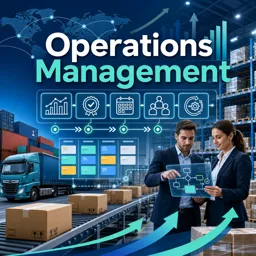
Duration of the online course: 4 hours and 47 minutes
5

(13)
Improve operations and supply chain skills with this free online course—master inventory, forecasting, scheduling, lean vs agile, and smarter planning.
Strong operations are what turn a good product idea into consistent results: on-time delivery, stable quality, and costs that stay under control. This free online course helps you build practical operations management thinking so you can understand how work flows through an organization, where waste and delays come from, and how to make decisions that improve performance across the supply chain.
You will connect the big picture of operations with the day-to-day choices that shape outcomes. From the transformation model to facility layout decisions, you’ll see how inputs become outputs and how processes can be designed for speed, reliability, and customer value. The course also brings essential planning concepts into focus, showing how demand signals, production plans, and execution on the floor need to align if you want fewer firefights and more predictability.
Inventory is treated as more than stock on a shelf—it is tied to service level, risk, and cash. You’ll work through key ideas such as safety stock, ABC analysis, EOQ versus EPQ, vendor-managed inventory, and just-in-time approaches, plus when periodic or perpetual systems make the most sense. You’ll also gain clarity on demand planning patterns, helping you recognize what changes you can prepare for and what requires flexible response.
Because operations does not exist in a vacuum, the course expands into supply chain management choices that affect resilience and speed. You’ll explore how supply chains are defined and structured, when lean or agile approaches fit best, and how vertical integration, alliances, third-party logistics, and reverse logistics can change cost, control, and customer experience. Strategy tools like SWOT and benchmarking are introduced to support smarter evaluation of options, not just intuition.
To strengthen problem-solving, you’ll learn to identify bottlenecks using the Theory of Constraints, and you’ll see how forecasting supports planning decisions, including qualitative and quantitative methods often used in business. Finally, the course ties plans to execution through master production scheduling, planning systems such as MRP, MRP II, and ERP, and scheduling approaches suited to both products and services. By the end, you’ll have a solid foundation to speak the language of operations and supply chain, contribute to continuous improvement initiatives, and make planning decisions with greater confidence.

4 hours and 47 minutes of online video course

Digital certificate of course completion (Free)

Exercises to train your knowledge

100% free, from content to certificate
What topics are covered in this free Operations Management course?
The course covers inventory control, demand planning, supply chains, logistics, forecasting, production scheduling, sustainability, benchmarking, and the Theory of Constraints.
What is the difference between EOQ, EPQ, and just-in-time inventory?
EOQ identifies an economical order quantity, EPQ calculates optimal production batch sizes, and JIT minimizes inventory by receiving or producing items only when needed.
How do MRP, MRP II, and ERP differ in operations management?
MRP plans material requirements, MRP II expands planning to production resources and capacity, and ERP integrates planning with wider business functions such as finance and purchasing.
Ready to get started?Download the app and get started today.
Install the app now
to access the course
Over 5,000 free courses
Programming, English, Digital Marketing and much more! Learn whatever you want, for free.

Study plan with AI
Our app's Artificial Intelligence can create a study schedule for the course you choose.

From zero to professional success
Improve your resume with our free Certificate and then use our Artificial Intelligence to find your dream job.
You can also use the QR Code or the links below.



Free CourseSupply Chain Analytics
5
(24)

30m

4 exercises
Free CourseSupply Chain Management and Logistics: Operations, Transportation, and Global Strategy
4.8
(6)
53m
12 exercises
Free CourseSupply Chain Digitization
4.8
(9)
31h55m
31 exercises
Free CourseLogistics Management
4.6

(19)
1h29m
11 exercises
Free CourseFundamentals of Supply Chain
4.6
(5)
2h42m
8 exercises
Free CourseSupply chain management
4.3
(49)
12h07m
16 exercises
Free CourseAPICS CLTD 3.0 Certification Prep: Logistics, Transportation and Distribution
4
(2)
17h55m
13 exercises
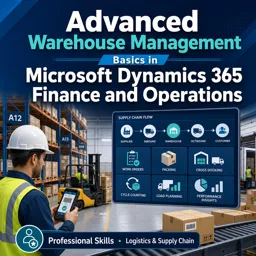
Free CourseAdvanced Warehouse Management Basics in Microsoft Dynamics 365 Finance and Operations
New
7h35m
20 exercises
Carry knowledge in your pocket.
Download the Cursa app.
There are hundreds of free courses available, with a free certificate of completion that is saved in your mobile image gallery.
Download the app to access the Course Completion Certificate for Free.


+ 10 million
students

Free and Valid
Certificate

60 thousand free
exercises

4.8/5 rating in
app stores

Free courses in
video and ebooks
Course comments: Operations Management
Yousif Ibrahim Abubaker Abdalla
Wonderful enough!
Joseph Mumba Chisanga
"Loving the operations management course! The video scripts are engaging, informative, and make complex concepts easy to grasp.”
Stickwork101
I found your course to uber helpful and informative.
Xoliswa Mdluli
Thank you
Xoliswa Mdluli
Thank you,