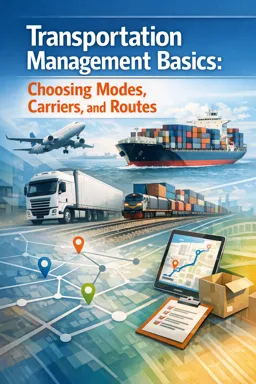
Why Mode Selection Matters
Mode selection is the process of choosing the primary transportation mode (road, rail, air, ocean) that best fits a shipment’s service requirement (delivery date/time window), cargo characteristics (weight, volume, fragility, temperature needs, hazardous classification), and cost target. In practice, you rarely optimize for a single factor; you balance speed, cost, and variability (risk of being early/late) while ensuring the cargo can be moved safely and legally.
Use a consistent checklist for every shipment:
- Service requirement: latest acceptable delivery, appointment constraints, penalties, customer priority.
- Cargo suitability: density (weight/volume), value, fragility, temperature control, hazmat restrictions.
- Lane reality: origin/destination access to ports, rail ramps, airports; distance; border crossings.
- Risk tolerance: acceptable variability, disruption exposure, insurance/security needs.
- Total landed cost: linehaul + accessorials + packaging + inventory carrying cost + expected expediting cost.
Mode Templates: Capabilities and Constraints
Road (Truck)
Typical use cases
- Regional and domestic moves where door-to-door access is required.
- Time-definite deliveries, retail replenishment, e-commerce, and plant-to-DC flows.
- Short-notice shipments and lanes with frequent schedule changes.
Capacity characteristics
- Flexible capacity: full truckload (FTL), less-than-truckload (LTL), and specialized equipment (reefer, flatbed, tanker).
- Constrained by driver availability, equipment type, and peak season surges.
- Payload limited by legal weight and axle limits; cube-out can occur for low-density freight.
Transit time behavior
- Listen to the audio with the screen off.
- Earn a certificate upon completion.
- Over 5000 courses for you to explore!

Download the app
- Fast for short-to-medium distances; typically measured in hours to a few days.
- Transit time scales roughly with distance and driving-hour regulations.
- Same-day/next-day possible in dense corridors with team drivers or relay networks.
Reliability factors
- Traffic congestion, weather, road closures, and appointment delays.
- Driver hours-of-service compliance and detention at shipper/receiver.
- Higher exposure to theft for high-value cargo; security measures may be needed.
Geographic/network constraints
- Best door-to-door coverage; can reach most origins/destinations.
- Cross-border requires customs readiness; border wait times add variability.
- Urban access restrictions (delivery windows, low-emission zones) can affect scheduling.
Cost patterns
- Cost per shipment is moderate; cost per unit can be high for small LTL shipments.
- Strong sensitivity to fuel, tolls, and imbalance (backhaul availability).
- Accessorials (liftgate, residential, inside delivery, detention) can materially change total cost.
Rail
Typical use cases
- Long-haul domestic moves of heavy, dense, or high-volume freight.
- Intermodal containers/trailers for consumer goods; carload for bulk commodities and industrial inputs.
- When cost efficiency is prioritized over fastest transit.
Capacity characteristics
- High linehaul capacity; efficient for large volumes and heavy weights.
- Intermodal capacity depends on ramp availability and train schedules.
- Carload requires rail-served facilities or transload; equipment availability can be a constraint.
Transit time behavior
- Typically slower than truck for door-to-door due to terminal handling and drayage.
- More predictable on long distances when schedules are stable, but can be impacted by network congestion.
- Best suited for planned flows with buffer time.
Reliability factors
- Terminal dwell time (time waiting at ramps) is a major driver of variability.
- Service disruptions from network congestion, weather, or labor events can ripple across lanes.
- Intermodal adds handoffs (truck-to-rail-to-truck), increasing touchpoints and risk.
Geographic/network constraints
- Requires access to rail network: ramps for intermodal; sidings/spurs for carload.
- Not ideal for remote points far from ramps unless drayage is feasible.
- International rail varies widely by region due to gauge, border processes, and infrastructure.
Cost patterns
- Lower cost per ton-mile than truck on long distances; strong advantage for heavy freight.
- Door-to-door cost includes drayage, terminal fees, and potential storage/demurrage.
- Pricing can be stable for contracted volumes; spot options may be limited.
Air
Typical use cases
- Urgent, high-value, or time-critical shipments (spares, medical devices, premium electronics).
- Low-weight, high-margin products where speed reduces stockouts or downtime.
- International moves when ocean lead time is too long.
Capacity characteristics
- Limited capacity relative to other modes; constrained by aircraft space and route frequency.
- Dimensional weight pricing penalizes bulky, lightweight freight.
- Special handling available (temperature-controlled, dangerous goods) but with strict rules and limited acceptance.
Transit time behavior
- Fast linehaul (hours), but door-to-door includes pickup, screening, cutoffs, and delivery.
- Best for shipments where every day matters; still requires planning around flight schedules.
- Airport-to-airport is faster than door-to-door; last-mile can dominate total time in remote areas.
Reliability factors
- Flight cancellations, missed connections, and capacity rollovers during peaks.
- Security screening and documentation errors can cause holds.
- Weather impacts hubs; disruptions can cascade quickly.
Geographic/network constraints
- Requires airport access and available lanes; some origins/destinations rely on feeder flights.
- International shipments require strict customs compliance; paperwork accuracy is critical.
- Some hazardous materials and lithium batteries face restrictions or require special approvals.
Cost patterns
- Highest cost per kg; cost is driven by weight/volume (dim weight), urgency, and capacity.
- Additional costs: fuel surcharges, security fees, special handling, and brokerage.
- Often justified by avoided downtime, reduced inventory, or penalty avoidance.
Ocean (Sea Freight)
Typical use cases
- International trade of large volumes, heavy freight, and cost-sensitive goods.
- Full container load (FCL) for consistent volumes; less-than-container load (LCL) for smaller shipments.
- Project cargo and breakbulk for oversized items (depending on port capability).
Capacity characteristics
- Very high capacity; best for large shipments and steady replenishment.
- Container equipment availability (20’, 40’, 40’HC, reefers) can be constrained in imbalanced trade lanes.
- LCL consolidations depend on forwarder schedules and consolidation cutoffs.
Transit time behavior
- Longest transit times (weeks), plus port handling and inland moves.
- Schedule variability from port congestion, blank sailings, and transshipment delays.
- Lead time must include cutoff dates, documentation deadlines, and customs clearance.
Reliability factors
- Port congestion, vessel schedule changes, and container rollovers.
- Weather and canal/strait disruptions can cause major delays.
- Higher risk of damage from multiple handlings (stuffing/unstuffing, transshipment) if packaging is weak.
Geographic/network constraints
- Requires port access and inland connections (truck/rail) at both ends.
- Not suitable for landlocked destinations without reliable inland corridors.
- Some cargo types require specialized equipment (reefers) and power availability.
Cost patterns
- Lowest cost per unit for large volumes; strong advantage for heavy/low-value goods.
- Total cost includes origin charges, ocean freight, destination charges, demurrage/detention risk, and inland delivery.
- LCL can be cost-inefficient for dense freight due to minimum charges and handling fees.
Comparing Modes with a Decision Matrix
A decision matrix helps you compare modes consistently. Use a 1–5 score (5 = best) and apply weights based on your shipment’s priorities.
| Criteria | Road | Rail | Air | Ocean |
|---|---|---|---|---|
| Speed (door-to-door) | 4 | 3 | 5 | 1 |
| Cost efficiency (per unit on long haul) | 3 | 4 | 1 | 5 |
| Variability (predictability) | 3 | 3 | 3 | 2 |
| Weight/volume suitability | 4 | 5 | 2 | 5 |
| Fragility handling risk | 3 | 3 | 4 | 2 |
| Temperature control availability | 4 | 3 | 3 | 4 |
| Hazardous materials flexibility | 4 | 4 | 2 | 4 |
| Network reach (door access) | 5 | 2 | 2 | 2 |
How to use the matrix (step-by-step)
- Define the service target: required delivery date/time and acceptable variability (e.g., “must arrive by Friday 10:00, no later”).
- Profile the cargo: weight, dimensions, density, value, fragility, temperature range, hazmat class (if any).
- Set weights for criteria: for example, Speed 40%, Cost 30%, Variability 20%, Cargo suitability 10%.
- Score feasible modes only: remove modes that cannot legally/physically carry the cargo (e.g., restricted hazmat by air).
- Compute weighted score: multiply each criterion score by its weight and sum.
- Reality-check with lane constraints: ramp/port access, pickup/delivery windows, and known congestion points.
- Choose primary mode and define buffers: add time for handoffs, customs, and appointments; decide on expediting triggers.
Example: choosing between truck vs intermodal rail
Shipment: 18 pallets, 28,000 lb, non-haz, no temperature control, moderate value, delivery needed in 6 days on a 1,800-mile lane. If truck transit is 3–4 days but costly, and intermodal is 5–7 days with higher variability at ramps, the decision hinges on whether the customer can accept a wider delivery window. If the delivery is appointment-based with penalties, truck may win despite higher cost. If the customer accepts a 1–2 day window and you can add buffer, intermodal may reduce cost.
Cargo Suitability: Practical Rules of Thumb
Weight/Volume (Density)
- Very dense/heavy freight: rail (carload) and ocean are typically most cost-effective; truck works for shorter distances.
- Bulky/light freight: watch dimensional pricing in air and LTL; consider ocean FCL or truck with cube utilization.
Fragility and Damage Sensitivity
- High fragility: reduce handoffs; prefer direct truck or well-controlled air services; strengthen packaging for ocean/LCL.
- Multiple handling points increase risk: LCL, transload, and intermodal terminals add touches.
Temperature Control
- Road reefers: flexible door-to-door, good for domestic perishables and pharma with monitoring.
- Ocean reefers: cost-effective for international, but requires strong planning around port dwell and power availability.
- Air cool-chain: fastest but expensive; ensure acceptance rules and packaging meet lane requirements.
Hazardous Materials
- Air: most restrictive; many hazmat types require special packaging, labeling, and may be prohibited.
- Road/Rail/Ocean: generally more flexible but still regulated; confirm carrier acceptance and route restrictions.
Intermodal Combinations and Handoff Effects
Many shipments use more than one mode. The benefit is combining the strengths of each mode; the tradeoff is added handoffs, which affect lead time and risk.
Common Intermodal Patterns
- Drayage + Rail Intermodal + Drayage: truck pickup to rail ramp, long-haul by rail, truck delivery from destination ramp.
- Ocean + Truck (inland): container moves from port to DC by truck; common for shorter inland distances.
- Ocean + Rail (inland): container moves from port to inland hub by rail, then truck to final destination; common for long inland distances.
- Air + Truck: truck feeder to/from airports; sometimes includes linehaul trucking between airports when flights are constrained.
How Handoffs Change Lead Time (Step-by-Step)
- Add cutoff times: terminals and ports have receiving cutoffs; missing them can push departure by 1+ days.
- Add dwell buffers: plan for time at ramps/ports (gate queues, unloading, staging, customs holds).
- Account for appointment scheduling: delivery appointments can create “hidden” waiting time even if linehaul is fast.
- Plan for documentation gates: incorrect paperwork can stop movement at terminals, airports, or borders.
- Define exception triggers: e.g., “If container not gated out within 24 hours of availability, expedite via truck.”
Risk Hotspots at Handoffs
- Damage risk: increases with each transfer (cross-dock, transload, LCL deconsolidation).
- Delay risk: terminal congestion, chassis availability (ocean), rail ramp dwell, flight rollovers (air).
- Cost risk: demurrage/detention (ocean), storage fees (air/rail terminals), re-delivery charges (truck).
Practical Intermodal Guidance
- Use intermodal when you can absorb variability: build buffer into promised lead time and communicate delivery windows.
- Reduce touchpoints for fragile/high-value freight: prefer direct truck or premium air services; avoid unnecessary transloads.
- Match equipment to cargo: reefer availability, flatbed needs, hazmat acceptance, and container type (standard vs high-cube).
- Design for visibility: require milestone tracking at each handoff (picked up, gated in, departed, arrived, available, delivered).
Structured Exercises: Choose the Mode
For each scenario, select the best primary mode (or intermodal combination) and write 2–3 sentences explaining your choice using: speed requirement, cost sensitivity, variability tolerance, and cargo suitability.
Exercise 1: Time-Critical Spare Part
- Cargo: 1 crate, 45 kg, high value, fragile.
- Lane: 1,200 miles domestic.
- Service requirement: must arrive within 24–36 hours to avoid production downtime.
- Question: Which mode and why? What handoff risks do you plan for?
Exercise 2: Heavy Industrial Components
- Cargo: 10 pallets, 38,000 lb total, dense, non-fragile.
- Lane: 1,800 miles domestic, origin and destination both near rail ramps.
- Service requirement: delivery in 7–9 days acceptable.
- Question: Truck vs rail intermodal vs rail carload (if feasible): which do you choose and what buffers do you add?
Exercise 3: International Replenishment (Cost-Sensitive)
- Cargo: 18 m3, 6,000 kg, medium value, not temperature-controlled.
- Lane: Asia to inland U.S. destination.
- Service requirement: delivery in 35–45 days acceptable; minimize cost.
- Question: Ocean FCL vs ocean LCL vs ocean + rail inland: which and why? Identify two handoff risks.
Exercise 4: Temperature-Controlled Food
- Cargo: 20 pallets refrigerated, moderate value, strict temperature range.
- Lane: 900 miles domestic.
- Service requirement: delivery in 2–3 days; temperature excursions not acceptable.
- Question: Which mode/equipment? What operational controls do you require at pickup and delivery?
Exercise 5: Hazmat with Moderate Urgency
- Cargo: 4 drums, regulated hazardous material (assume allowed by road and ocean, restricted by air).
- Lane: Europe to U.S. East Coast.
- Service requirement: delivery in 10–14 days; moderate cost sensitivity.
- Question: Ocean vs air (if restricted) vs expedited ocean + truck: what do you choose and what documentation/acceptance checks are critical?
Exercise 6: High-Value Consumer Electronics Peak Season
- Cargo: 6 pallets, 1,200 kg, high value, theft-sensitive.
- Lane: 2,300 miles domestic.
- Service requirement: delivery in 4 days; penalties for late delivery.
- Question: Truck vs rail intermodal: which do you choose? List three reliability/security measures you would add.