Supply chain management coordinates the flow of materials, information, and money across suppliers, operations, and customers.

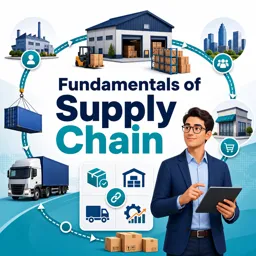
Duration of the online course: 2 hours and 42 minutes
4.7


(3)
Boost your logistics skills with a free supply chain course covering planning, inventory, and warehouse operations—practical insights for real careers.
Supply chain is behind almost everything you buy, from the moment a need appears to the moment the product is available where and when it matters. This free online course helps you build a clear, job-relevant understanding of how supply chains work, why they matter to business performance, and how everyday decisions ripple across purchasing, production, inventory, transportation, and warehousing.
You will learn to see supply chain as an end-to-end system rather than disconnected tasks. The lessons connect core concepts such as basic supply chain models, the different types of orders that drive activity, and how forecasting and validation influence the entire chain. You will also explore what a supply chain manager truly manages, focusing on the essential elements that keep operations stable, responsive, and cost-effective even when conditions change.
As you progress, the course makes complexity feel manageable by explaining why supply chains become challenging and how professionals navigate trade-offs across time, cost, capacity, and customer expectations. You will be introduced to practical thinking tools like postponement strategies, ways to interpret customer needs with the Kano model, and approaches to finding constraints that limit performance so improvement efforts target what actually matters.
A major focus is operational excellence in warehousing and inventory. You will understand what a warehouse is designed to achieve, how inbound flows work step by step, and what optimization looks like inside four walls. The course ties processes to outcomes: faster receiving, clearer storage logic, smoother picking, fewer errors, and better service levels. You will also clarify foundational inventory concepts, including why inventory exists, how to think about the right levels across stocking points, and how safety stock helps protect service when demand or supply is uncertain.
By the end, you will be able to speak confidently about supply chain fundamentals, connect concepts to real business scenarios, and recognize common roles and career paths in operations. With short quizzes and practice questions throughout, you can quickly validate what you have learned and leave with a stronger, more employable foundation in logistics and supply chain.

2 hours and 42 minutes of online video course

Digital certificate of course completion (Free)

Exercises to train your knowledge

100% free, from content to certificate
What are the three key elements managed in supply chain management?
Supply chain management coordinates the flow of materials, information, and money across suppliers, operations, and customers.
What is supply chain postponement strategy?
Postponement delays product customization, assembly, or distribution until customer demand is clearer, reducing inventory risk and improving flexibility.
What is safety stock inventory used for?
Safety stock is extra inventory held to protect against demand variability, supply delays, and other disruptions that could cause stockouts.
Ready to get started?Download the app and get started today.
Install the app now
to access the course
Over 5,000 free courses
Programming, English, Digital Marketing and much more! Learn whatever you want, for free.

Study plan with AI
Our app's Artificial Intelligence can create a study schedule for the course you choose.

From zero to professional success
Improve your resume with our free Certificate and then use our Artificial Intelligence to find your dream job.
You can also use the QR Code or the links below.



Video Courses
 recommended
Exercises
Test your knowledge of Incoterms 2020, including cost allocation, risk transfer, insurance, customs clearance, and delivery obligations.
Start exercisesTest your knowledge of vendor and carrier relationship management in logistics, including negotiation, performance, technology, and risk.
Start exercisesTest your knowledge of lean logistics process optimization, JIT, Kanban, value stream mapping, waste reduction, and pull production.
Start exercisesCarry knowledge in your pocket.
Download the Cursa app.
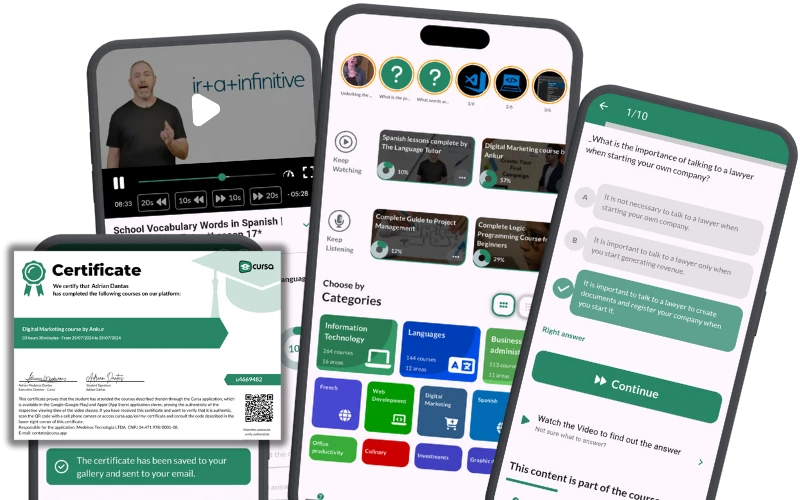
There are hundreds of free courses available, with a free certificate of completion that is saved in your mobile image gallery.
Download the app to access the Course Completion Certificate for Free.

+ 10 million
students

Free and Valid
Certificate

60 thousand free
exercises

4.8/5 rating in
app stores

Free courses in
video and ebooks