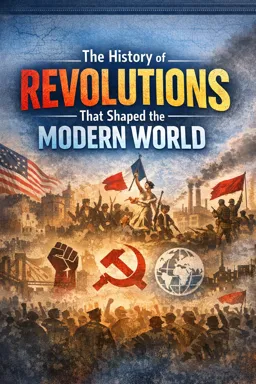

Free ebook on the revolutions that shaped the modern world, from rights and independence to decolonization and lasting political change.
Free ebook content
-

Revolutionary Change in the Modern World: A Framework for Causes, Actors, and Outcomes
+ Exercise: Which situation best fits the framework’s definition of a revolution?
-
Revolutionary Ideas: Rights, Representation, and the Politics of Equality
+ Exercise: When reading a constitution for how “the people” are defined in practice, which approach best identifies whether equality is legal in principle but limited in political power?
-
War, Finance, and State Breakdown: When Conflict Becomes Revolutionary
+ Exercise: According to the idea of a wartime “performance contract,” which situation most directly accelerates legitimacy collapse in a fiscal-military state?


-
The American Revolution: Independence, Constitutional Experiment, and Boundaries of Citizenship
+ Exercise: Why were petitions and early declarations important tools in the move from colonial resistance toward revolutionary rupture?
-
The French Revolution: From Constitutional Reform to Radicalization and New Political Culture
+ Exercise: Which sequence best explains how the French Revolution shifted from constitutional reform toward radicalization?
-
The Haitian Revolution: Emancipation, Anti-Slavery Politics, and the Challenge of Sovereignty
+ Exercise: Why did emancipation in the Haitian Revolution become durable only when multiple conditions aligned?
-
Latin American Independence Movements: Coalition Politics, Social Hierarchies, and Nation-Making
+ Exercise: Why were coalitions in Latin American independence movements often unstable over time?
-
Revolution and Industrial Society: 19th-Century Upheavals, Labor Politics, and Nationalism
+ Exercise: Why did economic disputes in 19th-century industrial societies often escalate into broader political conflict?
-
The Russian Revolution: Collapse of Autocracy, Revolutionary Dual Power, and the Soviet Project
+ Exercise: Why was the period of “dual power” after the autocracy’s collapse considered unstable?
-
The Chinese Revolution: Anti-Imperialism, Peasant Mobilization, and Revolutionary State Formation
+ Exercise: In a weak-state setting under strong foreign pressure, what combination most helps a revolutionary movement gain broad legitimacy according to the framework described?
-
Anti-Colonial Revolutions and Decolonization: Self-Determination, Guerrilla War, and New States
+ Exercise: In analyzing why some anti-colonial movements turned to guerrilla war, what key idea best captures how guerrilla war functions in these revolutions?
-
Patterns Across Revolutions That Shaped the Modern World: Diffusion, Backlash, and Lasting Legacies
+ Exercise: Which scenario best illustrates how high-intensity violence can shape revolutionary outcomes?
About the free ebook
The History of Revolutions That Shaped the Modern World
This free ebook examines how revolutions transformed political authority, social relations, and ideas of citizenship from the eighteenth century to decolonization. It provides a comparative historical framework for understanding why revolutionary crises emerge, who drives them, and how their consequences endure.
Ideas, conflict, and political change
Explore the powerful claims behind revolutionary movements: rights, representation, equality, sovereignty, and self-determination. The ebook considers how war, fiscal pressure, state weakness, and exclusion could turn demands for reform into struggles for fundamental change.
Revolutions across the modern world
Through major case studies, readers investigate the American, French, Haitian, Russian, and Chinese Revolutions, as well as Latin American independence movements and anti-colonial revolutions. Attention is given to constitutional experiments, emancipation, nationalism, labor politics, peasant mobilization, guerrilla warfare, and the formation of new states.
A comparative perspective
- Identify recurring causes of revolutionary upheaval.
- Examine the roles of elites, workers, peasants, enslaved people, soldiers, and political organizers.
- Compare reform, radicalization, backlash, and counterrevolution.
- Assess the legacies of revolutions for citizenship, empire, race, class, and state power.
Why study revolutions?
Revolutions did not follow one simple path. Some expanded political participation while preserving major inequalities; others dismantled systems of slavery, colonial rule, or autocracy while creating new conflicts and forms of authority. This ebook helps students connect individual events to wider patterns of diffusion, resistance, and long-term historical change.
What were the main causes of modern revolutions?
Common causes included fiscal crises, war, political exclusion, social inequality, imperial rule, and demands for rights or representation.
Why was the Haitian Revolution historically significant?
It overthrew French colonial rule, ended slavery in Haiti, and created the first independent Black republic in 1804.
How did anti-colonial revolutions reshape the twentieth century?
They challenged empires, advanced self-determination, and led to the creation of new independent states across Asia, Africa, and beyond.
This ebook includes:

12 content chapters

Digital certificate of course completion (Free)

Exercises to train your knowledge

100% free, from content to certificate
Ready to get started?

 recommended
In the app you will also find...

Over 5,000 free courses
Programming, English, Digital Marketing and much more! Learn whatever you want, for free.

Study plan with AI
Our app's Artificial Intelligence can create a study schedule for the course you choose.

From zero to professional success
Improve your resume with our free Certificate and then use our Artificial Intelligence to find your dream job.
You can also use the QR Code or the links below.