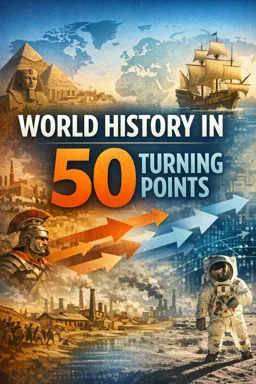

Free ebook exploring 50 turning points in world history, from early farming and empires to decolonization and digital networks.
Free ebook content
-

World History Turning Points: How to Read Change Through Evidence and Comparison
+ Exercise: Which scenario best fits the course definition of a historical “turning point”?
-
World History Turning Points: Farming, Surplus, and the First Large Settlements
+ Exercise: Which scenario best illustrates how stored food (surplus) can lead to specialization in early farming communities?
-
World History Turning Points: Cities, Writing, and Early States
+ Exercise: Why do writing and seals strengthen early states beyond simply recording transactions?
-
World History Turning Points: Bronze, Horses, and the First Long-Distance Military Revolutions
+ Exercise: Why did the combination of bronze metallurgy and horse-based transport help early states expand power over long distances?


-
World History Turning Points: Universal Religions and Ethical Traditions Reshaping Societies
+ Exercise: Which feature best explains how a religious tradition can become “portable” and recruit members beyond a specific place or lineage?
-
World History Turning Points: Coinage, Markets, and the Expansion of Interregional Trade
+ Exercise: In expanding interregional trade, which combination best explains how exchanges between strangers became more predictable and scalable?
-
World History Turning Points: Classical Empires and the Politics of Scale
+ Exercise: Which scenario best illustrates how infrastructure functions as a governance tool in large empires?
-
World History Turning Points: Pandemic Disease and Demographic Reversal in the Afro-Eurasian World
+ Exercise: Why did tighter Afro-Eurasian trade connectivity make epidemics more destabilizing for economies and states?
-
World History Turning Points: Gunpowder, Fortifications, and the Rebalancing of Military Power
+ Exercise: Why did gunpowder become truly transformative in warfare when it operated as a system rather than as isolated weapons?
-
World History Turning Points: Oceanic Navigation and the Creation of a Truly Global Maritime Network
+ Exercise: What best explains the turning point from regional seas to a truly global maritime network?
-
World History Turning Points: The Columbian Exchange and Ecological Transformation
+ Exercise: Which scenario best illustrates how an ecological change during the Columbian Exchange could produce a broader economic and demographic transformation?
-
World History Turning Points: The Transatlantic Slave Trade and Racialized Systems of Labor
+ Exercise: Which feature best explains what made Atlantic chattel slavery distinct from other coercive labor systems like serfdom, indenture, or corvée?
-
World History Turning Points: Scientific Inquiry, Print, and New Publics of Knowledge
+ Exercise: Which scenario best illustrates the turning point where authority became more contestable through faster critique and replication?
-
World History Turning Points: Industrialization and the Fossil-Fuel Energy Breakthrough
+ Exercise: Which change best captures how fossil-fuel power transformed production compared with relying on water, wind, or muscle power?
-
World History Turning Points: New Imperialism and the Global Reordering of Power
+ Exercise: Which situation best illustrates how “New Imperialism” typically tightened control over a territory in the late 1800s?
-
World History Turning Points: World Wars and Mass Mobilization
+ Exercise: Which situation best indicates that a conflict has moved toward “total war” rather than remaining a limited war?
-
World History Turning Points: Decolonization and the Rise of New Nation-States
+ Exercise: Which scenario best illustrates the difference between achieving legal independence and building strong state capacity during decolonization?
-
World History Turning Points: The Cold War as a Global System of Alliances, Revolutions, and Proxy Conflicts
+ Exercise: Which statement best captures why the Cold War functioned as a global system rather than just a series of separate events?
-
World History Turning Points: Digital Networks and the Acceleration of Global Interdependence
+ Exercise: How do network effects combined with data feedback loops tend to shape power in digital platform economies?
About the free ebook
World History in 50 Turning Points
World History in 50 Turning Points is a free ebook that examines how major changes in technology, environment, ideas, trade, power, and communication reshaped human societies. Rather than treating history as a simple sequence of dates, it shows how historians use evidence, comparison, and cause-and-effect reasoning to understand change across regions.
See global connections in historical change
Explore the rise of farming communities, cities, states, long-distance exchange, and empires alongside the transformations produced by disease, migration, warfare, and ecological exchange. The ebook connects local developments to wider networks across Afro-Eurasia, the Atlantic world, and the modern globe.
Examine power, innovation, and social consequences
From writing and coinage to gunpowder, print, fossil fuels, and digital networks, each turning point invites readers to consider who gained power, who faced new constraints, and how older systems adapted. Attention is also given to labor, racialized slavery, imperialism, mass mobilization, decolonization, and Cold War conflicts.
Build historical thinking skills
- Compare developments across different societies and time periods.
- Identify short-term triggers and long-term causes.
- Evaluate how environmental, economic, cultural, and political forces interact.
- Connect past global transformations with present-day interdependence.
Designed for school history study, this ebook provides a clear framework for interpreting pivotal changes without reducing the past to a single story.
How does the ebook explain why farming was a turning point in world history?
It examines how food surplus supported larger settlements, specialization, inequality, and early political institutions.
Does the ebook connect the Columbian Exchange to environmental change?
Yes. It considers the movement of crops, animals, diseases, and people and their ecological consequences.
What global effects of industrialization are covered?
It explores fossil-fuel energy, production, imperial power, labor changes, and expanding global interdependence.
This ebook includes:

19 content chapters

Digital certificate of course completion (Free)

Exercises to train your knowledge

100% free, from content to certificate
Ready to get started?

 recommended
In the app you will also find...

Over 5,000 free courses
Programming, English, Digital Marketing and much more! Learn whatever you want, for free.

Study plan with AI
Our app's Artificial Intelligence can create a study schedule for the course you choose.

From zero to professional success
Improve your resume with our free Certificate and then use our Artificial Intelligence to find your dream job.
You can also use the QR Code or the links below.