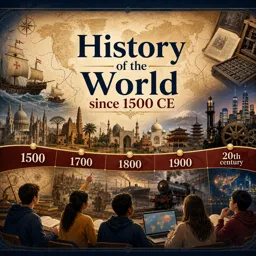
Free Course Image History of the World since 1500 CE

Free online courseHistory of the World since 1500 CE

Duration of the online course: 25 hours and 56 minutes

5

StarStarStarStarStar

(7)

Explore global history from 1500 CE with this free online course by Columbia. Dive into transformative eras across Europe, the Americas, Africa, Asia, and more.

In this free course, learn about

  • Early Modern Transformations in Europe and the Atlantic World
  • Early Modern Islamic and Asian Empires
  • Revolutions and the Early Industrial Age
  • Nineteenth-Century Empires in Asia and Africa
  • Ideas, Ideologies, and Power in the Nineteenth Century
  • The Twentieth Century, Decolonization, and the Cold War
  • Thematic Reflections and Course Conclusion

Course Description

The "History of the World since 1500 CE" course promises an immersive and comprehensive insight into the transformative events that have shaped our modern world. With a duration of 25 hours and 56 minutes, this course is perfect for anyone eager to understand the dynamic changes that have occurred from the early modern period to contemporary times. Students and history enthusiasts alike will find the detailed exploration of global history enlightening and enriching.

Structured within the Basic Studies category, under the History subcategory, this course aims to acquaint learners with significant historical milestones and phenomena from different parts of the world. The high-quality content and the methodical approach taken in this course have earned it an impeccable average rating of 5.0 stars, reflecting the high level of satisfaction from previous participants.

The journey begins with an in-depth look at the early modern transformations in Europe from 1500 to 1750, a period marked by profound cultural, political, and economic changes. From there, the course navigates through the interactions between The Americas, the Atlantic, and Africa, spanning the years 1530 to 1770. This dual-part exploration sheds light on the complexities of the triangular trade, colonization, and the resulting cultural exchanges and conflicts.

Covering the sprawling and dynamic Southwest Asia and the Indian Ocean regions from 1500 to 1750, students will gain insights into how trade, politics, and culture intertwined in these pivotal areas. Similarly, the mechanisms of early modern Islamic governance will be unraveled, providing a clear understanding of the socio-political and religious structures during this era.

Attention then shifts to East Asia, covering Korea, Japan, and China in the sixteenth century, followed by an examination of Northern Eurasia from 1500 to 1800. These sections highlight not only internal developments but also the ways these regions interacted with the broader world.

The course also delves into the revolutionary changes sweeping the Atlantic World between 1750 and 1850 and introduces learners to the early wave of industrialization from 1760 to 1851. This is followed by a detailed examination of Egypt and the Ottoman Empire in the nineteenth century and British India, providing a holistic view of these critical regions during a period of significant upheaval.

In the sections covering nineteenth-century China and Africa, the course provides a thorough understanding of the crucial political, social, and economic changes undergone by these regions. The exploration of the century's prevalent ideologies, encapsulated by the term "Nineteenth Century isms," informs students of the intellectual currents driving historical processes during this time.

The narrative then accelerates, encapsulating the themes of velocity and modernity, and introduces Social Darwinism, reflecting the scientific and pseudo-scientific ideas proliferating during the late nineteenth and early twentieth centuries.

As the course progresses into the twentieth century, it covers monumental historical events and shifts, including the impacts of World War I and II, decolonization, and Cold War dynamics. Special attention is given to the relations between humans and animals, highlighting an often-overlooked aspect of historical change.

Finally, the course wraps up with concluding reflections, synthesizing the vast array of content covered and encouraging students to appreciate the interconnectedness of global historical processes. By course end, learners emerge with a nuanced comprehension of world history since 1500 CE, equipped to understand the past’s continuing influence on today’s world.

Course content

  • Video class: Transformations in Europe, 1500-1750 1h16m
  • Exercise: _What is the topic of the novel mentioned in the lecture?
  • Video class: The Americas, the Atlantic, and Africa, 1530-1770 1h18m
  • Exercise: _What are the different options for including the Western Hemisphere civilizations in a world history textbook?
  • Video class: The Americas, The Atlantic, and Africa, 1530-1770 II 1h14m
  • Video class: Southwest Asia and the Indian Ocean, 1500-1750 1h12m
  • Exercise: _What is the underlying pattern that justifies the grouping of topics in the chapter on Ottoman, Safavid, and Mughal empires in the context of world history since 1500 CE?
  • Video class: Early Modern Islamic Governance 1h17m
  • Exercise: _What were the three empires covered in this chapter and what was their common characteristic?
  • Video class: Korea, Japan, and China in the Sixteenth Century 1h07m
  • Exercise: What major historical developments are critical in modern history?
  • Video class: Northern Eurasia, 1500 -1800 1h15m
  • Exercise: How does the concept of 'premature canonization' relate to the study of world history?
  • Video class: Revolutionary Changes in the Atlantic World, 1750-1850 Part I 1h13m
  • Exercise: How does the book 'The World: A History' by Felipe Fernandez Armesto differ in its approach to the American and French Revolutions from conventional narratives?
  • Video class: The Early Industrial Revolution, 1760-1851 1h13m
  • Exercise: _When was the term "Industrial Revolution" first coined?
  • Video class: Egypt and the Ottoman Empire in the 19th Century 1h15m
  • Exercise: _What is the topic of the chapter assigned for this week's reading?
  • Video class: British India 1h13m
  • Exercise: What is the main theme of the course being described?
  • Video class: Nineteenth Century China 1h09m
  • Exercise: _What is the main difference between Amitav Ghosh's novel River of Smoke and James Clavell's novel Tai-Pan?
  • Video class: Africa in the nineteenth century 1h16m
  • Exercise: _What is the author's opinion on the relationship between agriculture and civilization?
  • Video class: Nineteenth Century isms 1h16m
  • Exercise: _What is the main concern of the speaker in this lecture?
  • Video class: Velocity and Modernity 1h14m
  • Exercise: _What are the two pieces into which the chapter "The New Power Balance" is divided?
  • Video class: Social Darwinism 1h16m
  • Exercise: _What is the main topic of the chapter "The New Power Balance" in "History of the World since 1500 CE by Columbia"?
  • Video class: The Twentieth Century in History 1h13m
  • Exercise: _What was the impact of the introduction of knit garments in China in the early 20th century?
  • Video class: Money and Decolonization 1h13m
  • Exercise: What is the focus of the final examination for the history course?
  • Video class: America and the Cold War 1h10m
  • Exercise: _What difficulties arise when discussing the inevitability of the rise of the West?
  • Video class: Human/Animal Relations 1h20m
  • Exercise: _What is the author's criticism of using the Neolithic Revolution as a starting point for world history?
  • Video class: Concluding Reflections 1h07m
  • Exercise: _What is the difference between world history and global history according to the publisher?

This free course includes:

25 hours and 56 minutes of online video course

Digital certificate of course completion (Free)

Exercises to train your knowledge

100% free, from content to certificate

Ready to get started?Download the app and get started today.

Install the app now

to access the course
Icon representing technology and business courses

Over 5,000 free courses

Programming, English, Digital Marketing and much more! Learn whatever you want, for free.

Calendar icon with target representing study planning

Study plan with AI

Our app's Artificial Intelligence can create a study schedule for the course you choose.

Professional icon representing career and business

From zero to professional success

Improve your resume with our free Certificate and then use our Artificial Intelligence to find your dream job.

You can also use the QR Code or the links below.

QR Code - Download Cursa - Online Courses

More free courses at History

Download the App now to have access to + 3300 free courses, exercises, certificates and lots of content without paying anything!

  • 100% free online courses from start to finish

    Thousands of online courses in video, ebooks and audiobooks.

  • More than 48 thousand free exercises

    To test your knowledge during online courses

  • Valid free Digital Certificate with QR Code

    Generated directly from your cell phone's photo gallery and sent to your email

Cursa app on the ebook screen, the video course screen and the course exercises screen, plus the course completion certificate

+ 9 million
students

Free and Valid
Certificate

60 thousand free
exercises

4.8/5 rating in
app stores

Free courses in
video and ebooks