

World History examines major civilizations, cultures, migrations, conflicts, trade networks, and political changes across regions and eras.

2

2


Exercises
Test your knowledge of the political, military, social, and economic changes that transformed Japan during the Meiji era.
Start exercisesTest your knowledge of Medieval Europe, chivalry, feudalism, Norman England, the Black Death, Gothic architecture, and the Renaissance.
Start exercisesTest your world history knowledge with questions on ancient civilizations, Rome, the Silk Road, exploration, revolutions, and world wars.
Start exercises
Reading the Past Like a Detective: A Beginner’s Guide to Historical Methods
Learn historical methods step by step: sources, bias, context, and evidence to analyze the past like a historian.

How Historians Know What Happened: Sources, Bias, and Building the Past
Learn how historians analyze sources, detect bias, and build reliable interpretations of the past using evidence and critical thinking.

A Journey Through Ancient Egypt: Discovering the Land of the Pharaohs
Explore Ancient Egypt’s pyramids, pharaohs, and Nile River in this journey through one of history’s most fascinating civilizations.

Meet the Vikings: Adventurous Explorers From the North
Discover the world of the Vikings—brave explorers, skilled traders, and storytellers who shaped history across seas and continents.

The Rise and Fall of Sparta: Power, Society, and Influence in Ancient Greece
Discover how Sparta rose to power, shaped military history, and left a lasting legacy of discipline, resilience, and societal uniqueness in Ancient Greece.

The Golden Age of Athens: Culture, Democracy, and Legacy
Explore the Golden Age of Athens—where democracy, philosophy, and the arts flourished, leaving a timeless legacy that shaped Western civilization.

The American Revolution: Foundations of a New Nation
Explore the origins, battles, and legacy of the American Revolution, a fight for independence that reshaped the world and inspired democratic ideals.

Exploring the Major Themes and Turning Points of World History
Explore the key themes and turning points that shaped world history—from early civilizations to global trade, empires, and technological revolutions.
Explore human civilization through our selection of free online World History courses. These educational courses help students, teachers, lifelong learners, and history enthusiasts understand the events, societies, ideas, and cultural transformations that shaped the modern world. Study at your own pace while developing historical knowledge, chronological awareness, critical thinking, and source-analysis skills.
Our free World History courses cover essential periods and themes from ancient civilizations to contemporary global developments. Lessons may examine Mesopotamia, Ancient Egypt, Greece, Rome, medieval societies, Asian and African kingdoms, Indigenous cultures, European expansion, revolutions, industrialization, imperialism, world wars, decolonization, and globalization.
Each course offers accessible educational content designed to support independent learning. Whether you are preparing for an academic examination, reviewing classroom topics, expanding your general knowledge, or building a foundation for further historical studies, these online history courses provide a flexible learning opportunity.
All listed courses are free and include exercises that allow learners to review concepts and evaluate their understanding. These educational activities reinforce key dates, historical figures, vocabulary, geographic contexts, and cause-and-effect relationships.
The courses also offer free certification. After completing the required learning activities, you can earn a free certificate that demonstrates your commitment to World History education. Certification may complement a student portfolio, professional development record, résumé, or personal learning plan.
To access and complete these free online World History courses, it is necessary to install the Cursa application. Android users can install it through Google Play at Download for Android. iPhone users can install it through the App Store at Download for iOS / iPhone.
Choose a course, follow the educational lessons, complete the exercises, and work toward free certification. Start studying World History today to gain a broader understanding of civilizations, global connections, historical change, and the diverse experiences that have influenced humanity.
What does a World History course cover?
World History examines major civilizations, cultures, migrations, conflicts, trade networks, and political changes across regions and eras.
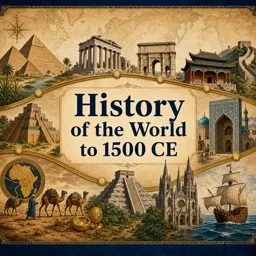
What will I learn in History of the World to 1500 CE?
You will explore early human societies, ancient civilizations, classical empires, major religions, and medieval global connections up to 1500 CE.
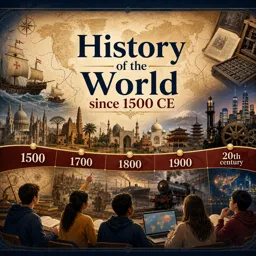
What topics are covered in History of the World since 1500 CE?
This course covers exploration, colonization, revolutions, industrialization, world wars, decolonization, globalization, and the modern world.
What are the most important turning points in world history?
Key turning points include the rise of agriculture, the spread of major religions, transoceanic exploration, industrialization, revolutions, and the world wars.
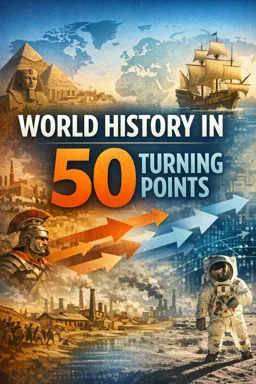
What is World History in 50 Turning Points about?
It uses 50 significant events and developments to explain how societies, states, economies, and cultures changed over time.
Which revolutions shaped the modern world?
Major modern revolutions include the English, American, French, Haitian, Russian, Chinese, and anti-colonial revolutions.
What will I learn in The History of Revolutions That Shaped the Modern World?
You will study the causes, leaders, ideas, conflicts, and global consequences of influential political and social revolutions.

Complete any course and issue your certificate via the app — at no cost.

Download the app! to have access to more than 4,000 Online Courses + Certificate, all free!
Download the app! 100% free courses.


Carry knowledge in your pocket.
Download the Cursa app.
There are hundreds of free courses available, with a free certificate of completion that is saved in your mobile image gallery.
Download the app to access the Course Completion Certificate for Free.


+ 10 million
students

Free and Valid
Certificate

60 thousand free
exercises

4.8/5 rating in
app stores

Free courses in
video and ebooks