The course explores Mesoamerican civilizations, European exploration, Columbus, navigation, colonial powers, missions, and the foundations of early America.

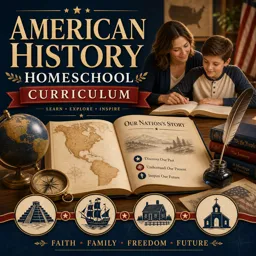
Duration of the online course: 3 hours and 56 minutes
New
Build a strong foundation in American history with this free online course—engaging lessons, critical thinking, and homeschool-ready projects.
This free online course helps homeschool students build a clear, confident understanding of early American history by connecting people, ideas, and turning points into a meaningful story. Instead of treating the past like a checklist of dates, you will learn to follow causes and consequences, recognize patterns that repeat across civilizations, and practice the kind of thoughtful reading and reflection that makes history stick. The goal is simple: help learners grow in wisdom, not just information, by learning how to ask better questions about the world and how it came to be.
Beginning with the deeper purpose of studying the humanities, the course frames history as a way to understand human nature, cultures, beliefs, and the choices that shape nations. You will explore how societies in Mesoamerica developed sophisticated systems of learning, ritual, architecture, and governance, and then examine the tensions and vulnerabilities that made them fragile over time. As the narrative moves toward contact and conquest, you will look closely at how small forces changed outcomes through alliances, strategy, technology, and circumstance, building a more realistic view of why empires rise and fall.
You will also follow the motivations and myths surrounding exploration, including what drove figures like Columbus and why legends about earlier voyages still matter to historical study. Along the way, the course encourages you to compare different colonial models, consider how navigation evolved, and understand how competing European goals reshaped the New World. Missions, mapmaking, and practical projects turn big themes into hands-on learning, while checks for understanding and lesson-end exams are used primarily to reinforce mastery and guide review rather than simply assign a score.
By the end, learners should feel better equipped to explain major developments in early American history, evaluate historical claims with more care, and produce work they can be proud of, including portfolio-style assignments that function as a record of growth. Whether you are organizing a full homeschool year or adding structure to independent study, this course offers a thoughtful, engaging path to stronger comprehension and richer discussions at home.

3 hours and 56 minutes of online video course

Digital certificate of course completion (Free)

Exercises to train your knowledge

100% free, from content to certificate
What topics are covered in Dave Raymond's American History Homeschool Curriculum Year 1?
The course explores Mesoamerican civilizations, European exploration, Columbus, navigation, colonial powers, missions, and the foundations of early America.
How does the American History Homeschool Curriculum teach more than dates and events?
It emphasizes studying history through the humanities, key ideas, primary themes, and a biblical worldview rather than memorizing a timeline alone.
What homeschool projects and assessments are included in the American History course?
Students complete lesson exams designed to reinforce learning and create a history portfolio, including hands-on projects such as colonial map reproduction.
Ready to get started?Download the app and get started today.
Install the app now
to access the course
Over 5,000 free courses
Programming, English, Digital Marketing and much more! Learn whatever you want, for free.

Study plan with AI
Our app's Artificial Intelligence can create a study schedule for the course you choose.

From zero to professional success
Improve your resume with our free Certificate and then use our Artificial Intelligence to find your dream job.
You can also use the QR Code or the links below.



Free CourseIntroduction to Ancient Greek History
5

(1)

28h29m

24 exercises
Free CourseAmerican History
5
(2)
19h30m
25 exercises
Free CourseHistory for Kids
5
(1)
6h04m
53 exercises
Free CourseHistory of the World since 1500 CE
4.9
(8)
25h56m
20 exercises
Free CourseHistory of the World to 1500 CE
4.6

(22)
31h11m
25 exercises
Free CourseAncient History Curriculum - from Creation through the Resurrection
New
5h47m
19 exercises
Free CourseComplete U.S. History
New
80h21m
34 exercises
Carry knowledge in your pocket.
Download the Cursa app.
There are hundreds of free courses available, with a free certificate of completion that is saved in your mobile image gallery.
Download the app to access the Course Completion Certificate for Free.


+ 10 million
students

Free and Valid
Certificate

60 thousand free
exercises

4.8/5 rating in
app stores

Free courses in
video and ebooks