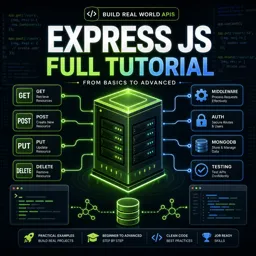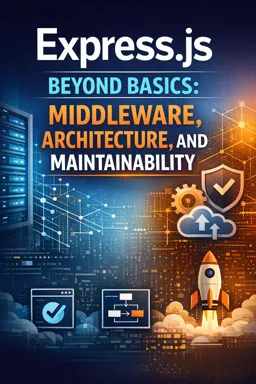

Free ebook on maintainable Express.js architecture, middleware design, error handling, security, testing, and production readiness.
Free ebook content
-

Express.js Beyond Basics: Application Structure for Maintainability
+ Exercise: Which layering choice best supports maintainability by keeping stable seams between HTTP concerns, business logic, and data access?
-
Middleware Design in Express.js: Composition, Order, and Reuse
+ Exercise: In an Express.js app, a route depends on req.body being populated. Which middleware setup best ensures this works reliably and avoids order-related issues?
-
Routing Architecture: Modular Routers and Clear Boundaries
+ Exercise: Which route-file pattern best maintains clear boundaries and scalability in an Express routing architecture?
-
Controllers, Services, and Repositories: Practical Layering Patterns
+ Exercise: In a layered Express.js architecture (controller → service → repository), which responsibility belongs in the service layer rather than the controller or repository?


-
Async Error Handling Patterns for Express.js
+ Exercise: In an Express app using async route handlers, what approach best ensures async failures are consistently captured and formatted without adding try/catch in every controller?
-
Centralized Error Handling: Consistent Responses and Debuggability
+ Exercise: In a centralized Express error-handling setup, which approach best preserves a stable client contract while keeping rich diagnostics for operators?
-
Request Validation and Data Sanitization for Express.js
+ Exercise: In an Express.js app that uses schema-based request validation middleware, what is the primary benefit of parsing and replacing req.params, req.query, and req.body before the controller runs?
-
Security Hardening in Express.js: Headers, Input Safety, and Policies
+ Exercise: When an Express app uses cookie-based authentication and enables CORS with credentials, which approach best prevents unintentionally allowing any website to make authenticated browser requests?
-
Rate Limiting, Throttling, and Abuse Prevention
+ Exercise: When an Express app is deployed behind a reverse proxy and you use IP-based rate limiting, what is the main reason to configure trust proxy correctly?
-
Logging, Monitoring Signals, and Request Correlation
+ Exercise: What is the main benefit of using a request-scoped logger (e.g., req.log) instead of a single global logger in an Express app?
-
Configuration Management: Environments, Secrets, and Safe Defaults
+ Exercise: Which approach best aligns with a robust configuration strategy for an Express.js application?
-
Testing Express.js Applications: Unit, Integration, and Middleware Tests
+ Exercise: In a layered Express.js application, what best explains why integration tests typically build an in-memory app using dependency injection?
-
Deployment Readiness for Express.js: Reliability and Operational Concerns
+ Exercise: When an Express.js service receives a termination signal in production, which sequence best describes a graceful shutdown that supports predictable deployments?
About the free ebook
Express.js Beyond Basics: Middleware, Architecture, and Maintainability
This free ebook helps backend developers design Express.js applications that remain clear, secure, testable, and reliable as they grow. It moves beyond isolated routes and shows how deliberate boundaries, predictable request handling, and operational practices support long-term maintainability.
Build an architecture that scales with your codebase
Learn practical ways to organize an Express.js application around modular routers, controllers, services, and repositories. The ebook explains how these layers can separate HTTP concerns, business rules, and data access without introducing unnecessary complexity.
Design middleware with confidence
Middleware order affects correctness, security, and observability. Explore reusable middleware composition, asynchronous error patterns, centralized error responses, validation, sanitization, and request correlation. These techniques make APIs easier to debug and safer to evolve.
Strengthen production readiness
Discover how to apply security headers, safe input handling, rate limiting, configuration discipline, logging signals, and testing strategies to Express.js services. The focus is on choices that help teams detect failures early, protect endpoints, and deploy with greater confidence.
What you will gain
- Clear patterns for structuring maintainable Express.js backends
- Consistent approaches to errors, validation, and API responses
- Practical safeguards against abuse and unsafe input
- Testing and operational habits for dependable deployments
Ideal for developers working on real Express.js APIs, this ebook provides a focused foundation for improving existing projects and making sound architectural decisions in new ones.
How should middleware be ordered in an Express.js application?
Place foundational middleware first, route-specific middleware before handlers, and centralized error middleware last.
Why use controllers, services, and repositories in Express.js?
They separate HTTP handling, business logic, and data access, making code easier to test and change.
What should centralized Express.js error handling return?
It should return consistent status codes and safe error messages while logging useful diagnostic details.
This ebook includes:

13 content chapters

Digital certificate of course completion (Free)

Exercises to train your knowledge

100% free, from content to certificate
Ready to get started?

 recommended
In the app you will also find...

Over 5,000 free courses
Programming, English, Digital Marketing and much more! Learn whatever you want, for free.

Study plan with AI
Our app's Artificial Intelligence can create a study schedule for the course you choose.

From zero to professional success
Improve your resume with our free Certificate and then use our Artificial Intelligence to find your dream job.
You can also use the QR Code or the links below.