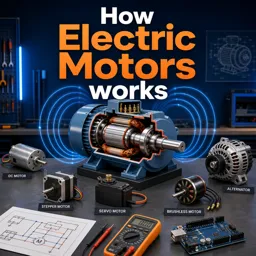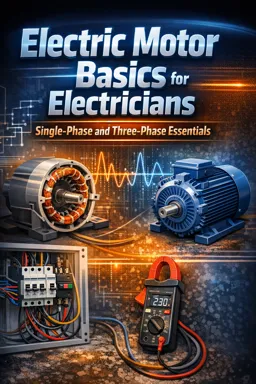

Free ebook for electricians covering single-phase and three-phase motor wiring, ratings, protection, controls, diagnostics, and commissioning.
Free ebook content
-

Electric Motor Basics for Electricians: How Motors Convert Electrical Power to Mechanical Work
+ Exercise: In an induction motor, what typically happens when the mechanical load increases and the motor must produce more torque?
-
Single-Phase Motor Essentials for Electricians: Types, Wiring, and Applications
+ Exercise: A blower motor in an air handler has multiple speed tap leads and a run capacitor that stays in the circuit during operation, with no centrifugal switch. Which single-phase motor type best matches these field clues?
-
Three-Phase Motor Essentials for Electricians: Induction Motors, Rotation, and Basic Connections
+ Exercise: A three-phase motor drives a pump but the shaft turns opposite the rotation arrow. What field action correctly reverses motor rotation while following safe practice?


-
Motor Nameplates and Ratings: Reading What Matters for Safe Installation and Troubleshooting
+ Exercise: When troubleshooting a motor, when is it appropriate to compare the measured running current to the nameplate FLA?
-
Starting Methods and Inrush: How Motors Start and What Electricians Must Verify
+ Exercise: A three-phase motor starts with a high current peak that does not decay quickly and the breaker trips after a few seconds. Which condition best explains why the current stays high longer than normal?
-
Overload Protection and Short-Circuit Protection for Motors: Correct Roles and Sizing Concepts
+ Exercise: A motor starter is experiencing nuisance trips during starting on a long-acceleration load, but voltage and mechanics are confirmed normal. Which adjustment best matches the proper sizing approach while still protecting the motor?
-
Motor Control Components Electricians Use: Contactors, Starters, Relays, and Interlocks
+ Exercise: In a basic start/stop control circuit with a seal-in (holding) contact, what keeps the contactor coil energized after the START pushbutton is released?
-
Capacitors, Relays, and Starting Switches: Field Diagnostics for Single-Phase HVAC Motors
+ Exercise: When replacing an HVAC motor capacitor, which selection rule best helps prevent repeat failures and motor damage?
-
VFD and Soft Starter Fundamentals for Electricians: What Changes in Wiring, Protection, and Testing
+ Exercise: Before performing an insulation resistance (megger) test on a motor fed by a VFD, what is the correct safe approach?
-
Common Motor Failure Symptoms: What Electricians See and What It Usually Means
+ Exercise: A motor is overheating, and measurements show high current on all phases while voltage at the motor terminals is normal. What direction should troubleshooting focus on first?
-
Safe Troubleshooting Workflow for Fans, Pumps, Compressors, and HVAC Motors
+ Exercise: During safe motor troubleshooting, the contactor is commanded on and the measured line voltage is normal with no-load (contactor open) but collapses during an attempted run. What does this most strongly suggest?
-
Installation, Replacement, and Commissioning Checks: Getting Motor Jobs Right the First Time
+ Exercise: During commissioning, a three-phase motor runs but the driven equipment is rotating in the wrong direction. What is the correct first correction to make?
About the free ebook
Electric Motor Basics for Electricians: Single-Phase and Three-Phase Essentials
This free online ebook gives electricians a practical foundation for installing, testing, protecting, and troubleshooting electric motors. It explains how motors turn electrical energy into mechanical work and connects core theory to common field equipment, including fans, pumps, compressors, and HVAC systems.
Build confidence with motor circuits
Learn the essential differences between single-phase and three-phase motors, including motor types, winding arrangements, rotation, basic connections, and typical applications. The ebook also clarifies how capacitors, start relays, centrifugal switches, contactors, overloads, and interlocks support reliable motor operation.
Read ratings and select protection correctly
Motor nameplates contain the information needed for safer installation and accurate diagnosis. This guide focuses on the ratings electricians must verify, such as voltage, current, horsepower, frequency, speed, phase, duty, and insulation information. It distinguishes the roles of overload protection and short-circuit protection so protective devices can be understood in the context of motor circuits.
Diagnose common motor problems safely
Explore practical symptoms such as humming, failure to start, overheating, repeated overload trips, wrong rotation, excessive current, and unusual noise. The ebook presents a safe troubleshooting approach that begins with isolation and inspection before moving to electrical measurements and mechanical checks.
Understand modern starting and speed-control equipment
Discover how inrush current affects motor starting and what changes when using reduced-voltage starters, soft starters, and variable frequency drives. Learn why VFD-fed motors require attention to wiring practices, settings, grounding, protection, and testing methods.
For installation and service work
- Verify motor ratings before replacement or connection.
- Recognize components in motor control circuits.
- Use systematic checks during commissioning and fault finding.
- Apply safer practices around energized and rotating equipment.
This ebook is designed as a clear professional reference for electricians who need dependable motor fundamentals for real-world electrical work.
What information on a motor nameplate is most important for replacement?
Verify voltage, phase, frequency, full-load current, horsepower, speed, enclosure, duty rating, and service factor before selecting a replacement.
Why does a single-phase motor hum but not start?
Common causes include a failed capacitor, defective start relay or switch, an open start winding, low voltage, or a mechanically locked load.
What changes when a motor is connected to a VFD?
The motor receives variable-frequency output, so wiring, grounding, parameter setup, insulation suitability, and testing procedures need special attention.
This ebook includes:

12 content chapters

Digital certificate of course completion (Free)

Exercises to train your knowledge

100% free, from content to certificate
Ready to get started?

 recommended
In the app you will also find...

Over 5,000 free courses
Programming, English, Digital Marketing and much more! Learn whatever you want, for free.

Study plan with AI
Our app's Artificial Intelligence can create a study schedule for the course you choose.

From zero to professional success
Improve your resume with our free Certificate and then use our Artificial Intelligence to find your dream job.
You can also use the QR Code or the links below.