The course covers crystal properties and the standard methods used to grow highly pure silicon rods for semiconductor wafers.

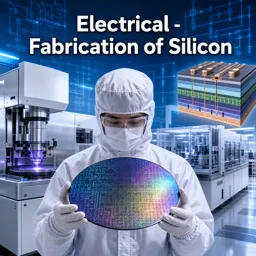
Duration of the online course: 35 hours and 10 minutes
4.8

(26)
Build job-ready semiconductor skills with this free online course on silicon fabrication, IC labs and CMOS processes—ideal for electricians seeking a certificate boost.
Step beyond basic electrical work and gain a clear, practical view of how modern electronics are made. This free online course connects electrical fundamentals to the real manufacturing steps that turn ultra-pure silicon into the integrated circuits inside everyday devices. If you want to understand what happens inside a fab, speak the language of technicians and engineers, or broaden your opportunities in electronics and industrial environments, this training gives you that bridge from the macro world to the nano scale.
You will develop a solid mental model of silicon as a material: why crystal structure matters, how high-purity silicon is produced, and what can go wrong when contamination enters the process. The course also helps you understand clean lab thinking and process discipline, reinforcing why particle control, water purity, and careful handling practices are essential to yield and reliability. This knowledge is valuable not only for semiconductor work, but for any role where precision, safety, and controlled processes define success.
From there, you will follow how electrical properties are engineered through diffusion and ion implantation, learning how impurities are introduced and driven into silicon to create functional regions in devices. You will also see why silicon dioxide is so central to VLSI technology and how oxidation becomes a key tool for insulation and device formation. As the flow continues, you will understand how patterns are created through lithography, how thin films are added by deposition methods, and how materials are selectively removed by etching to form complete structures. Throughout, the focus is on process understanding and the reasoning behind each step, so you can interpret terminology, troubleshoot intelligently, and connect measurements to outcomes.
Designed within professional skills for electricians and technical learners, the course supports upskilling for roles that intersect with electronics manufacturing, maintenance, QA, or high-tech facilities. By the end, you should feel confident reading process discussions, following a CMOS-oriented fabrication flow at a high level, and explaining how key fabrication choices influence device behavior and reliability.

35 hours and 10 minutes of online video course

Digital certificate of course completion (Free)

Exercises to train your knowledge

100% free, from content to certificate
What silicon crystal-growth methods are covered in the Electrical - Fabrication of Silicon course?
The course covers crystal properties and the standard methods used to grow highly pure silicon rods for semiconductor wafers.
How does the course explain diffusion, oxidation, and ion implantation in silicon IC fabrication?
It explains impurity diffusion, thermal silicon-dioxide growth, ion implantation principles, and their roles in forming semiconductor device regions.
What VLSI fabrication steps are included beyond silicon wafer growth?
The course covers cleanroom contamination control, lithography, thin-film deposition, etching, CMOS processing flow, and back-end technology.
Ready to get started?Download the app and get started today.
Install the app now
to access the course
Over 5,000 free courses
Programming, English, Digital Marketing and much more! Learn whatever you want, for free.

Study plan with AI
Our app's Artificial Intelligence can create a study schedule for the course you choose.

From zero to professional success
Improve your resume with our free Certificate and then use our Artificial Intelligence to find your dream job.
You can also use the QR Code or the links below.



Free CourseInstall Your Own Solar Power System
5
(2)

59m

6 exercises
Free CourseElectronic Circuits Course
5
(7)
43h25m
49 exercises

Free CourseWind Turbines
5
(4)
3h49m
19 exercises
Free CourseEngineering Circuits Analysis
5
(6)
3h11m
20 exercises
Free CourseElectronics - Nanoelectronics: Devices and Materials
4.8
(44)
40h15m
31 exercises
Free CourseBasic electronics
4.8
(23)
6h04m
30 exercises
Free CourseElectrical engineering
4.8
(27)
11h53m
20 exercises
Free CourseBeginner Electronics
4.8
(85)
5h27m
24 exercises
Free CourseElectricity course
4.8
(58)
31h41m
6 exercises
Free CourseElectrical Engineering Basics
4.8

(24)
7h21m
27 exercises
Carry knowledge in your pocket.
Download the Cursa app.
There are hundreds of free courses available, with a free certificate of completion that is saved in your mobile image gallery.
Download the app to access the Course Completion Certificate for Free.


+ 10 million
students

Free and Valid
Certificate

60 thousand free
exercises

4.8/5 rating in
app stores

Free courses in
video and ebooks
Course comments: Electrical - Fabrication of Silicon
anwar haizal
It really good course for me as chemical engineer to adapt to the semiconductor manufacturing