
Use a series resistor calculated from the battery voltage, LED forward voltage, and desired current. For a typical LED, a value around 330–470 ohms is often used.

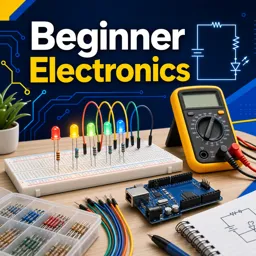
Duration of the online course: 5 hours and 27 minutes
4.8

(82)
Build real circuits from scratch in this free electronics course—learn AC/DC, LEDs, resistors, multimeters and schematics, plus earn a certificate.
Gain practical confidence in electronics by learning how electricity behaves, how components work, and how to build simple circuits that actually function. This free online course is designed for absolute beginners who want a clear starting point in professional electrical skills, whether you are exploring a future as an electrician, adding a useful hands-on skill for the workplace, or simply aiming to understand the devices around you.
You will begin by making sense of core concepts like AC vs. DC, open and closed circuits, and what current and resistance really mean in a real-world setup. From there, you will work with the components you meet in everyday projects: resistors and how to choose the right value, LEDs and the protective role of resistance, switches, buttons, potentiometers, capacitors, and diodes. The focus is not on memorizing definitions, but on understanding how each part influences a circuit and what changes when you connect parts in different ways.
A key outcome of the course is learning to translate between three essential views of electronics: the physical build on a breadboard, the measurements you take with a multimeter, and the schematic symbols used to communicate a design. You will practice diagnosing what is happening in a circuit by checking voltage, continuity, and other basic readings, so you can troubleshoot with logic instead of guesswork.
As you progress, you will connect theory to practice through topics like Ohm’s Law, series vs. parallel circuits, and basic power and wattage considerations. By the end, you should feel ready to plan a small circuit, assemble it cleanly, measure it safely, and refine it until it performs as intended—skills that transfer directly to more advanced electronics, maker projects, and entry-level electrical work.

5 hours and 27 minutes of online video course

Digital certificate of course completion (Free)

Exercises to train your knowledge

100% free, from content to certificate
What resistor value is needed to connect an LED to a 9V battery?
Use a series resistor calculated from the battery voltage, LED forward voltage, and desired current. For a typical LED, a value around 330–470 ohms is often used.
How are series and parallel circuits different?
A series circuit has one path for current, while a parallel circuit has multiple paths and each branch receives the supply voltage.
What can a multimeter measure in beginner electronics projects?
A basic multimeter measures voltage, current, resistance, and continuity, helping you test components and troubleshoot circuits.
Ready to get started?Download the app and get started today.
Install the app now
to access the course
Over 5,000 free courses
Programming, English, Digital Marketing and much more! Learn whatever you want, for free.

Study plan with AI
Our app's Artificial Intelligence can create a study schedule for the course you choose.

From zero to professional success
Improve your resume with our free Certificate and then use our Artificial Intelligence to find your dream job.
You can also use the QR Code or the links below.




Free CourseInstall Your Own Solar Power System
5
(2)

59m

6 exercises
Free CourseElectronic Circuits Course
5
(7)
43h25m
49 exercises

Free CourseWind Turbines
5
(4)
3h49m
19 exercises
Free CourseEngineering Circuits Analysis
5
(6)
3h11m
20 exercises
Free CourseElectronics - Nanoelectronics: Devices and Materials
4.8
(44)
40h15m
31 exercises
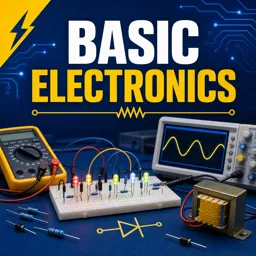
Free CourseBasic electronics
4.8
(23)
6h04m
30 exercises
Free CourseElectrical engineering
4.8
(27)
11h53m
20 exercises

Free CourseElectrical - Fabrication of Silicon
4.8
(26)
35h10m
28 exercises
Free CourseElectricity course
4.8
(58)
31h41m
6 exercises
Free CourseElectrical Engineering Basics
4.8

(24)
7h21m
27 exercises
Carry knowledge in your pocket.
Download the Cursa app.
There are hundreds of free courses available, with a free certificate of completion that is saved in your mobile image gallery.
Download the app to access the Course Completion Certificate for Free.


+ 10 million
students

Free and Valid
Certificate

60 thousand free
exercises

4.8/5 rating in
app stores

Free courses in
video and ebooks
Course comments: Beginner Electronics
Students found the free course highly enjoyable and interesting, praising its clear explanations, engaging videos, practical exercises, and effective teaching methods. They also appreciated its value for sharpening skills and suggested adding realistic simulation labs.
Bright
I highly appreciate your teaching methods. From theory to practical. I really enjoyed it.
Ivan Snider
great courses, awesome way to sharpen skills
Paul Ray
very good teachers and easy interesting exercise and explanations
Selvarajah Rumesh
Good
Shawn God two
please make a lab for real simulation on people like us god23two please subscribe
Martin Márk Herr
This was very interesting. I thoroughly enjoyed the videos and exercises.