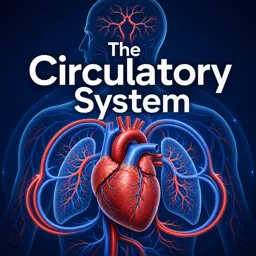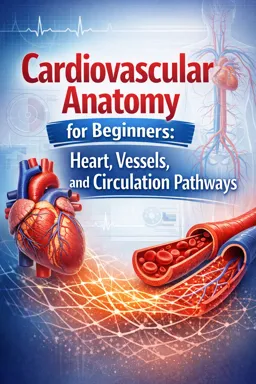

Free ebook on cardiovascular anatomy covering heart chambers, valves, coronary vessels, and pulmonary and systemic circulation pathways.
Free ebook content
-

Cardiovascular Anatomy Foundations: Orientation, Terminology, and Circulatory Layout
+ Exercise: When describing pulmonary vessels using proximal and distal, which statement correctly anchors these terms to the vessel’s origin and blood flow?
-
Heart External Anatomy: Surfaces, Borders, Great Vessels, and Coronary Landmarks
+ Exercise: On the anterior surface of the heart, which pair of vessels typically travels together in the anterior interventricular sulcus toward the apex?
-
Heart Chambers: Right and Left Atria and Ventricles in Step-by-Step Detail
+ Exercise: Which statement correctly explains how specific internal structures support one-way blood flow through the ventricles?
-
Heart Valves and Fibrous Skeleton: One-Way Flow Mechanics
+ Exercise: During isovolumetric contraction, which combination of valves is expected to be closed?


-
Coronary Circulation Anatomy: Arterial Supply, Venous Drainage, and Dominance Patterns
+ Exercise: When determining coronary dominance, what finding defines whether a heart is right-dominant or left-dominant?
-
Pulmonary Circulation Pathway: Right Heart to Lungs and Back to Left Heart
+ Exercise: In the pulmonary circulation pathway, where does blood actually switch from deoxygenated to oxygenated (the “transitioning” region)?
-
Systemic Circulation Pathway: Left Heart to Aorta, Body Tissues, and Venous Return
+ Exercise: When tracing systemic circulation from an artery to the venous return, which structure must be included to correctly connect the arterial and venous sides?
-
Major Arteries of the Body: Aorta Branches and Regional Supply Routes
+ Exercise: When tracing arterial supply from the dorsum of the foot back toward the aorta, which sequence best matches the correct proximal pathway?
-
Major Veins of the Body: Superior/Inferior Vena Cava Systems and Portal Considerations
+ Exercise: Which pathway correctly describes how venous blood from much of the gastrointestinal tract reaches the right atrium?
-
Blood Vessel Wall Structure: How Arteries, Veins, and Capillaries Match Their Functions
+ Exercise: A histology image shows a medium-sized vessel with a very prominent wavy internal elastic lamina and a thick tunica media packed with smooth muscle. Which vessel type best matches these features?
-
Integrated Circulation Routes: Connecting Heart Anatomy with Whole-Body Blood Flow
+ Exercise: In an integrated circulation “map run,” which statement correctly pairs oxygenation status with vessel type in the pulmonary circuit?
About the free ebook
Cardiovascular Anatomy for Beginners: Heart, Vessels, and Circulation Pathways
This free online ebook introduces the anatomy that keeps blood moving through the body. Learn how the heart’s chambers, valves, blood vessels, and circulation routes work together to deliver oxygen and nutrients and remove waste.
Build a clear map of the cardiovascular system
Start with anatomical orientation and essential terminology, then examine the heart from its external landmarks to its internal chambers. The ebook explains the structure of the atria and ventricles, the function of one-way valves, and the fibrous framework that supports cardiac motion.
Follow blood through every major pathway
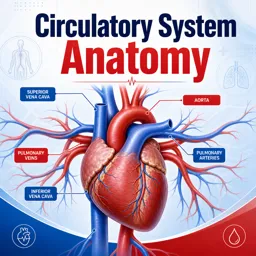
Trace deoxygenated blood from the body to the right side of the heart, through the lungs, and back to the left side of the heart. Then follow oxygenated blood through the aorta, arteries, capillaries, veins, and venae cavae. Each route is connected to the structures responsible for directing flow.
Understand vessels in context
Explore coronary circulation, including arterial supply, venous drainage, and dominance patterns. Review major systemic arteries and veins, portal circulation considerations, and the wall structure of arteries, veins, and capillaries.
What you will be able to recognize
- The major external and internal structures of the heart
- The route of blood through pulmonary and systemic circulation
- How cardiac valves maintain one-way blood flow
- How coronary vessels supply and drain the myocardium
- Why arteries, veins, and capillaries have different structures
Written for early anatomy learners, this ebook connects individual structures to the complete circulation pathway, helping you study cardiovascular anatomy with greater confidence and accuracy.
What is the path of blood through the heart and lungs?
Blood returns to the right heart, travels to the lungs through pulmonary arteries, returns to the left heart, and then enters systemic circulation.
What is coronary artery dominance?
Coronary dominance describes which coronary artery gives rise to the posterior descending artery, most often the right coronary artery.
How do arteries, veins, and capillaries differ in structure?
Arteries have thicker muscular walls, veins have thinner walls and often valves, and capillaries have very thin walls for exchange.
This ebook includes:

11 content chapters

Digital certificate of course completion (Free)

Exercises to train your knowledge

100% free, from content to certificate
Ready to get started?

 recommended
In the app you will also find...

Over 5,000 free courses
Programming, English, Digital Marketing and much more! Learn whatever you want, for free.

Study plan with AI
Our app's Artificial Intelligence can create a study schedule for the course you choose.

From zero to professional success
Improve your resume with our free Certificate and then use our Artificial Intelligence to find your dream job.
You can also use the QR Code or the links below.