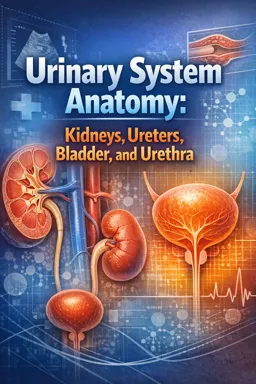

Free ebook on urinary system anatomy, covering kidneys, nephrons, ureters, bladder, urethra, blood supply, and urine flow.
Free ebook content
-

Urinary System Anatomy: Core Organization and Functional Map
+ Exercise: Which feature of the ureter’s entry into the bladder helps reduce urine backflow as the bladder fills?
-
Kidney Gross Anatomy: External Features, Hilum, and Internal Compartments
+ Exercise: In a hilum-level axial view of the kidney, which structure is typically the most posterior when using the common anterior-to-posterior relationship?
-
Nephron Overview: Microanatomy Linked to Kidney Regions
+ Exercise: In a kidney section, you identify a tubule segment located deep in the medulla. Which conclusion best fits this finding?
-
Renal Blood Supply and Drainage: Arterial Tree, Venous Return, and Spatial Relationships
+ Exercise: A contrast study shows a sharply demarcated, wedge-shaped perfusion defect confined to a specific renal territory. Which anatomical feature best explains this segment-shaped infarct pattern?


-
Urine Outflow Pathways: From Collecting Ducts to Renal Pelvis
+ Exercise: Which sequence correctly traces urine flow from the collecting ducts to the ureter, maintaining the “ducts in tissue → collecting spaces → ureter” logic?
-
Ureter Anatomy: Course, Constrictions, and Wall Structure
+ Exercise: Which statement best explains how the ureter’s wall structure both permits urine transport and helps prevent backflow into the kidney?
-
Urinary Bladder Anatomy: Regions, Peritoneal Relations, and Support
+ Exercise: During bladder filling, which region remains the most fixed and acts as the anchor point as the dome rises superiorly?
-
Urethra Anatomy and Sphincters: Continence Structures and Key Landmarks
+ Exercise: Which location best identifies the external urethral sphincter (striated) rather than the internal urethral sphincter (smooth)?
-
Surface Anatomy and Imaging Correlation: Visualizing Kidneys, Ureters, and Bladder In Situ
+ Exercise: When projecting the ureter’s course on the body surface, which description best matches its typical path from kidney to bladder?
-
Integrated Urine Flow Pathway Review: Anatomical Checkpoints and Common Misconceptions
+ Exercise: Urine exits the papillary ducts at the tip of a renal papilla. What is the next named gross structure urine enters?
About the free ebook
Urinary System Anatomy: Kidneys, Ureters, Bladder, and Urethra
This free online ebook examines the anatomy of the urinary system, connecting organ structure with the route urine takes from its formation in the kidneys to elimination through the urethra. It is designed for learners who need a clear, anatomically grounded view of the kidneys, ureters, urinary bladder, and urethra.
Connect structure, location, and function
Learn how the kidneys are organized externally and internally, including their hila, cortex, medulla, renal pyramids, calyces, and renal pelvis. The ebook relates nephron microanatomy to kidney regions, helping explain where filtration, reabsorption, and urine concentration are associated within the organ.
It also follows the renal arterial branches and venous drainage, emphasizing spatial relationships that matter when identifying structures in diagrams, specimens, and medical images.
Trace the urinary passageways
Explore the route from collecting ducts into the calyces and renal pelvis, then along the ureters to the bladder and urethra. Particular attention is given to normal ureteric constrictions, wall layers, bladder regions, peritoneal relations, and the sphincter structures involved in continence.
Apply anatomy to orientation and imaging
The ebook links surface anatomy with imaging-based orientation, so you can recognize how urinary organs sit in relation to nearby structures. An integrated review reinforces key anatomical checkpoints and helps correct frequent misconceptions about urine flow.
What you will strengthen
- Recognition of gross and microscopic urinary anatomy
- Understanding of renal vessels and urine drainage pathways
- Identification of ureter, bladder, and urethral landmarks
- Confidence interpreting anatomical relationships in situ
This educational resource focuses on normal anatomy and supports structured study for health and anatomy learners.
What are the three normal constrictions of the ureter?
They occur at the ureteropelvic junction, where the ureter crosses the pelvic brim, and at the ureterovesical junction.
How does urine travel from the nephron to the bladder?
It passes through collecting ducts, papillary ducts, calyces, renal pelvis, ureter, and then the urinary bladder.
What is the difference between the internal and external urethral sphincters?
The internal sphincter is smooth muscle and involuntary; the external sphincter is skeletal muscle and under voluntary control.
This ebook includes:

10 content chapters

Digital certificate of course completion (Free)

Exercises to train your knowledge

100% free, from content to certificate
Ready to get started?

 recommended
In the app you will also find...

Over 5,000 free courses
Programming, English, Digital Marketing and much more! Learn whatever you want, for free.

Study plan with AI
Our app's Artificial Intelligence can create a study schedule for the course you choose.

From zero to professional success
Improve your resume with our free Certificate and then use our Artificial Intelligence to find your dream job.
You can also use the QR Code or the links below.