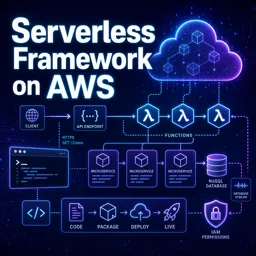
WHAT IS LAMBDA?
Lambda is a serverless compute service that allows developers to run code without managing servers. Infrastructure tasks such as scaling, patching, and availability are fully handled by the cloud provider—most commonly through AWS Lambda. This frees developers to focus solely on application logic while maintaining reliability and efficiency.
SECURITY ADVANTAGES OF USING LAMBDA
Serverless architectures introduce inherent security benefits compared to traditional server-based setups. Since there are no servers to manage directly, risks tied to operating system vulnerabilities and manual patching are greatly reduced. Each Lambda function also runs in its own isolated environment, limiting the impact of potential threats.
Key security advantages include:
- Reduced attack surface: No direct server access via SSH or RDP.
- Principle of least privilege: Fine-grained, role-based access control ensures functions only use required resources.
- Automatic updates: Cloud providers apply runtime patches, minimizing exposure to vulnerabilities.
ENSURING COMPLIANCE IN THE CLOUD WITH LAMBDA
For organizations subject to compliance frameworks such as GDPR, HIPAA, or PCI-DSS, Lambda provides features and integrations that simplify adherence:
- Logging and auditing: Track function invocations and potential security events through integrated logging.
- Encryption: Secure environment variables and outputs during processing and transit.
- Automated policy enforcement: Evaluate and remediate cloud resources to meet compliance standards.
USE CASES: SECURITY AND COMPLIANCE WORKFLOWS WITH LAMBDA
Lambda’s event-driven design makes it ideal for automating compliance and security operations. Common workflows include:
- Detecting and remediating misconfigurations automatically.
- Processing and analyzing logs in real time to identify suspicious behavior.
- Enforcing data residency or retention policies during storage events.
CONCLUSION
Lambda enhances both security and compliance in cloud environments by combining automation with serverless flexibility. Organizations benefit from reduced overhead, improved resilience, and streamlined adherence to regulatory standards. By leveraging Lambda, IT teams can maintain stronger security postures while ensuring compliance in an increasingly complex digital landscape.