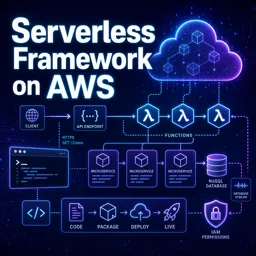
Define the function, provider, and events in serverless.yml, then run serverless deploy to create the AWS resources.

Duration of the online course: 5 hours and 54 minutes
New
Deploy AWS Lambda apps faster with a free Serverless Framework course—set up CLI, test APIs locally, and ship to AWS with confidence.
Build modern cloud backends without babysitting servers. In this free online course, you will learn how to develop, test, and deploy serverless applications on AWS using the Serverless Framework, a toolset that streamlines infrastructure setup and makes AWS Lambda projects easier to maintain as they grow. Instead of wiring services manually in the console, you will work with configuration-driven deployments that encourage repeatability, cleaner environments, and quicker iteration.
You will start by setting up the essentials the right way: creating AWS credentials for programmatic access, configuring the AWS CLI with profiles, and installing the Serverless Framework to bootstrap projects quickly. From there, you will move from a first Lambda function to a complete workflow that includes running functions locally, invoking them on demand, emulating HTTP endpoints with offline tooling, and validating behavior before pushing changes to the cloud. This approach helps you reduce deployment friction, spot errors earlier, and keep your feedback loop fast.
As you advance, the course connects your functions to API Gateway so you can build real endpoints and test them using common tools such as Postman. You will also learn how deployments are managed through CloudFormation and how to cleanly remove stacks when environments are no longer needed, a practical skill for controlling costs and keeping AWS accounts organized. Along the way, you will gain clarity on HTTP APIs versus REST APIs and how handler patterns affect the way your Lambda functions respond.
A major focus is configuration and secrets management. You will work with variables and nested variables in serverless YAML, reference values from JSON config files, and pull sensitive settings from AWS Systems Manager Parameter Store. By learning environment variable strategies, including safe type conversion, you can ship the same code across dev, staging, and production with minimal changes and fewer surprises.
Finally, you will integrate AWS DynamoDB to implement CRUD-style serverless backends. You will explore how tables are structured with partition and sort keys, how secondary indexes change access patterns, and why query operations differ from scan operations when performance matters. You will also touch on DynamoDB Streams to react to data changes and connect serverless events to downstream actions. By the end, you will have the confidence to build deployable, scalable AWS serverless APIs using real-world patterns and workflows.

Explore free online Serverless courses designed to help you master cloud-native development, serverless architecture, AWS Lambda, Azure Functions, APIs, and scalable applications. Learn at your own pace, build practical skills, and earn a certificate with every course to strengthen your resume and advance your cloud computing career.

Explore the best free online Lambda courses and build practical skills in lambda functions, functional programming, and AWS Lambda serverless computing. Learn at your own pace through beginner-friendly lessons, hands-on projects, and expert-led training. Enroll today, complete a course for free, and earn a certificate to showcase your new Lambda skills.
Explore free online AWS courses with certificates and build practical cloud computing skills at your own pace. Learn Amazon Web Services fundamentals, cloud architecture, storage, security, networking, DevOps, and deployment through flexible training designed for beginners and professionals seeking career-ready AWS expertise.

Explore the best free online Postman courses and learn API testing, development, automation, collections, environments, and REST workflows at your own pace. Build practical skills with beginner-friendly lessons and hands-on projects, then earn a certificate to showcase your Postman expertise and advance your software career.

5 hours and 54 minutes of online video course

Digital certificate of course completion (Free)

Exercises to train your knowledge

100% free, from content to certificate
How do I deploy an AWS Lambda function using the Serverless Framework?
Define the function, provider, and events in serverless.yml, then run serverless deploy to create the AWS resources.
What is the difference between DynamoDB Query and Scan in a serverless application?
Query retrieves items using key conditions and is more efficient; Scan examines every item in the table.
How can a Serverless Framework project use secrets from AWS SSM Parameter Store?
Reference the SSM parameter in serverless.yml and grant the Lambda execution role permission to read it.
Ready to get started?Download the app and get started today.
Install the app now
to access the course
Over 5,000 free courses
Programming, English, Digital Marketing and much more! Learn whatever you want, for free.

Study plan with AI
Our app's Artificial Intelligence can create a study schedule for the course you choose.

From zero to professional success
Improve your resume with our free Certificate and then use our Artificial Intelligence to find your dream job.
You can also use the QR Code or the links below.



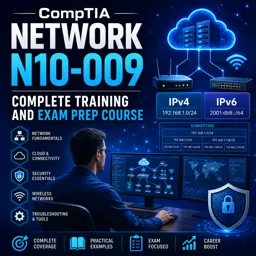
Free CourseCompTIA Network N10-009 Complete Training and Exam Prep Course
5

(1)

12h54m

43 exercises
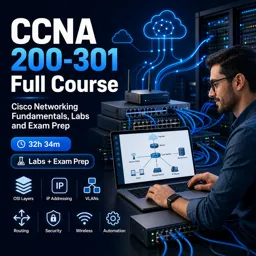
Free CourseCCNA 200-301 Full Course: Cisco Networking Fundamentals, Labs and Exam Prep
5
(2)
32h34m
46 exercises
Free CourseComputer Networking
5
(4)
4h01m
40 exercises
Free CourseNetworking Fundamentals
5
(1)
3h25m
15 exercises
Free CourseFoundations of IT support
5
(6)
4h48m
11 exercises
Free CourseWindows server 2012
5
(26)
9h15m
29 exercises
Free CourseActive Directory
5
(22)
14h51m
36 exercises
Free CourseCloud computing - beginner to advance
4.9
(17)
51h10m
5 exercises
Free CourseMicrosoft Azure Fundamentals (AZ-900) Full Course
4.9
(7)
7h15m
30 exercises
Free CourseCCNA 200-301 complete
4.8
(34)
44h20m
24 exercises
Carry knowledge in your pocket.
Download the Cursa app.
There are hundreds of free courses available, with a free certificate of completion that is saved in your mobile image gallery.
Download the app to access the Course Completion Certificate for Free.


+ 10 million
students

Free and Valid
Certificate

60 thousand free
exercises

4.8/5 rating in
app stores

Free courses in
video and ebooks