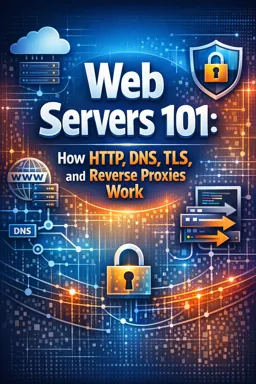

Free ebook explaining how DNS, TCP, HTTP, TLS, reverse proxies, and load balancing deliver web pages from URL to browser.
Free ebook content
-

The Web Request/Response Lifecycle From URL to Page Render
+ Exercise: In a typical page load, why might changing only the URL fragment (for example, moving from a page to #section) not trigger a network request?
-
URLs and Origins: Scheme, Host, Port, Path, Query, and Fragments
+ Exercise: A browser loads https://example.com/page and runs JavaScript that fetches https://example.com:8443/data. Which statement best describes the relationship between these two URLs in terms of origin?
-
DNS Resolution: How Names Become IP Addresses
+ Exercise: Why can a DNS change to an A record appear to propagate gradually even after the authoritative zone is updated?


-
TCP Connections and Ports: Getting a Reliable Channel to the Server
+ Exercise: A client runs nc -vz server.example 443 and the result is connection refused. What is the most likely meaning of this outcome?
-
HTTP Messages: Methods, Status Codes, Headers, and Bodies
+ Exercise: When an API creates a new resource successfully, which response pattern best helps the client find the new resource?
-
Keep-Alive and Connection Reuse: Reducing Latency Across Requests
+ Exercise: Why does reusing an existing HTTP connection typically reduce latency when loading a page with many resources?
-
HTTPS and TLS: Encrypting Traffic and Preventing Tampering
+ Exercise: Which scenario best describes how TLS provides integrity to prevent undetected tampering of HTTPS traffic?
-
Certificates and Trust Chains: How Browsers Validate Identity
+ Exercise: A site works in some browsers but fails in others with errors suggesting it cannot build a chain to a trusted issuer. Which server-side change is the most appropriate fix?
-
TLS Handshake in Words: Key Exchange, Session Keys, and SNI
+ Exercise: In a typical TLS 1.3 connection using ECDHE, what is the primary role of the server certificate during the handshake?
-
Reverse Proxies: Front Doors for Web Servers and Applications
+ Exercise: In a reverse proxy setup, what is a key benefit of having one public entry point in front of multiple upstream services?
-
Load Balancing Patterns: Distributing Traffic and Handling Failures
+ Exercise: An API has a mix of very fast requests and occasional slow ones, causing some servers to stay busy longer than others. Which load balancing pattern best helps reduce this imbalance by sending new requests to the backend with the fewest active requests?
-
End-to-End Walkthrough: What Happens When You Type a URL
+ Exercise: When a page feels slow before any content appears, what is a likely cause described in the walkthrough?
-
Practical Troubleshooting: Using curl, dig, and Browser DevTools to Debug
+ Exercise: When an API call fails in the browser but works with curl, what is the most effective next step to isolate a likely browser-only cause?
About the free ebook
Web Servers 101: How HTTP, DNS, TLS, and Reverse Proxies Work
This free ebook explains the systems that turn a typed web address into a rendered page. Follow the path from a URL through DNS lookup, network connections, HTTP exchanges, encryption, and application infrastructure.
Understand the web request path
Learn how URL components define a destination, how DNS translates hostnames into IP addresses, and how TCP provides a reliable connection to the right server port. The ebook makes HTTP practical by examining methods, status codes, headers, request bodies, and response bodies.
See how HTTPS establishes trust
Explore what TLS protects, how certificates and trust chains help browsers validate a server's identity, and how a TLS handshake creates session keys for encrypted traffic. It also clarifies the role of SNI when multiple secure sites share an IP address.
Learn what happens behind the front door
Discover why reverse proxies sit in front of applications, how they route requests, terminate TLS, and support load-balancing strategies. Understand connection reuse, failure handling, and the trade-offs that affect speed and resilience.
Build troubleshooting confidence
A practical end-to-end walkthrough connects each layer of the request lifecycle. Use curl, dig, and browser developer tools to investigate DNS results, HTTP behavior, certificates, redirects, headers, and common delivery problems.
Who this ebook helps
- Developers diagnosing web application connectivity issues
- Cloud and infrastructure learners studying web-server architecture
- Technical professionals who need a clear mental model of browser-to-server communication
What happens after a browser looks up a domain name in DNS?
The browser connects to an IP address, usually over TCP, then sends an HTTP or HTTPS request to the server.
How does TLS protect an HTTPS connection?
TLS validates the server certificate and establishes encrypted session keys that protect data from interception or tampering.
What is the difference between a reverse proxy and a load balancer?
A reverse proxy receives requests for backend services; it can also load balance traffic across multiple application servers.
This ebook includes:

13 content chapters

Digital certificate of course completion (Free)

Exercises to train your knowledge

100% free, from content to certificate
Ready to get started?

 recommended
In the app you will also find...

Over 5,000 free courses
Programming, English, Digital Marketing and much more! Learn whatever you want, for free.

Study plan with AI
Our app's Artificial Intelligence can create a study schedule for the course you choose.

From zero to professional success
Improve your resume with our free Certificate and then use our Artificial Intelligence to find your dream job.
You can also use the QR Code or the links below.