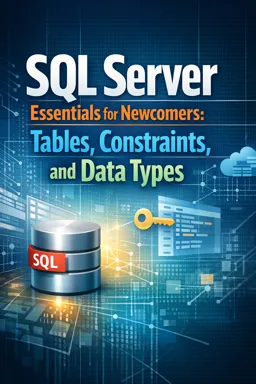

Free ebook on SQL Server tables, data types, keys, constraints, defaults, and practical database design for newcomers.
Free ebook content
-

SQL Server Essentials: Working with Databases, Schemas, and Tables
+ Exercise: Why is it recommended to use explicit schema qualification (schema.table) when creating and referencing tables in SQL Server?
-
SQL Server Data Types: Choosing the Right Column Types
+ Exercise: You need to store user action timestamps across time zones and preserve the original UTC offset at the moment of capture. Which SQL Server type best fits this requirement?
-
Identity Columns and Keys in SQL Server Tables
+ Exercise: You insert a new row into a table that has an IDENTITY primary key, and your application must reliably get the generated key even with triggers and concurrent activity. Which approach best fits this requirement?


-
Constraints in SQL Server: Enforcing Reliable Data
+ Exercise: In SQL Server, what is the default behavior of a FOREIGN KEY when you try to delete a parent row that still has related child rows?
-
Default Values and Computed Columns in SQL Server
+ Exercise: When will SQL Server apply a DEFAULT constraint value to a column during an INSERT?
-
Tooling Basics for SQL Server: SSMS and Azure Data Studio Workflows
+ Exercise: When testing table changes or data modifications while learning, which workflow best reduces the risk of leaving unintended changes in the database?
-
Putting It Together: Designing a Robust SQL Server Table Set
+ Exercise: Why is UnitPrice stored on the OrderItem table instead of always joining to Product for the current price?
About the free ebook
SQL Server Essentials for Newcomers: Tables, Constraints, and Data Types
Build a practical foundation in SQL Server database design with this free ebook for aspiring developers, analysts, and database learners. Learn how well-designed tables protect data quality, support meaningful queries, and make future changes easier to manage.
Design tables with purpose
Explore how databases, schemas, and tables work together to organize information. The ebook explains how to translate real-world entities into columns and rows while choosing clear names and a structure that remains understandable as an application grows.
Select data types carefully
Column data types affect storage, validation, accuracy, and query behavior. Understand common SQL Server choices for text, integers, decimals, dates, times, and logical values. You will also learn why selecting a type based on the intended data matters more than choosing the largest available option.
Protect data with keys and constraints
Reliable databases enforce rules where the data lives. Discover how primary keys, identity columns, foreign keys, unique constraints, check constraints, and NOT NULL requirements prevent incomplete, duplicate, or invalid records. The ebook clarifies the distinct role of each feature and how they work together.
Use defaults and computed values effectively
Reduce repetitive data entry with default values and derive useful values with computed columns. These features can make inserts more consistent while keeping calculation rules close to the table design.
Work with SQL Server tools
Get oriented with SQL Server Management Studio and Azure Data Studio workflows for creating, inspecting, and testing database objects. The focus is on practical habits that help you review table definitions and verify that design rules behave as intended.
Apply the concepts to a connected design
Finish with a cohesive table-set design exercise that brings together column choices, relationships, keys, constraints, defaults, and computed columns. By the end, you will be better prepared to create SQL Server tables that are accurate, maintainable, and ready for real applications.
What is the difference between an identity column and a primary key in SQL Server?
An identity column generates numeric values automatically; a primary key uniquely identifies each row. An identity column is often used as a primary key, but they are separate features.
Which SQL Server data type should be used for currency values?
Use decimal or numeric with an appropriate precision and scale for most monetary values to avoid floating-point rounding issues.
How do SQL Server constraints improve data quality?
Constraints enforce rules such as required values, uniqueness, valid ranges, and valid relationships before invalid data is stored.
This ebook includes:

7 content chapters

Digital certificate of course completion (Free)

Exercises to train your knowledge

100% free, from content to certificate
Ready to get started?

 recommended
In the app you will also find...

Over 5,000 free courses
Programming, English, Digital Marketing and much more! Learn whatever you want, for free.

Study plan with AI
Our app's Artificial Intelligence can create a study schedule for the course you choose.

From zero to professional success
Improve your resume with our free Certificate and then use our Artificial Intelligence to find your dream job.
You can also use the QR Code or the links below.