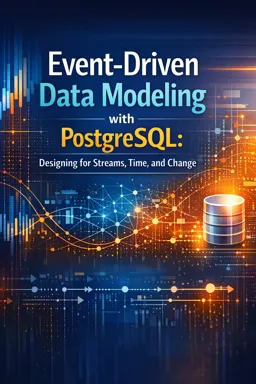

Free ebook on event-driven data modeling with PostgreSQL, covering event streams, temporal queries, projections, and reliable pipelines.
Free ebook content
-

Event-Driven Thinking for Database Design
+ Exercise: In an event-driven database model, what is the primary purpose of keeping an append-only event log alongside a derived current-state table?
-
Modeling Append-Only Event Tables in PostgreSQL
+ Exercise: Which approach best enforces an append-only event table in PostgreSQL so that history is preserved and changes are made by new facts?
-
Idempotency, Deduplication, and Exactly-Once Effects
+ Exercise: Which approach best ensures exactly-once effects when an event may be delivered multiple times to a PostgreSQL consumer that applies a balance delta?
-
Time, Sequence, and Ordering Guarantees in Event Streams
+ Exercise: In a PostgreSQL event table, which design best supports deterministic per-entity replay under clock skew and out-of-order arrival?
-
Designing Event Payloads with JSONB and Typed Columns
+ Exercise: In a hybrid event table design, why would you promote a frequently queried JSONB field into a typed generated column?


-
Partitioning Strategies for High-Volume Event Data
+ Exercise: Which query pattern is most likely to enable effective partition pruning on a time-partitioned events table?
-
Indexing for Temporal Queries and Stream Reads
+ Exercise: When optimizing a stream read that fetches the next page after a cursor for a specific stream_id, which index strategy best supports stable ordering and efficient keyset pagination?
-
Querying Historical State and Point-in-Time Views
+ Exercise: For reproducible audits, which as-of definition is recommended because it stays stable even when late events arrive?
-
Building Read Models with Projections and Materialized Views
+ Exercise: Which scenario is the best fit for using a PostgreSQL materialized view instead of an incremental projection when building a read model?
-
Maintaining Projections with Incremental and Replayable Processing
+ Exercise: Which design choice most directly makes incremental projection updates safe against gaps or double-processing when failures occur?
-
Schema Evolution for Events and Backward-Compatible Change
+ Exercise: You need to rename an event payload field from customerId to customer_id without breaking older consumers. Which rollout best preserves backward compatibility?
-
Auditing, Traceability, and Data Lineage from Operational Events
+ Exercise: In an event-driven system, what best supports traceability for a current value stored in a derived read model table?
-
Outbox Pattern and Logical Replication for Reliable Pipelines
+ Exercise: What is the main reliability benefit of writing an outbox event row in the same PostgreSQL transaction as the domain change?
-
Analytics-Ready Event Data and Operational-to-Analytical Flows
+ Exercise: Which design choice best makes event data analytics-ready for consistent aggregation and joining over time?
-
Capstone: Implementing an Event-Sourced Domain with Replayable History and Performant Read Models
+ Exercise: Which approach best enables replaying a projection without downtime while continuing to serve consistent reads?
About the free ebook
Event-Driven Data Modeling with PostgreSQL
This free ebook explores how to design PostgreSQL databases for systems where change is recorded as a stream of durable events. Learn to preserve history, model evolving business facts, and build reliable read models without losing the operational context behind each update.
Design for change, replay, and traceability
Rather than treating the latest row value as the whole story, event-driven modeling captures what happened, when it happened, and why. The ebook explains append-only event tables, event identity, idempotent writes, deduplication, ordering, and the practical meaning of exactly-once effects.
You will examine ways to combine JSONB payloads with typed columns so event data remains flexible, queryable, and resilient to schema change. It also covers partitioning and indexing choices for high-volume streams, temporal queries, and efficient access to historical state.
Turn event streams into useful application views
Event storage is only one part of the architecture. This ebook shows how projections, materialized views, and replayable processors can create fast read models from an immutable history. It discusses incremental maintenance, rebuilding projections safely, and choosing consistency boundaries for operational applications.
Build dependable data pipelines
Learn how auditing, lineage, the outbox pattern, and logical replication support reliable delivery of database changes to downstream systems. The material also connects operational event streams to analytics-ready data flows while keeping events understandable over time.
A practical PostgreSQL-focused approach
- Model event tables that retain a trustworthy record of change.
- Query point-in-time state and historical timelines.
- Plan backward-compatible event schema evolution.
- Implement an event-sourced domain with performant read models.
By the end, you will have a practical framework for using PostgreSQL as a foundation for event-driven applications that need history, scalability, and dependable data movement.
How do append-only event tables work in PostgreSQL?
They store each business change as a new immutable row, preserving the full sequence of events instead of overwriting prior state.
How can PostgreSQL prevent duplicate event processing?
Use stable event IDs, unique constraints, transactional writes, and idempotent projection logic to make retries safe.
What is the outbox pattern in PostgreSQL?
It writes an application change and an outbound event in the same transaction, enabling reliable downstream publication.
This ebook includes:

15 content chapters

Digital certificate of course completion (Free)

Exercises to train your knowledge

100% free, from content to certificate
Ready to get started?

 recommended
In the app you will also find...

Over 5,000 free courses
Programming, English, Digital Marketing and much more! Learn whatever you want, for free.

Study plan with AI
Our app's Artificial Intelligence can create a study schedule for the course you choose.

From zero to professional success
Improve your resume with our free Certificate and then use our Artificial Intelligence to find your dream job.
You can also use the QR Code or the links below.