
Use DISTINCT, for example: SELECT DISTINCT state FROM customers;

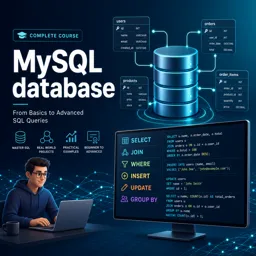
Duration of the online course: 3 hours and 40 minutes
4.7


(133)
Build real MySQL skills fast with this free online course: write SQL queries, filter and join tables, and practice for a certificate-ready portfolio.
Knowing how to work with databases is a core skill in technology, whether you aim to become a developer, analyst, QA, or build your own product. This free online course helps you move from curiosity to confidence with MySQL, one of the most widely used relational database systems in the world. You will learn how databases are organized, why keys matter for data integrity, and how to set up a MySQL server so you can practice with a real environment from the start.
As you progress, you will gain the practical SQL abilities that employers and real projects rely on. You will learn how to explore a database, retrieve the information you need with SELECT, and apply rules that keep your statements clear and correct. From there, you will sharpen your query results by choosing the right columns, removing duplicates, limiting output, and sorting data to reveal patterns that are otherwise hidden.
The course also focuses on how to ask better questions of your data. You will practice filtering with WHERE, combining conditions with AND and OR, and using grouping logic that prevents mistakes. Searching becomes more powerful as you work with wildcards, pattern matching, and regular expressions to handle real-world text data. You will also learn to create custom outputs using expressions and functions, including aggregate functions that help summarize large datasets into meaningful insights.
To go beyond single tables, you will understand how to connect information properly using joins, including outer joins for scenarios where some records may not match. You will work with subqueries to solve questions step by step, and combine results using UNION when appropriate. You will also learn efficient approaches for searching text with full-text search features, a valuable skill for building search-driven applications.
Finally, you will strengthen your foundation in data manipulation and structure by practicing inserting, updating, and deleting records safely. You will understand how tables are created and modified with constraints such as NOT NULL and AUTO INCREMENT, and how to maintain a database over time using operations like alter, drop, and rename. The result is a solid MySQL toolkit you can apply immediately in projects, interviews, and everyday work with data.

3 hours and 40 minutes of online video course

Digital certificate of course completion (Free)

Exercises to train your knowledge

100% free, from content to certificate
How do I retrieve unique values from a column in MySQL?
Use DISTINCT, for example: SELECT DISTINCT state FROM customers;
What is the difference between a LEFT OUTER JOIN and an INNER JOIN in MySQL?
An INNER JOIN returns matching rows only; a LEFT OUTER JOIN also includes all rows from the left table.
How do I add a new column to an existing MySQL table?
Use ALTER TABLE, for example: ALTER TABLE customers ADD COLUMN phone VARCHAR(20);
Ready to get started?Download the app and get started today.
Install the app now
to access the course
Over 5,000 free courses
Programming, English, Digital Marketing and much more! Learn whatever you want, for free.

Study plan with AI
Our app's Artificial Intelligence can create a study schedule for the course you choose.

From zero to professional success
Improve your resume with our free Certificate and then use our Artificial Intelligence to find your dream job.
You can also use the QR Code or the links below.



Free CourseSQL Database Programming
5
(2)

4h28m

24 exercises

Free CourseLearn to use Google BigQuery for Beginners
5
(2)
1h17m
14 exercises
Free CourseDatabase Systems: SQL, Indexing, Query Optimization, Transactions and Distributed Databases
5
(1)
33h54m
23 exercises
Free CourseProgramming Databases
5
(3)
1h14m
7 exercises
Free CourseMongoDB Database
5
(4)
1h27m
10 exercises
Free CourseDatabase Management Systems
5
(11)
5h21m
27 exercises
Free CourseDatabase Systems
5
(2)
4h32m
44 exercises

Free CourseMongoDB Tutorial for Beginners
5
(1)
1h39m
14 exercises
Free CourseMySQL
5
(4)
1h11m
10 exercises

Free CourseMongoDB
5
(2)
36m
5 exercises
Carry knowledge in your pocket.
Download the Cursa app.
There are hundreds of free courses available, with a free certificate of completion that is saved in your mobile image gallery.
Download the app to access the Course Completion Certificate for Free.


+ 10 million
students

Free and Valid
Certificate

60 thousand free
exercises

4.8/5 rating in
app stores

Free courses in
video and ebooks
Course comments: MySQL database
Students found the free course excellent, clear, and easy to follow. They described it as a perfect basic introduction to SQL, praised the professor’s explanations, and said they learned new things without confusion.
Eze precious
I'm happy
VEDANT RANE
.
Jose Amandio de Almeida
This Course is the Best
Abdul Makdoom
nice
Nimisha Pravin Telang
the perfect basic course
Bollu Shylendra
good
mebankmen khongmalai
it is a great help for me i learnt new things from this course
Akash Palvalsa
Fast and Excellent course. Bucky was great in explaining every concept without creating any confusion . Overall it's a quick and easy course for everyone to learn SQL database.