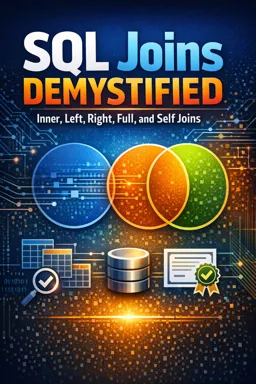
Use a JOIN clause, such as INNER JOIN, with an ON condition that matches the related columns in both tables.

Duration of the online course: 1 hours and 14 minutes
New
Build job-ready database skills with a free online course in T-SQL—write queries, join tables, group results, and confidently manage relational data.
Strong database skills open doors in software development, data analytics, and IT support. This free online course helps you move from basic curiosity to practical confidence by teaching you how relational databases work and how to program them using Transact-SQL (T-SQL). You will learn to think in tables, relationships, and rules that keep data accurate, consistent, and easy to retrieve as systems grow.
You start by understanding what an RDBMS is and how to set up the environment so you can practice in a realistic workflow. From there, you explore why normalization matters and how good structure reduces duplication, prevents update errors, and makes reporting more reliable. Instead of treating databases like spreadsheets, you will develop the relational mindset: using keys, relationships, and constraints to model real scenarios cleanly.
As your SQL foundation develops, you practice writing queries that return exactly what you need, including sorting and filtering results for clarity. You then learn how to combine information across multiple tables using joins, an essential skill for producing meaningful views of real-world data. Once comfortable with multi-table thinking, you level up by writing subqueries, allowing you to solve more complex questions and build queries that adapt to changing conditions.
The course also shows you how to summarize and analyze data with functions and GROUP BY, so you can generate totals, counts, and time-based insights that are common in business dashboards and reports. Finally, you learn how to modify data responsibly with T-SQL, including concepts like identity columns for reliable record creation. By the end, you will be prepared to write clearer queries, understand database design decisions, and work more effectively with SQL-based systems in professional projects.

1 hours and 14 minutes of online video course

Digital certificate of course completion (Free)

Exercises to train your knowledge

100% free, from content to certificate
How do I join two tables in Transact-SQL using a common field?
Use a JOIN clause, such as INNER JOIN, with an ON condition that matches the related columns in both tables.
What does database normalization do in a relational database?
Normalization organizes data into related tables to reduce duplication and improve data consistency.
What is the IDENTITY keyword used for when creating a SQL Server table?
IDENTITY automatically generates sequential numeric values, commonly for a table's primary key column.
Ready to get started?Download the app and get started today.
Install the app now
to access the course
Over 5,000 free courses
Programming, English, Digital Marketing and much more! Learn whatever you want, for free.

Study plan with AI
Our app's Artificial Intelligence can create a study schedule for the course you choose.

From zero to professional success
Improve your resume with our free Certificate and then use our Artificial Intelligence to find your dream job.
You can also use the QR Code or the links below.



Free CourseSQL Database Programming
5

(2)

4h28m

24 exercises
Free CourseLearn to use Google BigQuery for Beginners
5
(2)
1h17m
14 exercises
Free CourseDatabase Systems: SQL, Indexing, Query Optimization, Transactions and Distributed Databases
5
(1)
33h54m
23 exercises
Free CourseMongoDB Database
5
(4)
1h27m
10 exercises
Free CourseDatabase Management Systems
5
(11)
5h21m
27 exercises
Free CourseDatabase Systems
5
(2)
4h32m
44 exercises
Free CourseMongoDB Tutorial for Beginners
5
(1)
1h39m
14 exercises
Free CourseMySQL
5
(4)
1h11m
10 exercises
Free CourseMongoDB
5
(2)
36m
5 exercises
Free Course PosgresSQL
4.8

(12)
4h14m
37 exercises
Carry knowledge in your pocket.
Download the Cursa app.
There are hundreds of free courses available, with a free certificate of completion that is saved in your mobile image gallery.
Download the app to access the Course Completion Certificate for Free.


+ 10 million
students

Free and Valid
Certificate

60 thousand free
exercises

4.8/5 rating in
app stores

Free courses in
video and ebooks