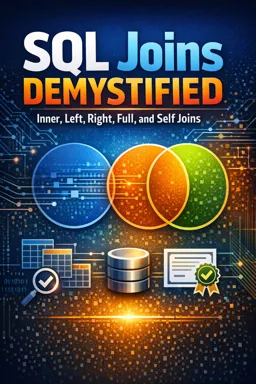
The selection operator (σ) filters tuples in a relation according to a specified predicate.

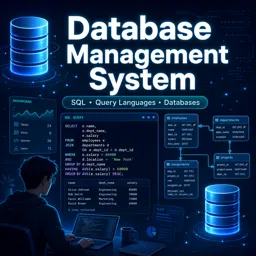
Duration of the online course: 9 hours and 50 minutes
5

(1)
Build job-ready SQL and DBMS skills with a free online course—master relational algebra, joins, aggregates, and write clean queries with confidence.
Strong database skills are one of the fastest ways to level up in technology and programming, whether you are preparing for competitive exams, aiming for a backend role, or simply trying to write better data-driven applications. This free online course in Database Management System helps you move from knowing basic SQL commands to truly understanding how queries work, why they work, and how to reason about results with precision.
You will start by building a clear foundation in query languages through the lens of relational algebra. Instead of memorizing symbols, you will learn how common operations translate into real outcomes on tables, including selecting tuples under specific conditions, combining relations, and recognizing which operations are fundamental versus derived. This way of thinking trains you to break down any problem into smaller, reliable steps, a skill that is valuable in both interviews and production work.
As the course progresses, you shift naturally into SQL and connect theoretical understanding to practical querying. You will learn how to create table structures, write readable queries, and avoid common mistakes when filtering and aggregating data. You will also get comfortable with important details such as when aggregates belong in HAVING instead of WHERE, why aliases matter, and how GROUP BY keeps a query valid when you select non-aggregated attributes alongside aggregate functions.
To make the learning stick, the exercises challenge you to interpret queries and choose the correct approach in realistic scenarios. You will practice understanding joins and their effects, including the difference between inner and outer joins, and tackle more advanced question styles such as finding the latest hires per department under a location constraint. By the end, you will be able to read complex query statements with confidence, write accurate SQL for multi-table problems, and think like a database professional.

9 hours and 50 minutes of online video course

Digital certificate of course completion (Free)

Exercises to train your knowledge

100% free, from content to certificate
What relational algebra operation selects tuples that meet a condition?
The selection operator (σ) filters tuples in a relation according to a specified predicate.
How does an outer join differ from an inner join in relational algebra?
An inner join returns only matching tuples, while an outer join also retains nonmatching tuples with null values for missing attributes.
How can SQL return the latest-hired employee in each department at a specific location?
Join Employees and Departments, filter by the location, and compare each hire date with the maximum hire date grouped by department.
Ready to get started?Download the app and get started today.
Install the app now
to access the course
Over 5,000 free courses
Programming, English, Digital Marketing and much more! Learn whatever you want, for free.

Study plan with AI
Our app's Artificial Intelligence can create a study schedule for the course you choose.

From zero to professional success
Improve your resume with our free Certificate and then use our Artificial Intelligence to find your dream job.
You can also use the QR Code or the links below.



Free CourseSQL Database Programming
5
(2)

4h28m

24 exercises

Free CourseLearn to use Google BigQuery for Beginners
5
(2)
1h17m
14 exercises
Free CourseDatabase Systems: SQL, Indexing, Query Optimization, Transactions and Distributed Databases
5
(1)
33h54m
23 exercises
Free CourseProgramming Databases
5
(3)
1h14m
7 exercises
Free CourseMongoDB Database
5
(4)
1h27m
10 exercises
Free CourseDatabase Management Systems
5
(11)
5h21m
27 exercises
Free CourseDatabase Systems
5
(2)
4h32m
44 exercises

Free CourseMongoDB Tutorial for Beginners
5
(1)
1h39m
14 exercises
Free CourseMySQL
5
(4)
1h11m
10 exercises

Free CourseMongoDB
5
(2)
36m
5 exercises
Carry knowledge in your pocket.
Download the Cursa app.
There are hundreds of free courses available, with a free certificate of completion that is saved in your mobile image gallery.
Download the app to access the Course Completion Certificate for Free.


+ 10 million
students

Free and Valid
Certificate

60 thousand free
exercises

4.8/5 rating in
app stores

Free courses in
video and ebooks