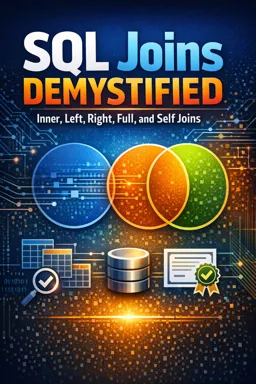
The course covers modern SQL, joins, sorting, query execution models, query planning, and optimizations such as predicate pushdown.

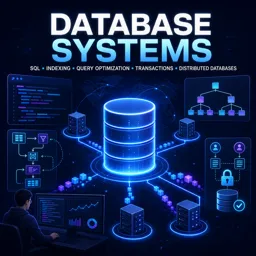
Duration of the online course: 33 hours and 54 minutes
New
Build real database skills: modern SQL, indexing, query optimization and transactions in a free online course with practical exercises and a certificate option.
Strong database knowledge is what turns basic CRUD into systems that stay fast, correct, and reliable under real-world load. This free online course helps you move beyond writing queries and into understanding how database engines actually work: how data is modeled, stored, found quickly with indexes, executed efficiently by the optimizer, and protected with transaction guarantees even when many users hit the system at once.
You will start with the relational model and the ideas that made it durable in industry, then connect those foundations to modern SQL used in production analytics and applications. From there, you will go under the hood to see why storage layout matters, why sequential access often beats random I/O, and how structures like log-structured merge trees and slotted pages shape performance characteristics. As you progress, you will learn how and why databases choose row or column formats, how memory and buffer management influence latency, and what tradeoffs appear when systems lean on the operating system versus owning their caching behavior.
Indexing and execution are treated as practical engineering topics: hash tables and tree indexes, what makes B+ trees effective for range scans, and how alternative structures such as inverted indexes or Bloom filters can accelerate specific workloads. You will also develop intuition for core operator algorithms like sorting and joins, then connect that to query execution models and parallel execution components used to scale out work across cores and machines. Along the way, exercises reinforce concepts so you can reason about why one plan is faster than another, not just memorize rules.
Correctness is as important as speed. The course explains concurrency control theory and brings it to life with two-phase locking, optimistic methods, and MVCC, showing how databases deliver isolation and consistent reads. You will then cover durability with write-ahead logging and recovery concepts, including how systems restore a consistent state after failures. Finally, you will explore distributed database architectures and replication patterns, learning the constraints and advantages of shared-disk versus shared-nothing designs and how transactional and analytical distributed systems make different tradeoffs.
By the end, you will be able to evaluate database behavior with an engineer’s mindset: predict bottlenecks, choose the right index strategy, understand what the optimizer is trying to do, and speak confidently about transactions, logging, and distributed designs in interviews and on the job.

33 hours and 54 minutes of online video course

Digital certificate of course completion (Free)

Exercises to train your knowledge

100% free, from content to certificate
What SQL and query optimization concepts are covered in this database systems course?
The course covers modern SQL, joins, sorting, query execution models, query planning, and optimizations such as predicate pushdown.
How does the course explain database indexes and storage engines?
It explores disk storage, buffer management, LSM trees, row versus column storage, hash tables, B+ trees, Bloom filters, and vector or inverted indexes.
Does the course cover transactions, recovery, and distributed databases?
Yes. Topics include two-phase locking, OCC, MVCC, write-ahead logging, ARIES recovery, replication, and distributed database architectures.
Ready to get started?Download the app and get started today.
Install the app now
to access the course
Over 5,000 free courses
Programming, English, Digital Marketing and much more! Learn whatever you want, for free.

Study plan with AI
Our app's Artificial Intelligence can create a study schedule for the course you choose.

From zero to professional success
Improve your resume with our free Certificate and then use our Artificial Intelligence to find your dream job.
You can also use the QR Code or the links below.



Free CourseSQL Database Programming
5

(2)

4h28m

24 exercises
Free CourseLearn to use Google BigQuery for Beginners
5
(2)
1h17m
14 exercises
Free CourseProgramming Databases
5
(3)
1h14m
7 exercises
Free CourseMongoDB Database
5
(4)
1h27m
10 exercises
Free CourseDatabase Management Systems
5
(11)
5h21m
27 exercises
Free CourseDatabase Systems
5
(2)
4h32m
44 exercises
Free CourseMongoDB Tutorial for Beginners
5
(1)
1h39m
14 exercises
Free CourseMySQL
5
(4)
1h11m
10 exercises
Free CourseMongoDB
5
(2)
36m
5 exercises
Free Course PosgresSQL
4.8

(12)
4h14m
37 exercises
Carry knowledge in your pocket.
Download the Cursa app.
There are hundreds of free courses available, with a free certificate of completion that is saved in your mobile image gallery.
Download the app to access the Course Completion Certificate for Free.


+ 10 million
students

Free and Valid
Certificate

60 thousand free
exercises

4.8/5 rating in
app stores

Free courses in
video and ebooks