
Free ebook explaining SQL inner, left, right, full, and self joins, including NULL handling, filters, duplicate rows, and query design.
Free ebook content
-

Join Mental Models: Rows, Keys, Matches, and Unmatched Records
+ Exercise: In a LEFT JOIN, where should you place a condition like order_total > 30 if you want to keep customers who have no orders?
-
Inner Join: Keeping Only Confirmed Matches
+ Exercise: Which result best describes what happens when you INNER JOIN orders to customers on customer_id?
-
Left Join: Preserving the Primary Table While Filling Missing Matches
+ Exercise: In a LEFT JOIN between customers (left) and tickets (right), where should you place a filter like t.status = open if you want to keep customers who have no tickets or no open tickets?
-
Right Join: Mirroring Left Join Reasoning from the Opposite Side
+ Exercise: In a RIGHT JOIN used to list all departments and show employees when they exist, how should you apply a filter so that departments with no matching employees are still included?
-
Full Join: Combining Matches with Both Sides’ Unmatched Rows
+ Exercise: In a reconciliation report built with a FULL OUTER JOIN between app_orders and invoices, what is a common reason to use COALESCE(a.order_id, b.order_id) as order_id?
-
Self Join: Relating a Table to Itself with Aliases and Clear Conditions
+ Exercise: When pairing employees in the same department using a self join, what condition best ensures the results exclude self-pairs and avoid mirrored duplicates like (A,B) and (B,A)?


-
Join Conditions: ON vs WHERE, Multi-Column Keys, and Null-Safe Thinking
+ Exercise: In a LEFT JOIN that should keep all rows from the left table, where should you place a filter on a column from the right table (for example, only PAID orders) to avoid removing unmatched left rows?
-
Reading Join Queries: From FROM and ON Clauses to Interpreting Results
+ Exercise: In a join query that links customers to orders and then to order_items, why is COUNT(DISTINCT o.order_id) often used when reporting orders_count per customer?
-
Join Order and Optimizer Realities: Avoiding Common Misconceptions
+ Exercise: Which statement best reflects how SQL join order relates to performance and execution in modern databases?
-
Handling Missing Matches: Defaults, COALESCE, and Filtering Without Accidental Inner Joins
+ Exercise: In a LEFT JOIN between customers and orders, you want to keep all customers but only attach orders with status PAID. Which approach best preserves customers who have no PAID orders?
-
Avoiding Duplicate Explosions: One-to-Many Traps, Pre-Aggregation, and De-Duping
+ Exercise: You need one row per order, but you must include metrics from order_items and payments, both of which can have multiple rows per order. What is the safest approach to avoid duplicated rows and inflated aggregates?
-
Progressive Scenarios: Translating Business Questions into Correct Join Patterns
+ Exercise: When building a query for one row per customer showing the most recent order date, what approach best avoids inflated row counts from joining raw orders?
About the free ebook
SQL Joins Demystified: Inner, Left, Right, Full, and Self Joins
This free ebook explains how SQL joins combine related data without relying on guesswork. Build a practical mental model for rows, keys, matches, and unmatched records, then apply it to queries that answer real business questions.
Understand what each join returns
Learn how INNER JOIN keeps confirmed matches, while LEFT JOIN, RIGHT JOIN, and FULL JOIN preserve unmatched rows from one or both sides. The ebook also clarifies self joins, aliases, and the conditions needed when a table relates to itself.
Write safer, more accurate join queries
Explore the difference between conditions in ON and WHERE, including why an incorrectly placed filter can turn an outer join into an unintended inner join. You will also work with multi-column keys, NULL values, COALESCE defaults, and filtering strategies for missing matches.
Avoid common data mistakes
Joins can create surprising results when relationships are one-to-many or when source tables contain duplicate keys. This ebook helps you recognize duplicate explosions, use pre-aggregation where appropriate, and interpret query results with confidence.
Turn questions into SQL patterns
Progressive scenarios show how to move from a business question to a correct join design. You will gain a clearer way to read FROM and ON clauses, reason about join order, and understand how database optimizers affect execution without changing the logical result.
- Compare matching and nonmatching records clearly
- Choose join types based on the result you need
- Protect outer joins from accidental filtering errors
- Diagnose duplicates before they distort reports
What is the difference between INNER JOIN and LEFT JOIN in SQL?
INNER JOIN returns only matching rows; LEFT JOIN also retains all rows from the left table.
Why can a WHERE clause remove rows from a LEFT JOIN result?
A WHERE filter on the right table can exclude NULL unmatched rows, effectively behaving like an inner join.
How do SQL joins create duplicate rows?
Duplicates occur when one row matches multiple rows in the joined table, especially in one-to-many relationships.
This ebook includes:

12 content chapters

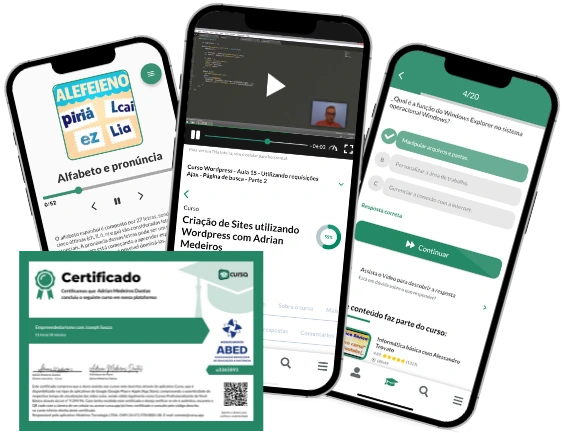
Digital certificate of course completion (Free)

Exercises to train your knowledge

100% free, from content to certificate
Ready to get started?

 recommended
In the app you will also find...

Over 5,000 free courses
Programming, English, Digital Marketing and much more! Learn whatever you want, for free.

Study plan with AI
Our app's Artificial Intelligence can create a study schedule for the course you choose.

From zero to professional success
Improve your resume with our free Certificate and then use our Artificial Intelligence to find your dream job.
You can also use the QR Code or the links below.