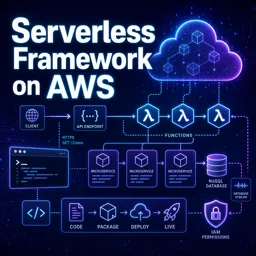

Free ebook on Azure Functions, event triggers, bindings, deployment, scaling, reliability, observability, and serverless cost control.
Free ebook content
-

Serverless on Azure with Azure Functions: Core Concepts and Function Apps
+ Exercise: You are deciding whether to keep multiple Azure Functions in one Function App or split them into separate Function Apps. Which situation most strongly suggests splitting into multiple Function Apps?
-
Azure Functions Project Structure and Local Development Workflow
+ Exercise: When an Azure Functions HTTP trigger is hard to unit test and tightly coupled to runtime types, which approach best improves testability while keeping the local development inner loop fast?


-
Triggers: Designing Event-Driven Entry Points (HTTP, Timer, Queue, Event Grid)
+ Exercise: You need to notify analytics, CRM, and a customer notification service when an order ships, ensuring each subscriber can receive the event independently. Which trigger best fits this fan-out requirement?
-
Bindings: Input/Output Integration Patterns Without Boilerplate
+ Exercise: When should you prefer using an Azure Functions binding instead of calling an SDK directly?
-
Configuration and Secrets: App Settings, Key Vault, and Managed Identity
+ Exercise: Which approach best keeps secrets out of an Azure Function App while still allowing the function code to read configuration by name?
-
Deployment Options: From Local to Azure with Repeatable Releases
+ Exercise: Which approach best supports repeatable production releases for Azure Functions by promoting the same build artifact across dev/test/prod with approvals and automated validation?
-
Scaling and Performance: Concurrency, Cold Starts, and Throughput Control
+ Exercise: When tuning a queue-triggered Azure Function to avoid overwhelming a downstream database, which approach best implements backpressure for predictable throughput?
-
Reliability by Design: Retries, Idempotency, Poison Messages, and Timeouts
+ Exercise: In an event-driven Azure Functions handler, how should malformed or schema-invalid events typically be handled to protect reliability?
-
Observability: Structured Logging, Metrics, Tracing, and Alerting
+ Exercise: In a serverless workflow that spans an HTTP-triggered function and a queue-triggered function, what is the preferred way to preserve an end-to-end distributed trace across both triggers?
-
Cost Awareness and Practical Use Cases: Webhooks, Schedulers, and Queue Processing
+ Exercise: In an HTTP webhook receiver built with Azure Functions, which approach best improves cost predictability while maintaining reliability when downstream systems are slow?
About the free ebook
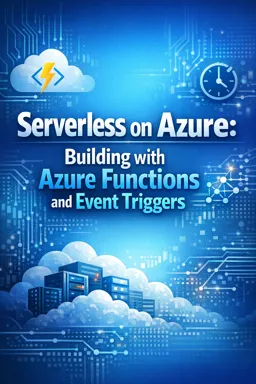
Serverless on Azure: Building with Azure Functions and Event Triggers
This free ebook explains how to build practical, event-driven cloud applications with Azure Functions. Learn how serverless architecture lets teams run code in response to requests, schedules, messages, and cloud events without managing traditional web servers.
Build function apps with confidence
Explore the foundations of Azure Functions, including function apps, project organization, local development, configuration, and deployment workflows. The material shows how to design HTTP endpoints and background processes that are portable, maintainable, and ready for repeatable releases.
Connect services through triggers and bindings
Understand how triggers start functions from HTTP requests, timers, queues, and Event Grid events. Learn how input and output bindings reduce integration boilerplate while connecting functions to Azure services and messaging workflows.
Design for secure, reliable operation
Discover practical approaches to application settings, Azure Key Vault, and managed identity so secrets are not embedded in code. The ebook also addresses retries, idempotency, poison messages, and timeout handling for workflows that must tolerate delivery failures and duplicate events.
Improve performance, visibility, and cost control
Learn how scaling behavior, concurrency, cold starts, and throughput limits affect serverless workloads. Use structured logging, metrics, tracing, and alerts to diagnose production behavior. Practical scenarios such as webhooks, scheduled jobs, and queue processing help connect Azure Functions concepts to real implementation decisions.
What you will be able to evaluate
- Which trigger best matches an event source or processing pattern
- How bindings simplify data movement between services
- How to protect configuration and authenticate to Azure resources
- How to balance reliability, responsiveness, and operational cost
Which Azure Functions triggers are covered in this ebook?
It covers HTTP, Timer, Queue, and Event Grid triggers for APIs, scheduled work, messaging, and cloud events.
How does the ebook address Azure Functions cold starts and scaling?
It explains concurrency, throughput control, scaling behavior, and design choices that affect startup latency.
How can Azure Functions securely access secrets and Azure services?
The ebook covers app settings, Azure Key Vault, and managed identity for safer configuration and authentication.
This ebook includes:

10 content chapters

Digital certificate of course completion (Free)

Exercises to train your knowledge

100% free, from content to certificate
Ready to get started?

 recommended
In the app you will also find...

Over 5,000 free courses
Programming, English, Digital Marketing and much more! Learn whatever you want, for free.

Study plan with AI
Our app's Artificial Intelligence can create a study schedule for the course you choose.

From zero to professional success
Improve your resume with our free Certificate and then use our Artificial Intelligence to find your dream job.
You can also use the QR Code or the links below.