
Free ebook on Go fundamentals: syntax, modules, slices, maps, structs, errors, testing, and goroutines for building clear, fast programs.
Free ebook content
-

Go Fundamentals: Setting Up the Go Toolchain and Writing Your First Program
+ Exercise: Which workflow best matches how modern Go projects should be set up and executed when you want dependencies tracked correctly?
-
Go Syntax Essentials: Variables, Types, Control Flow, and Functions
+ Exercise: In Go, why does a function like parsePort typically return (0, error) when validation fails?


-
Packages and Imports in Go: Organizing Code with Clear Boundaries
+ Exercise: Which statement best explains why a call to mathutil.divRound from package main fails to compile?
-
Go Modules: Dependencies, Versioning, and Reproducible Builds
+ Exercise: After you add a new third-party import to your Go code, what is the main purpose of running go mod tidy?
-
Slices and Arrays in Go: Working with Collections Safely and Efficiently
+ Exercise: In Go, why should you usually assign the result of append back to the slice variable (e.g., s = append(s, v))?
-
Maps in Go: Key-Value Data, Lookups, and Idiomatic Patterns
+ Exercise: In Go, why is the “comma ok” idiom useful when reading from a map like map[string]int?
-
Structs and Methods in Go: Modeling Data and Behavior
+ Exercise: In Go, why would you choose a pointer receiver for a method on a struct?
-
Interfaces in Go: Decoupling Code with Small, Focused Contracts
+ Exercise: Why is it recommended to define small, focused interfaces in Go (similar to io.Reader) instead of large “do-everything” interfaces?
-
Error Handling in Go: Returning Errors, Wrapping, and Clean Control Flow
+ Exercise: In Go, why should you wrap an underlying error using fmt.Errorf with %w instead of %v when adding context?
-
Testing and Tooling in Go: go test, Benchmarks, and Code Quality Checks
+ Exercise: In a table-driven Go test using t.Run inside a loop, why is the line "tc := tc" commonly added before calling t.Run?
-
Concurrency Basics in Go: Goroutines, Channels, and Synchronization Patterns
+ Exercise: In a bounded worker pool that uses jobs, results, and a done channel, what is the correct shutdown/closure responsibility to avoid leaks and double-close panics?
About the free ebook
Go (Golang) Fundamentals: Simple, Fast Programs for Beginners
Build a practical foundation in Go, the language designed for clear, efficient, and reliable software. This free ebook introduces the tools and habits used to create simple command-line programs and maintainable applications.
Write idiomatic Go from the start
Learn how to install and use the Go toolchain, create a first program, and work confidently with variables, types, functions, conditions, and loops. The ebook explains Go’s straightforward syntax while emphasizing readable code and explicit behavior.
Organize data and code effectively
Explore packages, imports, modules, and dependency management for reproducible builds. Practice using arrays, slices, maps, structs, and methods to model data safely. You will also see how small interfaces help separate responsibilities without unnecessary complexity.
Handle real program concerns
Go programs make errors explicit. Learn patterns for returning, checking, wrapping, and communicating errors clearly. The ebook also introduces testing with go test, benchmarks, and code-quality tooling so you can verify behavior as programs grow.
Use Go concurrency with purpose
Understand the essentials of goroutines, channels, and synchronization patterns. Learn when concurrent work can improve a program and how to coordinate tasks while avoiding common mistakes.
Prepare programs for production-style work
Bring the concepts together through practical guidance on project layout, configuration, and logging. By the end, you will have a solid starting point for building fast, understandable Go applications and continuing with larger projects.
What you will gain
- A working Go development setup and workflow
- Core language knowledge for writing clean programs
- Confidence with modules, collections, structs, interfaces, and errors
- Foundational testing and concurrency skills
- Practical organization patterns for application projects
How do Go modules make dependency builds reproducible?
Go modules record dependency versions in go.mod and checksums in go.sum, helping teams build with consistent dependencies.
What is the difference between a Go slice and an array?
An array has a fixed length, while a slice is a flexible view over an underlying array and can grow with append.
How are errors handled in Go programs?
Functions commonly return an error value that callers check explicitly; errors can also be wrapped to preserve context.
This ebook includes:

12 content chapters

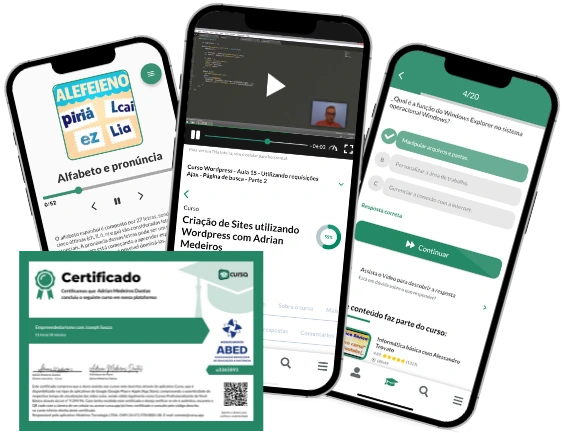
Digital certificate of course completion (Free)

Exercises to train your knowledge

100% free, from content to certificate
Ready to get started?

 recommended
In the app you will also find...

Over 5,000 free courses
Programming, English, Digital Marketing and much more! Learn whatever you want, for free.

Study plan with AI
Our app's Artificial Intelligence can create a study schedule for the course you choose.

From zero to professional success
Improve your resume with our free Certificate and then use our Artificial Intelligence to find your dream job.
You can also use the QR Code or the links below.