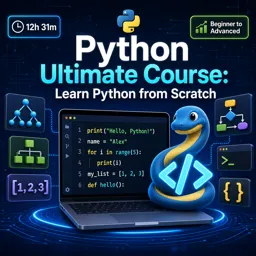
Free Course Image Python Ultimate Course: Learn Python from Scratch

Free online coursePython Ultimate Course: Learn Python from Scratch

Duration of the online course: 12 hours and 31 minutes

New

Free Python course with visual, beginner-friendly lessons on setup, syntax, control flow, data structures, and functions to build strong fundamentals.

In this free course, learn about

  • Getting Started with Python
  • Core Syntax: Variables, Input, and Data Types
  • Booleans and Control Flow Fundamentals
  • Loops and Iteration Patterns
  • Python Data Structures: Lists and Beyond
  • Functions and Arguments in Python

Course Description

Python Ultimate Course: Learn Python from Scratch is a free online course in Technology and Programming designed to take you from zero to confident Python fundamentals with clear, visual explanations. It focuses on building real understanding of how Python works, how to set up your environment, and how to think like a programmer from the start.

You begin with the essentials: what Python is, installing Python and VS Code, and writing your first lines of code using comments, print, variables, user input, data types, strings, and numbers. Along the way you learn practical text manipulation and math operations so you can confidently work with everyday programming tasks.

The course then strengthens your logic skills with control flow: booleans, comparisons, logical operators, membership checks, and conditional statements including concise one-line patterns and match-case. You also practice iteration thoroughly with for and while loops, plus control statements like break, continue, and pass, including lesser-known patterns such as for-else and nested loops.

Next, you build a solid foundation in Python data structures. You work deeply with lists and common list workflows like accessing, updating, ordering, copying safely, combining sequences, and using modern tools like zip, enumerate, map, and filter. You also learn iterables vs iterators, lambda expressions, and list comprehensions to write cleaner, more expressive code.

To round things out, the course covers tuples, sets, and dictionaries, and helps you choose the right structure for each situation. Finally, you learn how to write reusable code with functions, understand parameters and arguments, scope rules, positional vs keyword usage, default values, *args and **kwargs, and the important difference between returning values and printing output. If you want a structured, beginner-friendly path into Python, this course provides a clear progression from basics to core programming fluency.

Course content

  • Video class: What is Python (Visually Explained) | How It Works and How to Learn It | #Python Course 1 10m
  • Video class: How to Install Python and VS Code BONUS Roadmap! (Step-by-Step) | #Python Course 2 14m
  • Exercise: During Python installation, which option should you check to make running Python from the terminal easier?
  • Video class: Python Comments: Visually Explained | #Python Course 3 05m
  • Exercise: In Python, what happens to the text after the # symbol on a line of code?
  • Video class: Python Print Function: Visually Explained | #Python Course 4 21m
  • Exercise: Which escape sequence adds a new line in Python output when used inside print?
  • Video class: Python Variables: Visually Explained | #Python Course 5 13m
  • Exercise: In Python, what does the statement x = 2 do if x was previously set to 1?
  • Video class: Python Input Function: Visually Explained | #Python Course 6 09m
  • Exercise: What happens when Python executes input("Enter a value")?
  • Video class: Python Data Types: Visually Explained | #Python Course 7 30m
  • Exercise: What is the main purpose of data types in Python?
  • Video class: Python String Functions Explained | Text Manipulation 1h14m
  • Exercise: Which option correctly explains why the expression "Your age is: " + age can raise an error, and how to fix it?
  • Video class: Python Numbers Mastery | Math Functions, Round 28m
  • Exercise: Which statement correctly describes how Python handles numeric types and advanced math functions?
  • Video class: Python Control Flow: Visually Explained | #Python Course 10 07m
  • Exercise: What is the main purpose of control flow in Python?
  • Video class: Python Boolean Functions | bool, all, any, isinstance | #Python Course 11 08m
  • Exercise: Which built-in function returns True if at least one value in an iterable is truthy?
  • Video class: Python Comparison Operators (Visually Explained) | #Python Course 12 07m
  • Exercise: Which Python expression correctly checks whether age is between 18 and 30 (inclusive) using chained comparison?
  • Video class: Python Logical Operators (Visually Explained) | and, or, not, Execution Order | #Python Course 13 17m
  • Exercise: In Python, how can you ensure that the expression (is_logged_in or is_guest) is evaluated before checking that the user is not banned?
  • Video class: Python Membership 12m
  • Exercise: What does the Python identity operator is compare?
  • Video class: Python If Elif Else Statements (Visually Explained) | #Python Course 15 51m
  • Exercise: In Python, what does an if/elif/else chain do after it executes the first True condition?
  • Video class: Python If-Else One Line and Match-Case (Visually Explained) | #Python Course 16 14m
  • Exercise: Which statement about Python inline if (ternary) expressions is correct?
  • Video class: Python For Loops (Visually Explained) | #Python Course 17 23m
  • Exercise: In Python, what is the main purpose of a for loop?
  • Video class: Python Break vs Continue vs Pass (Visually Explained) | Control Statements | #Python Course 18 20m
  • Exercise: What is the main effect of using the Python break statement inside a loop?
  • Video class: Python For-Else Loop (Visually Explained) | Hidden Control Flow Trick | #Python Course 19 17m
  • Exercise: When does the else block of a for loop execute in Python?
  • Video class: Python Nested Loops are Easy | A Must-Have Skill for Data Engineers | #Python Course 20 16m
  • Exercise: In a nested for loop, when does Python move to the next iteration of the outer loop?
  • Video class: Python While Loops (Visually Explained) | For vs While Loops | #Python Course 21 28m
  • Exercise: What is the main advantage of using a while loop instead of a for loop in Python?
  • Video class: Introduction to Data Structures in Python (Visually Explained) | #Python Course 22 10m
  • Exercise: Which built-in Python data structure is described as an ordered and very flexible collection that can contain duplicates?
  • Video class: How to Create a List in Python (Visually Explained) | #Python Course 23 12m
  • Exercise: What happens when you pass a string into the built-in list() function in Python?
  • Video class: How to Access Lists in Python (Indexing 16m
  • Video class: Python Unpacking (Visually Explained) | Asterisk * and Underscore _ | #Python Course 25 17m
  • Exercise: In Python list unpacking, what does the asterisk (*) do when used in an assignment like: name, *details, country = person?
  • Video class: How to Explore 14m
  • Exercise: Which Python check returns True only when two list variables refer to the same object in memory (same identity)?
  • Video class: How to Add, Remove, and Update Lists in Python (Visually Explained) | #Python Course 27 23m
  • Exercise: Which method should you use to add a new item to the end of a Python list?
  • Video class: How to Order Lists in Python (Visually Explained) | sort(), sorted(), reverse() | #Python Course 28 10m
  • Exercise: Which approach creates a sorted copy of a list without changing the original list?
  • Video class: How to Copy Python Lists Safely (Visually Explained) | Shallow Copy vs Deepcopy | #Python Course 29 17m
  • Exercise: When copying a nested list (matrix) in Python, which approach creates a fully independent copy at all levels?
  • Video class: How to Combine Lists in Python | 4 Simple Ways and ZIP Visually Explained | #Python Course 30 10m
  • Exercise: What is the main purpose of Python’s zip() when combining multiple sequences?
  • Video class: Python Iterator vs Iterable (Visually Explained) | enumerate, map, filter | #Python Course 31 23m
  • Exercise: Which statement best describes what Python’s built-in map() returns when applied to a list?
  • Video class: Python Lambda Functions (Visually Explained) | #Python Course 32 15m
  • Exercise: What is a common use of lambda with map when transforming a list of prices like ["$12.50", "$9.99"] into numeric values?
  • Video class: Python List Comprehension (Visually Explained) | The Cleanest Way to Code | #Python Course 33 09m
  • Exercise: Which structure correctly represents a Python list comprehension that transforms items and filters them?
  • Video class: 30 Python List Operations in 5 Minutes | #Python Course 34 06m
  • Exercise: In Python lists, what is the key difference between indexing and slicing?
  • Video class: Python Tuples (Visually Explained) | #Python Course 35 08m
  • Exercise: Which Python data structure is best for storing values that must not change after creation (e.g., database server settings)?
  • Video class: Python Sets (Visually Explained) | #Python Course 36 18m
  • Exercise: Which set operation returns only the values that appear in both sets?
  • Video class: Python Dictionaries (Visually Explained) | #Python Course 37 27m
  • Exercise: Which statement best describes how a Python dictionary stores data?
  • Video class: Python Data Structures: When to Use List, Tuple, Set, Dict | #Python Course 38 03m
  • Exercise: Which data structure is best when data must be protected and not changed after creation?
  • Video class: Python Functions Made Simple (Visual Explanation) | #Python Course 39 18m
  • Exercise: What is the main benefit of using functions instead of copying and pasting the same logic multiple times?
  • Video class: Python Parameters vs Arguments (Explained Visually) | #Python Course 40 10m
  • Exercise: In Python functions, what is the correct relationship between parameters and arguments?
  • Video class: Python Parameters vs Global vs Local Variables (Visual Explanation) | #Python Course 41 10m
  • Exercise: Which statement correctly describes how global, local variables, and parameters behave in Python functions?
  • Video class: Python Positional vs Keyword Arguments Explained | Default Parameters | #Python Course 42 12m
  • Exercise: When mixing positional and keyword arguments in a Python function call, which rule must be followed?
  • Video class: Python *Args and **Kwargs Finally Make Sense | #Python Course 43 08m
  • Exercise: In Python functions, what is the main difference between *args and **kwargs?
  • Video class: Python Return Vs Print() (Visual Explanation) | #Python Course 44 11m
  • Exercise: In Python, what should you use if you want a function result to be reused later in the program?

This free course includes:

12 hours and 31 minutes of online video course

Digital certificate of course completion (Free)

Exercises to train your knowledge

100% free, from content to certificate

Ready to get started?Download the app and get started today.

Install the app now

to access the course
Icon representing technology and business courses

Over 5,000 free courses

Programming, English, Digital Marketing and much more! Learn whatever you want, for free.

Calendar icon with target representing study planning

Study plan with AI

Our app's Artificial Intelligence can create a study schedule for the course you choose.

Professional icon representing career and business

From zero to professional success

Improve your resume with our free Certificate and then use our Artificial Intelligence to find your dream job.

You can also use the QR Code or the links below.

QR Code - Download Cursa - Online Courses

More free courses at Programming Languages ( Python, Ruby, Java, C )

Free Ebook + Audiobooks! Learn by listening or reading!

Download the App now to have access to + 5000 free courses, exercises, certificates and lots of content without paying anything!

  • 100% free online courses from start to finish

    Thousands of online courses in video, ebooks and audiobooks.

  • More than 60 thousand free exercises

    To test your knowledge during online courses

  • Valid free Digital Certificate with QR Code

    Generated directly from your cell phone's photo gallery and sent to your email

Cursa app on the ebook screen, the video course screen and the course exercises screen, plus the course completion certificate