The usual sequence is source code, preprocessing, compilation, assembly, linking, and then generating the target executable or binary file.

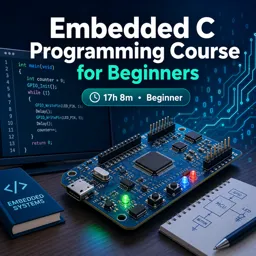
Duration of the online course: 17 hours and 8 minutes
4.5


(6)
Build real Embedded C skills fast with a free online course—learn compilation flow, data types, binary/hex, and work confidently with host vs target systems.
Embedded systems power the devices we rely on every day, and C remains the language at the center of that world. This free online course is designed for beginners who want a clear path from zero to confidently reading, writing, and reasoning about Embedded C code. Instead of assuming prior knowledge, it builds your foundation step by step so you can understand not only what to type, but why it works in real hardware-oriented workflows.
You will start by demystifying what a computer program actually is and how C code becomes machine-ready. Understanding the build flow matters in embedded work, where a small mistake in the toolchain can lead to confusing results. Along the way, you will gain practical clarity on standardization, file generation, and the difference between the host machine where you write code and the target machine where your program runs. You will also get oriented with the typical hardware and software setup used in embedded development and learn how IDE support fits into daily coding.
A strong embedded developer is comfortable thinking in bits, so this course makes number systems intuitive. You will practice binary, decimal, and hexadecimal conversions and learn how computers store values at the lowest level, including what fits inside common memory sizes such as 8-bit storage. This knowledge helps you prevent bugs related to overflow, representation limits, and data interpretation when working close to hardware.
From there, you will build solid C fundamentals tailored to embedded realities: comments and escape sequences, variables and naming rules, and the difference between local and global scope in a way that connects directly to reliability and maintainability. You will explore core data types such as char, int, and float, including how characters relate to ASCII and how floating-point bits are allocated. Finally, you will learn type casting so you can control conversions deliberately instead of letting hidden behavior create subtle defects.
By the end, you will have a practical mental model for how Embedded C programs are built and executed, plus the confidence to write clean beginner-level code that matches how embedded systems truly work.

Explore free online C and C++ courses designed for beginners and aspiring developers. Learn programming fundamentals, pointers, memory management, object-oriented programming, data structures, and more at your own pace. Build practical coding skills with expert-led lessons, and earn a certificate with every completed course.

Explore free online Programming Basics courses designed for beginners ready to learn coding. Build essential skills in programming concepts, logic, algorithms, variables, and problem-solving through flexible, self-paced lessons. Enroll at no cost, practice with beginner-friendly content, and earn a certificate to showcase your new programming skills.

17 hours and 8 minutes of online video course

Digital certificate of course completion (Free)

Exercises to train your knowledge

100% free, from content to certificate
What is the correct C build sequence for an embedded program?
The usual sequence is source code, preprocessing, compilation, assembly, linking, and then generating the target executable or binary file.
What is the maximum unsigned value that an 8-bit memory location can store?
An 8-bit unsigned value can store 255, because its binary range is 00000000 to 11111111.
How are the 32 bits of a C float typically allocated?
A standard IEEE 754 single-precision float uses 1 sign bit, 8 exponent bits, and 23 fraction (mantissa) bits.
Ready to get started?Download the app and get started today.
Install the app now
to access the course
Over 5,000 free courses
Programming, English, Digital Marketing and much more! Learn whatever you want, for free.

Study plan with AI
Our app's Artificial Intelligence can create a study schedule for the course you choose.

From zero to professional success
Improve your resume with our free Certificate and then use our Artificial Intelligence to find your dream job.
You can also use the QR Code or the links below.



Free CourseLearn Python
5
(3)

13h00m

17 exercises
Free CourseCreate Desktop App
5
(4)
5h33m
30 exercises
Free CourseRuby on Rails
5
(7)
9h39m
34 exercises
Free CourseJava Programming
5
(4)
9h15m
48 exercises
Free CoursePython Ultimate Course: Learn Python from Scratch
5
(1)
12h31m
42 exercises
Free CourseJava
4.8
(56)
22h17m
28 exercises
Free CourseC# Sharp for beginner
4.8
(37)
3h55m
15 exercises
Free CourseC++ as your first Programming Language
4.8
(108)
5h12m
23 exercises
Free CourseJava for beginners
4.8
(183)
26h50m
49 exercises
Free CourseComputer science and Java
4.8
(65)
9h15m
31 exercises
Carry knowledge in your pocket.
Download the Cursa app.
There are hundreds of free courses available, with a free certificate of completion that is saved in your mobile image gallery.
Download the app to access the Course Completion Certificate for Free.


+ 10 million
students

Free and Valid
Certificate

60 thousand free
exercises

4.8/5 rating in
app stores

Free courses in
video and ebooks

Course comments: Embedded C Programming Course for beginners
Bunny creations
wonderful teaching
Mamata Muduli R
good beginner friendly course ...
Abdullah Umer Nisar Siyal
very nice