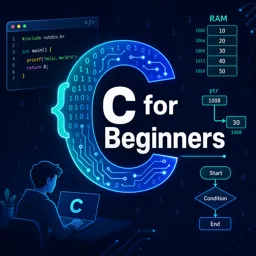
Free Course Image C for Beginners

Free online courseC for Beginners

Duration of the online course: 11 hours and 8 minutes

4.74

StarStarStarStarHalf star

(138)

Learn the fundamentals of C programming in this free online course. Covering everything from binary and hexadecimal tutorials to pointers and algorithm design principles.

In this free course, learn about

  • Computer Science and Number Systems Foundations
  • Computer Architecture and First C Program
  • Data Representation and Basic Types in C
  • Arrays, Pointers, and Strings in C
  • Control Flow, Loops, and Basic Data Structures
  • Algorithm Design and Course Wrap-Up

Course Description

"C for Beginners" is a comprehensive course tailored for people who are new to the world of programming. With a total duration of 11 hours and 8 minutes, this course offers an extensive journey into the basics and intricacies of the C programming language. It has garnered an impressive average rating of 4.74 out of 5 stars, reflecting its quality and the satisfaction of numerous learners.

Belonging to the Information Technology category and specifically falling under the subcategory of Multipurpose Programming Languages (such as Python, Ruby, Java, and C), this course is ideal for aspiring programmers aiming to build a solid foundation in one of the most influential programming languages.

The course begins with a welcoming introduction to computer science, accessible to everyone, regardless of their background. It then delves into the critical decision of choosing the right programming language, aligning your goals with the capabilities of different languages.

Learning binary and hexadecimal systems is also emphasized, providing a strong understanding of how computers interpret data at the lowest level. The course ensures that learners grasp the importance of binary in computing.

As the course progresses, students explore essential programming concepts such as include statements, data handling by programming languages, and the relationship between programs and RAM. These foundational lessons pave the way for understanding how programs operate as data themselves.

Next, attend to comprehensive lessons on program flow, functions, arguments, and return values. These topics are crucial for writing efficient and effective code. The course's hands-on approach is highlighted by guiding students through writing, reviewing, and running their first program in C, specifically using the CodeBlocks environment.

Subsequent sections cover vital data principles, including types, numeric overflow, ASCII, and how characters and numbers are encoded. The nuances of signed and unsigned numbers in C, as well as the potential pitfalls of numeric overflow, are discussed in detail.

Variables are introduced, along with their connection to function return values, string termination, and the versatile printf function. By understanding placeholders and more advanced formatting, students refine their skills in managing output effectively.

Pointers and arrays are essential topics in C programming, and this course addresses them through multiple lessons. Students learn to create and manipulate pointers, access memory directly, and grasp the significance of these tools in more complex programming scenarios.

The concepts of constants, string literals, and direct memory manipulation using pointers are included to enhance the understanding of memory management in C. Lessons extend to conditional flow statements, logical operators, and implementing if statements to facilitate decision-making in code.

To build more robust programs, the course introduces GOTO and loop constructs, alongside custom functions, Booleans, and bitmasks. Practical knowledge is further reinforced through the introduction of data structures and binary data representation.

Finally, algorithm design and the implementation of the for loop in C form the capstone of this course. By concluding with advanced algorithm strategies, the course ensures that learners can approach problem-solving with a systematic and efficient mindset, ready to tackle real-world programming challenges.

Course content

  • Video class: Introduction to Computer Science for Everyone 02m
  • Exercise: What is the key element needed to create useful software beyond knowing a programming language?
  • Video class: Lesson 1.2 : Which programming language? 05m
  • Exercise: Why are there many different programming languages?
  • Video class: Binary Tutorial 15m
  • Exercise: What is the decimal value of the binary number '110'?
  • Video class: The importance of understanding binary 06m
  • Exercise: Every BMP files are a stream of...
  • Video class: Lesson 2.3 : Hexadecimal Tutorial 21m
  • Exercise: What digit is used in hexadecimal after the number 9?
  • Video class: Lesson 3.1 : Include Statements 06m
  • Exercise: What is the main purpose of an include statement in programming?
  • Video class: Lesson 3.2 : How programming languages work with data 04m
  • Exercise: Why is it important to specify data types in programming?
  • Video class: Lesson 3.3 : Some Basics Concerning RAM 07m
  • Exercise: What happens to data stored in RAM when the computer is turned off?
  • Video class: Lesson 3.4 : Programs are Data Too 03m
  • Exercise: What is the main function of the CPU during program execution?
  • Video class: Lesson 4.1 : About Program Flow 04m
  • Exercise: What is the purpose of the instruction pointer in a CPU?
  • Video class: Lesson 4.2 : Functions, Methods, Routines 04m
  • Exercise: Every function...
  • Video class: Lesson 4.3 : About Arguments and Return Values 06m
  • Exercise: What is a function's role in programming discussed in the transcript?
  • Video class: Lesson 4.4 : About Syntax and Functions 04m
  • Exercise: What is the fundamental step in learning a programming language?
  • Video class: Lesson 5.1 : Writing your first program in C 20m
  • Exercise: What is the correct syntax to include the standard input/output library in a C program?
  • Video class: Lesson 5.2 : Review of your first program 06m
  • Exercise: What is the purpose of the 'include' statement in C programming?
  • Video class: Lesson 5.3 : Running your first program 04m
  • Exercise: How can you run a C program without downloading a compiler?
  • Video class: Typing and running your first program in CodeBlocks 07m
  • Exercise: What is the first step to download and install Code Blocks on a Windows computer?
  • Video class: Lesson 6.1 : Basics of signed and unsigned numbers 10m
  • Exercise: What is a signed number?
  • Video class: Lesson 6.2 : The Basics of Numeric Overflow 06m
  • Exercise: What happens to a 3-bit number when it overflows?
  • Video class: Lesson 6.3 : Fractional numbers in binary 08m
  • Exercise: How are fractional numbers represented in binary?
  • Video class: Lesson 6.4 : Numeric Data Types in C 06m
  • Video class: Lesson 6.5 : The basics of ASCII and the char data type 06m
  • Video class: Lesson 6.6 : How numbers are encoded as characters in ASCII 05m
  • Video class: Lesson 6.7 : Maximum values for unsigned integers in C 07m
  • Video class: Lesson 6.8 : Minimum and maximum values of signed integers 10m
  • Video class: Lesson 7.1 : Introducing Variables 04m
  • Video class: Lesson 7.2 : The connection between function return values and variables 08m
  • Video class: Lesson 7.3 Terminating strings of text and other data 11m
  • Video class: Lesson 7.4 : More about the printf function and an introduction to placeholders 10m
  • Video class: Lesson 8.1 : Introducing arrays and pointers - part one 16m
  • Exercise: What is an array?
  • Video class: Lesson 8.2 : Introducing arrays and pointers - part two 06m
  • Video class: Lesson 8.3 : Introducing the pointer data type 06m
  • Video class: Lesson 8.4 : How to create a pointer in C 15m
  • Video class: Lesson 8.5 : Assigning a value to a pointer 08m
  • Video class: Lesson 8.6 : Getting the value stored at a memory address using a pointer 23m
  • Video class: Lesson 8.7 : A chance to practice and use what you have learned 04m
  • Video class: Lesson 9.1 : Using pointers for direct memory access and manipulation in C 19m
  • Video class: Lesson 9.2 : About changing the memory address contained within a pointer 11m
  • Video class: Lesson 9.3 : Pointers containing memory addresses of multi byte variables 34m
  • Video class: Lesson 9.4 : Pointers have memory addresses too 13m
  • Video class: Lesson 9.5 : Why do you need to learn pointers? 05m
  • Video class: Lesson 9.6 : Introducing the char* pointer 13m
  • Video class: Lesson 10.1 : Introducing constants and string literals in C 10m
  • Video class: Lesson 10.2 : Important review and clarifications 27m
  • Video class: Lesson 10.3 : More about strings and constants in C 16m
  • Video class: Lesson 10.4 : A new way to visualize RAM 06m
  • Video class: Lesson 10.5 : Introducing the character string as an array of characters in C 11m
  • Video class: Lesson 10.6 : Using a pointer to directly manipulate data in memory in C 15m
  • Video class: Lesson 11.1 : Introducing conditional flow statements 03m
  • Video class: Lesson 11.2 : The mechanisms for control flow statements 08m
  • Video class: Lesson 11.3 : Implementing a simple if statement in c 14m
  • Video class: Lesson 11.4 : More about if statements and logical operators 13m
  • Video class: Lesson 11.5 : Introducing Logical OR 05m
  • Video class: Lesson 12.1 : Introducing GOTO and Loops in C 09m
  • Video class: Lesson 12.2 : More about blocks of code and GOTO statements 04m
  • Video class: Lesson 12.3 : Introducing the While Loop in C 09m
  • Video class: Lesson 12.4 : Introducing Custom Functions in C 10m
  • Video class: Lesson 12.5 : Introducing Booleans 09m
  • Video class: Lesson 12.6 : Introducing Bitmasks 14m
  • Video class: Lesson 12.7 : Changing data using bitmasks 13m
  • Video class: Unit 12 Supplemental Video : Displaying data in memory as binary 06m
  • Video class: Lesson 12.8 : Introduction to data structures 09m
  • Video class: Lesson 13.1 : Introduction to Algorithm Design Part 1 13m
  • Video class: Lesson 13.2 : Basics of Algorithm Design Part 2 : Introducing the For Loop in C 11m
  • Video class: Lesson 13.2 : Supplemental : Printing Binary Data #2 12m
  • Video class: End of playlist 00m

This free course includes:

11 hours and 8 minutes of online video course

Digital certificate of course completion (Free)

Exercises to train your knowledge

100% free, from content to certificate

Ready to get started?Download the app and get started today.

Install the app now

to access the course
Icon representing technology and business courses

Over 5,000 free courses

Programming, English, Digital Marketing and much more! Learn whatever you want, for free.

Calendar icon with target representing study planning

Study plan with AI

Our app's Artificial Intelligence can create a study schedule for the course you choose.

Professional icon representing career and business

From zero to professional success

Improve your resume with our free Certificate and then use our Artificial Intelligence to find your dream job.

You can also use the QR Code or the links below.

QR Code - Download Cursa - Online Courses

Course comments: C for Beginners

Students found the free online C programming course very beginner-friendly, clear, and helpful. They praised the app, recommended it to new computer science students, and appreciated how the professor explained concepts from scratch and offered a certificate.

Debasish Rana

It's the best beginner friendly video to understand C Programming

Arup Roy

Now , it's very nice app for learning online course with certificate and it is fully free course,

rounak tamboli

this is the course for beginners who just taken the admission in computers science iso i will say that student should complete this courses

REPANA SIVARAJ

thank you very much friend.i like this course.message me.

S Balaji

very good

Sandeep Nayak

it's the best video to understand C Programming for beginner level,if you want to learn C then you can start from here.Here sir teaches from beginner level he cleared all the concepts .Thank you so much it is helpful for me.

More free courses at Programming Languages ( Python, Ruby, Java, C )

Download the App now to have access to + 3300 free courses, exercises, certificates and lots of content without paying anything!

  • 100% free online courses from start to finish

    Thousands of online courses in video, ebooks and audiobooks.

  • More than 48 thousand free exercises

    To test your knowledge during online courses

  • Valid free Digital Certificate with QR Code

    Generated directly from your cell phone's photo gallery and sent to your email

Cursa app on the ebook screen, the video course screen and the course exercises screen, plus the course completion certificate

+ 9 million
students

Free and Valid
Certificate

60 thousand free
exercises

4.8/5 rating in
app stores

Free courses in
video and ebooks