The course covers regression, Naive Bayes, SVMs, K-means, EM, PCA, reinforcement learning, and control methods.

Duration of the online course: 25 hours and 9 minutes
4.8

(116)
Build job-ready machine learning skills with a free online course in Python—learn models that predict, classify, and cluster data, with exercises and a certificate option.
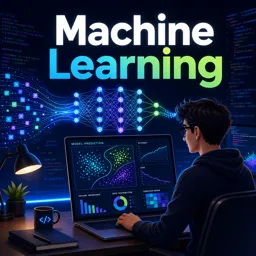
Machine learning is the skill that turns raw data into decisions: predicting demand, spotting fraud, ranking search results, recommending products, or grouping customers by behavior. This free online course guides you from core principles to practical ways of thinking that modern teams use when building intelligent systems with Python. Instead of treating algorithms as black boxes, you will learn how to reason about model choice, optimization, and generalization so your solutions work beyond a single dataset.
You will develop an intuition for how learning algorithms improve with experience and what it means to balance bias and variance when your model meets real-world noise. Along the way, you explore foundational supervised methods for regression and classification, then progress to probabilistic approaches often used in text and event modeling. You will also connect the dots between decision boundaries and margins, understanding why support vector machines can be powerful and how kernels help models capture non-linear structure without exploding complexity.
A key focus is learning to make models reliable. You will see how expanding the hypothesis space can affect generalization, how complexity measures shape what we can guarantee, and how to think about performance when data is limited. You will also practice unsupervised learning to uncover structure in unlabeled datasets, including clustering to find groups and dimensionality reduction to simplify features while keeping the signal. This mindset is invaluable for cleaning datasets, compressing information, and preparing inputs for downstream models.
The course goes further by introducing sequential decision-making ideas that underpin reinforcement learning. You will learn how Markov decision processes frame control and planning, why partial observability makes policy computation difficult, and how dynamic programming style methods approximate good decisions in large spaces. These topics build a strong conceptual base for applications in robotics, operations, and automated decision systems.
With exercises that reinforce each concept, you will leave with a clearer understanding of the theory behind machine learning and the confidence to apply it in practical programming work. If you are aiming for a career shift, stronger data science fundamentals, or better AI fluency for software projects, this course offers a rigorous path to leveling up while learning at your own pace.

25 hours and 9 minutes of online video course

Digital certificate of course completion (Free)

Exercises to train your knowledge

100% free, from content to certificate
What machine learning algorithms are covered in this Stanford-based course?
The course covers regression, Naive Bayes, SVMs, K-means, EM, PCA, reinforcement learning, and control methods.
How does this course explain SVMs for non-linearly separable data?
It introduces kernel methods, which let SVMs learn nonlinear decision boundaries in transformed feature spaces.
Does the course include reinforcement learning and Markov decision processes?
Yes. It covers MDPs, fitted value iteration, LQR control, helicopter control design, and challenges in POMDPs.
Ready to get started?Download the app and get started today.
Install the app now
to access the course
Over 5,000 free courses
Programming, English, Digital Marketing and much more! Learn whatever you want, for free.

Study plan with AI
Our app's Artificial Intelligence can create a study schedule for the course you choose.

From zero to professional success
Improve your resume with our free Certificate and then use our Artificial Intelligence to find your dream job.
You can also use the QR Code or the links below.



Free CourseLearn Python
5
(3)

13h00m

17 exercises
Free CourseJava Programming
5
(4)
9h15m
48 exercises
Free CourseRuby on Rails
5
(7)
9h39m
34 exercises
Free CourseCreate Desktop App
5
(4)
5h33m
30 exercises
Free CoursePython Ultimate Course: Learn Python from Scratch
5
(1)
12h31m
42 exercises
Free CourseJava
4.8
(56)
22h17m
28 exercises
Free CourseC# Sharp for beginner
4.8
(37)
3h55m
15 exercises
Free CourseC++ as your first Programming Language
4.8
(108)
5h12m
23 exercises
Free CourseJava for beginners
4.8
(183)
26h50m
49 exercises
Free CourseComputer science and Java
4.8
(65)
9h15m
31 exercises
Carry knowledge in your pocket.
Download the Cursa app.
There are hundreds of free courses available, with a free certificate of completion that is saved in your mobile image gallery.
Download the app to access the Course Completion Certificate for Free.


+ 10 million
students

Free and Valid
Certificate

60 thousand free
exercises

4.8/5 rating in
app stores

Free courses in
video and ebooks

Course comments: Machine Learning
Students found the free course excellent, clear, knowledgeable, and useful for learning and skill development. Most reviews were highly positive, though one noted low-quality video and another asked where lecture notes are posted.
Rahul kumar Khare
hello I'm indian and I would like to inform that I am really happy after getting this platform and courses.
KESHAVA MURTHY. A
very good App for learning and skill development
Joseph Newton-Akpor
which site is the lecture note posted
McAugustus Sapanga
..you ok í
grahamhconquer
I'm still working through this course bear in mind I've taught myself coding in a variety of languages also I spent weeks building circuits 8bit comp
Uday Kumar S
Course is knowledgeable, but low quality video.
grahamhconquer
excellent course understood it easier than in the military thank you, grahamconquer81@gmail.com Any information about employment thanks
Biswarup Das
Nice course
Siddhartha Mondal
very goof