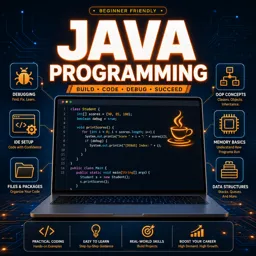
Free Course Image Java

Free online courseJava

Duration of the online course: 22 hours and 17 minutes

4.84

StarStarStarStarStar

(56)

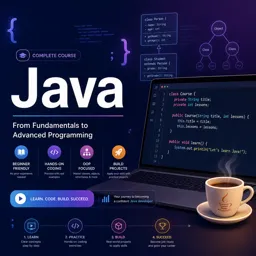
Master Java programming with Stanford's free online course. Explore comprehensive programming methodology lectures. Ideal for IT and programming enthusiasts.

In this free course, learn about

  • Course Orientation and Karel Programming
  • Introduction to Java and Basic Syntax
  • Types, Casting, Methods, and Strings
  • Data Structures, Constants, and Graphics
  • Text Processing and Computer Memory
  • Arrays and Matrices in Java
  • Interfaces and Graphical User Interfaces
  • Large Programs and Name Surfer Project
  • Social Networks, Libraries, and Course Wrap‑Up

Course Description

The "Java by [CourseTitle]" course is a comprehensive 22-hour and 17-minute journey into the world of Java programming. Delivered by [Author], this course has garnered an exceptional average rating of 4.85 out of 5, reflecting its quality and the value it offers to learners. Belonging to the Information Technology category and specifically the subcategory of Multipurpose Programming Languages, this course is a fundamental resource for anyone aiming to master Java alongside other prominent languages like Python, Ruby, and C.

Throughout the course, students are guided through a series of meticulously crafted lectures that focus on "Programming Methodology." Each lecture builds upon the previous one, ensuring a gradual and comprehensive understanding of core Java concepts. Starting with the basics, learners are introduced to fundamental programming principles and gradually advance to more complex topics. Every lecture has been designed to provide a strong foundation in Java, making this course suitable for both beginners and those with prior programming experience looking to deepen their knowledge.

The course's structure ensures that learners develop a robust and practical understanding of Java. By incorporating Programming Methodology, the lectures not only teach coding skills but also emphasize the importance of writing clean, efficient, and maintainable code. As students progress through the lectures, they will gain insights into best practices, algorithmic thinking, and essential programming paradigms, empowering them to tackle real-world software development challenges.

One of the standout features of this course is its focus on practical application. Each lecture includes hands-on examples and projects that encourage learners to apply their newfound knowledge immediately. This practical approach solidifies theoretical concepts and gives students the confidence to implement Java programming techniques in various scenarios. Whether it's developing simple applications or tackling more complex projects, the skills acquired in this course will prove invaluable.

The exceptional rating of the "Java by [CourseTitle]" course underscores its effectiveness and the high level of satisfaction among past students. The comprehensive and meticulously planned content, combined with [Author]'s esteemed reputation, makes this course a top choice for those seeking to learn Java. By the end of the course, students will have a thorough understanding of Java programming methodology, equipping them with the skills to excel in the field of Information Technology and beyond.

Enrolling in "Java by [CourseTitle]" is an investment in a future-proof skill set. As programming continues to be an essential skill in the ever-evolving tech landscape, mastering Java opens up numerous opportunities across various industries. This course lays the groundwork for a successful programming career and serves as a launching pad for further exploration into other multipurpose programming languages like Python, Ruby, and C. With a wealth of knowledge and practical experience, graduates of this course will be well-prepared to navigate the complexities of modern software development.

Course content

  • Video class: Lecture 1 | Programming Methodology (Stanford) 49m
  • Exercise: What programming language is used in the course CS 106a?
  • Video class: Lecture 2 | Programming Methodology (Stanford) 48m
  • Exercise: What is the primary programming platform used in the CS106A class?
  • Video class: Lecture 3 | Programming Methodology (Stanford) 50m
  • Exercise: _What should you use for the purpose of the Karel assignments?
  • Video class: Lecture 4 | Programming Methodology (Stanford) 48m
  • Exercise: _What was the first computing device made available around 4,000 years ago?
  • Video class: Lecture 5 | Programming Methodology (Stanford) 49m
  • Exercise: _What are the three things associated with a variable in Java?
  • Video class: Lecture 6 | Programming Methodology (Stanford) 45m
  • Exercise: _What is the function used to get input from the user and assign it to an integer variable in Java?
  • Video class: Lecture 7 | Programming Methodology (Stanford) 51m
  • Exercise: _What is the difference between explicit and implicit casting in Java?
  • Video class: Lecture 8 | Programming Methodology (Stanford) 48m
  • Exercise: _What is the reason for using methods with parameters and good names in Java?
  • Video class: Lecture 9 | Programming Methodology (Stanford) 52m
  • Exercise: _What is a string in Java?
  • Video class: Lecture 10 | Programming Methodology (Stanford) 46m
  • Exercise: What is the constant value of units required for all students to graduate in the class discussed?
  • Video class: Lecture 11 | Programming Methodology (Stanford) 49m
  • Exercise: Where is the default location for loading image files in a GImage object in a program discussed in the transcript?
  • Video class: Lecture 12 | Programming Methodology (Stanford) 49m
  • Exercise: _What is enumeration in Java?
  • Video class: Lecture 13 | Programming Methodology (Stanford) 46m
  • Exercise: _What is the function countUpperCase() used for?
  • Video class: Lecture 14 | Programming Methodology (Stanford) 46m
  • Exercise: _What is a byte in computer memory?
  • Video class: Lecture 15 | Programming Methodology (Stanford) 48m
  • Exercise: What happens when you set an object equal to another object in programming?
  • Video class: Lecture 16 | Programming Methodology (Stanford) 49m
  • Exercise: _What is an array in Java?
  • Video class: Lecture 17 | Programming Methodology (Stanford) 50m
  • Exercise: _What is a matrix in Java?
  • Video class: Lecture 18 | Programming Methodology (Stanford) 46m
  • Exercise: What type of array is used to track student scores?
  • Video class: Lecture 19 | Programming Methodology (Stanford) 49m
  • Exercise: _What is an interface in Java?
  • Video class: Lecture 20 | Programming Methodology (Stanford) 44m
  • Exercise: _What is a combo box?
  • Video class: Lecture 21 | Programming Methodology (Stanford) 47m
  • Exercise: _What method do you need to call in order to get the name of the interactor that caused the action performed method to be called?
  • Video class: Lecture 22 | Programming Methodology (Stanford) 45m
  • Exercise: _What is the purpose of the program named "Name Surfer"?
  • Video class: Lecture 23 | Programming Methodology (Stanford) 51m
  • Exercise: What concept is the main focus of the lecture before Thanksgiving?
  • Video class: Lecture 24 | Programming Methodology (Stanford) 47m
  • Exercise: _What is one of the things that computers do a lot of, according to the presentation?
  • Video class: Lecture 25 | Programming Methodology (Stanford) 47m
  • Exercise: _What is a social network in the context of the lecture?
  • Video class: Lecture 26 | Programming Methodology (Stanford) 42m
  • Exercise: _What is the relationship between the ACM libraries and standard Java?
  • Video class: Lecture 27 | Programming Methodology (Stanford) 41m
  • Exercise: What is emphasized as the main focus of computer science beyond programming?
  • Video class: Lecture 28 | Programming Methodology (Stanford) 41m
  • Exercise: What type of graphics contest categories were presented in the class?

This free course includes:

22 hours and 17 minutes of online video course

Digital certificate of course completion (Free)

Exercises to train your knowledge

100% free, from content to certificate

Ready to get started?Download the app and get started today.

Install the app now

to access the course
Icon representing technology and business courses

Over 5,000 free courses

Programming, English, Digital Marketing and much more! Learn whatever you want, for free.

Calendar icon with target representing study planning

Study plan with AI

Our app's Artificial Intelligence can create a study schedule for the course you choose.

Professional icon representing career and business

From zero to professional success

Improve your resume with our free Certificate and then use our Artificial Intelligence to find your dream job.

You can also use the QR Code or the links below.

QR Code - Download Cursa - Online Courses

Course comments: Java

Shraddha Gudage

best

Biswarup Das

It's really helpfull.

More free courses at Programming Languages ( Python, Ruby, Java, C )

Download the App now to have access to + 3300 free courses, exercises, certificates and lots of content without paying anything!

  • 100% free online courses from start to finish

    Thousands of online courses in video, ebooks and audiobooks.

  • More than 48 thousand free exercises

    To test your knowledge during online courses

  • Valid free Digital Certificate with QR Code

    Generated directly from your cell phone's photo gallery and sent to your email

Cursa app on the ebook screen, the video course screen and the course exercises screen, plus the course completion certificate

+ 9 million
students

Free and Valid
Certificate

60 thousand free
exercises

4.8/5 rating in
app stores

Free courses in
video and ebooks