It covers HTTP, routing, REST APIs, authentication, validation, Postgres, caching, queues, search, observability, security, scaling, and concurrency.

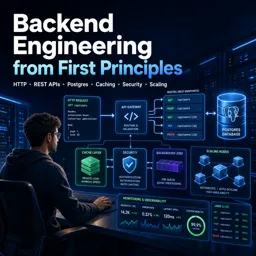
Duration of the online course: 25 hours and 13 minutes
New
Become job-ready in backend engineering: master HTTP, REST APIs, Postgres, caching, security and scaling in a free online course with exercises.
Strong backend systems rarely come from copying patterns blindly. They come from understanding first principles: how requests move across the internet, how servers interpret them, how data is stored and retrieved, and what breaks in production. This free online course is designed to help you build that foundation so you can read unfamiliar codebases with confidence, make better design decisions, and debug issues faster when the real world gets messy.
You will start where every backend journey truly begins: HTTP. By learning why HTTP is stateless, how routing works, and how data is serialized and deserialized between client and server, you gain a clear mental model of what happens between a request and a response. From there, you will connect essential application concepts such as validation and transformation, authentication versus authorization, and the responsibilities of controllers, services, repositories, middleware, and request context. Instead of memorizing frameworks, you will learn what these pieces are trying to achieve and how they fit together.
As you progress, you will strengthen your ability to design clean REST APIs, choose appropriate HTTP methods, and implement behavior that stays predictable as systems evolve. You will also build practical database understanding with Postgres, including how and why traditional storage persists data, and how backend performance can collapse when queries and indexing are treated as an afterthought.
Modern backends rely on more than a database. You will explore caching, background jobs and task queues for responsiveness, and fast search with Elasticsearch when naïve SQL patterns stop scaling. The course also emphasizes production readiness: fault tolerance through consistent error handling, configuration discipline across environments, logging/monitoring/observability, and graceful shutdown so deployments do not drop work in flight.
Finally, you will move into the topics that separate functional apps from reliable platforms: security fundamentals, scaling strategies, performance engineering metrics that reflect real user experience, the importance of stateless design for horizontal scaling, and why concurrency is essential for most API servers. With video lessons plus exercises, you will develop the practical intuition needed to build backends that are easier to operate, safer to expose, and ready to grow.

25 hours and 13 minutes of online video course

Digital certificate of course completion (Free)

Exercises to train your knowledge

100% free, from content to certificate
What does a backend engineering course from first principles cover?
It covers HTTP, routing, REST APIs, authentication, validation, Postgres, caching, queues, search, observability, security, scaling, and concurrency.
How does this course explain the difference between authentication and authorization?
Authentication verifies who a user is; authorization determines what that authenticated user is allowed to access or do.
Why are caching and background jobs important in backend systems?
Caching reduces repeated expensive work, while background jobs move slow tasks such as email sending or file processing out of the request path.
Ready to get started?Download the app and get started today.
Install the app now
to access the course
Over 5,000 free courses
Programming, English, Digital Marketing and much more! Learn whatever you want, for free.

Study plan with AI
Our app's Artificial Intelligence can create a study schedule for the course you choose.

From zero to professional success
Improve your resume with our free Certificate and then use our Artificial Intelligence to find your dream job.
You can also use the QR Code or the links below.



Free CourseBackend REST API
5

(9)

5h24m

25 exercises
Free CourseNodeJS complete
5
(1)
1h30m
12 exercises
Free CourseAPIs
5
(5)
4h32m
20 exercises
Free CourseFlask
5
(1)
8h50m
14 exercises
Free CourseDjango for Everybody
5
(1)
18h32m
Free CoursePython Django Full Stack Developer
5
(3)
14h23m
27 exercises
Free CourseMaster Vue JS API
5
(-4)
6h14m
6 exercises
Free CoursePython Fast API
4.8
(5)
1h34m
14 exercises
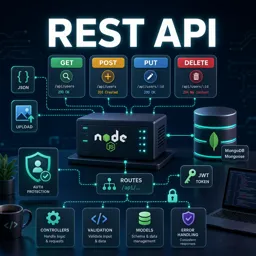
Free CourseREST API
4.7

(6)
4h14m
10 exercises
Free CourseNodeJS for beginners
4
(1)
6h51m
32 exercises
Carry knowledge in your pocket.
Download the Cursa app.
There are hundreds of free courses available, with a free certificate of completion that is saved in your mobile image gallery.
Download the app to access the Course Completion Certificate for Free.


+ 10 million
students

Free and Valid
Certificate

60 thousand free
exercises

4.8/5 rating in
app stores

Free courses in
video and ebooks