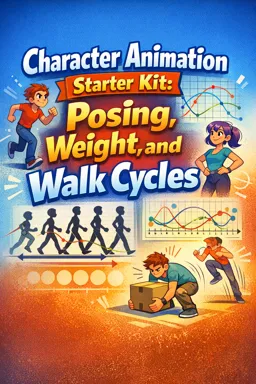

Free ebook on character animation fundamentals: readable poses, weight, body mechanics, walk cycles, run cycles, and refinement.
Free ebook content
-

Character Animation Starter Kit: Readable Poses, Silhouettes, and Line of Action
+ Exercise: During a quick silhouette check, what is the best way to fix a readability problem where the hand merges into the torso?
-
Character Animation Starter Kit: Balance, Center of Gravity, and Ground Contact
+ Exercise: When preparing to lift one foot while keeping the other foot planted, what change most reliably makes the pose read grounded and physically stable?
-
Character Animation Starter Kit: Blocking Workflow and Key Pose Planning
+ Exercise: When starting a blocking pass, what is the most effective first step to keep the shot’s poses and timing purposeful?
-
Character Animation Starter Kit: Timing, Spacing, and Ease Without Over-Complication
+ Exercise: If a motion feels “poppy” near a stop, what is the recommended first fix before adding new keys?


-
Character Animation Starter Kit: Building a Walk Cycle with Contacts, Passing, and Extremes
+ Exercise: When a walk cycle shows foot sliding during planted frames, what adjustment most directly helps eliminate the slide?
-
Character Animation Starter Kit: Adding Weight and Personality to Walks
+ Exercise: When modifying a solid base walk to feel heavier without introducing foot sliding, what is the recommended order of adjustments?
-
Character Animation Starter Kit: Run Cycles and Faster Locomotion Basics
+ Exercise: When a run cycle looks like the character is slipping rather than driving forward, which adjustment best addresses the issue?
-
Character Animation Starter Kit: Body Mechanics Mini-Shots (Lift, Push, Sit, and Stop)
+ Exercise: In a body mechanics mini-shot, what approach best helps make effort and weight transfer feel believable during actions like lifting or pushing?
-
Character Animation Starter Kit: Basic Acting Beats with Clear Poses and Transitions
+ Exercise: In a simple 3-beat acting shot (Notice → Decide → Respond), what is the main purpose of adding breakdowns between key poses?
-
Character Animation Starter Kit: From Blocking to Splines—Refinement Without Losing Clarity
+ Exercise: When refining a shot by switching from stepped blocking to splines, what best helps prevent a planted foot from sliding or drifting?
About the free ebook
Character Animation Starter Kit: Posing, Weight, and Walk Cycles
This free ebook introduces practical character-animation fundamentals for creating motion that feels clear, balanced, and believable. Learn to make poses readable before adding detail, using silhouette and line of action to communicate intention at a glance.
Build movement from strong physical ideas
Explore balance, center of gravity, and convincing ground contact so characters appear to support their own weight. The ebook uses a focused blocking approach: plan key poses, establish the action, then refine timing and spacing without making the workflow unnecessarily complex.
Create locomotion with personality
Develop walk cycles through contacts, passing positions, and extremes, then adjust posture, rhythm, and weight to give each walk a distinct character. Apply the same principles to runs and faster locomotion while preserving clarity and control.
Practice useful body mechanics and acting
Work through compact actions such as lifting, pushing, sitting, and stopping. These exercises connect posing with force, momentum, and recovery. You will also learn how clear poses and purposeful transitions support simple acting beats.
Refine without losing the idea
Move from blocking to splines while protecting the strongest choices in your animation. Clarity comes first: every pose, timing decision, and transition should reinforce what the character is doing, feeling, and carrying.
- Improve pose readability and silhouettes
- Plan walk and run cycles with reliable landmarks
- Show weight through balance, contact, and timing
- Polish animation while retaining strong storytelling
What are the key poses in a walk cycle?
The core positions are contact, down, passing, and up/extreme poses, repeated for each step.
How can I make an animated character feel heavier?
Use stronger balance shifts, believable ground contact, slower changes of direction, and visible recovery.
Why is silhouette important in character animation?
A clear silhouette makes the pose and action readable even before facial detail or polish is added.
This ebook includes:

10 content chapters

Digital certificate of course completion (Free)

Exercises to train your knowledge

100% free, from content to certificate
Ready to get started?

 recommended
In the app you will also find...

Over 5,000 free courses
Programming, English, Digital Marketing and much more! Learn whatever you want, for free.

Study plan with AI
Our app's Artificial Intelligence can create a study schedule for the course you choose.

From zero to professional success
Improve your resume with our free Certificate and then use our Artificial Intelligence to find your dream job.
You can also use the QR Code or the links below.