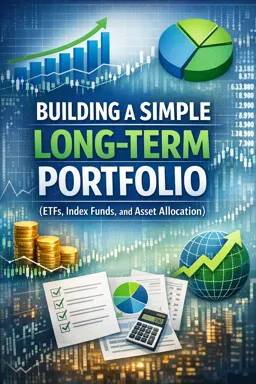

Free ebook on building a simple long-term portfolio with ETFs, index funds, diversification, asset allocation, and rebalancing.
Free ebook content
-

Long-Term Investing with ETFs and Index Funds: Goals, Time Horizon, and What a Portfolio Is
+ Exercise: How does a shorter time horizon typically affect the amount of volatility that is reasonable for a portfolio goal?
-
Risk vs. Return in a Simple ETF Portfolio: Volatility, Drawdowns, and Behavioral Risk
+ Exercise: Why can the order of investment returns matter more when you are withdrawing money from a portfolio?
-
Diversification Basics Using Index Funds and ETFs: What It Covers and What It Doesn’t
+ Exercise: You currently hold two stock ETFs: one is a US large-cap growth fund and the other is a “global innovation” fund, but both are technology-heavy and share several of the same mega-cap top holdings. Which statement best describes the main diversification issue?


-
ETFs vs. Index Mutual Funds for Long-Term Portfolios: Costs, Taxes, and Trading Mechanics
+ Exercise: Which choice best matches a preference for intraday price control and managing execution price when buying a broad index fund?
-
Asset Allocation with Index Funds: Choosing a Stock/Bond Mix That Fits Your Horizon
+ Exercise: When choosing a long-term stock/bond mix, what is the main purpose of including high-quality bonds and cash-like assets alongside stocks?
-
Simple Portfolio Structures with ETFs: 2-Fund, 3-Fund, and 4-Fund Approaches
+ Exercise: In which situation does adding a fourth ETF to a simple portfolio most appropriately fit the intended “4-fund” approach?
-
How to Select Specific ETFs and Index Funds: Screening Criteria and Common Pitfalls
+ Exercise: When choosing between two broad U.S. equity ETFs that both match your intended exposure, which additional check best reflects a repeatable selection process for long-term use?
-
Rebalancing a Long-Term ETF Portfolio: Rules, Thresholds, and Tax-Aware Methods
+ Exercise: Which approach best describes a tax-aware way to rebalance a long-term ETF portfolio when you have new money to invest?
-
Contributions, Dollar-Cost Averaging, and Automation for a Simple Index Portfolio
+ Exercise: Which statement best describes the main purpose of aligning automated contributions with payday in a simple index portfolio plan?
-
Monitoring and Maintaining a Long-Term ETF Portfolio: What to Review and What to Ignore
+ Exercise: Which situation is most likely a legitimate signal to consider changing something in a long-term ETF portfolio (rather than noise to ignore)?
-
Putting It All Together: Building Your Personal 2–4 Fund ETF Portfolio Plan
+ Exercise: In a written portfolio plan, what is the primary purpose of specifying an explicit rebalancing rule with a trigger and a method?
About the free ebook
Building a Simple Long-Term Portfolio
This free ebook explains how ETFs, index funds, and a deliberate asset-allocation plan can support a disciplined approach to long-term investing. It focuses on the practical decisions behind a portfolio: defining goals, setting a time horizon, understanding risk, and choosing a stock-and-bond mix that you can realistically maintain.
Invest with a clear framework
Learn how diversification works across markets and asset classes, while recognizing what diversification cannot prevent. The ebook compares ETFs with index mutual funds through key considerations such as expenses, taxes, trading mechanics, and convenience.
Keep the portfolio structure simple
Explore common two-fund, three-fund, and four-fund portfolio structures. The material shows how to evaluate individual funds using factors such as index coverage, expense ratio, holdings, liquidity, overlap, and fund-provider details. It also highlights common selection mistakes, including performance chasing and unnecessary complexity.
Build habits for long-term maintenance
Discover practical approaches to regular contributions, dollar-cost averaging, portfolio automation, and rebalancing. You will see how calendar-based and threshold-based rebalancing differ, why tax-aware choices may matter in taxable accounts, and which portfolio changes deserve attention versus short-term market noise.
Turn concepts into a personal plan
The final material brings the ideas together into a personal 2–4 fund portfolio plan. Use it to organize your objectives, target allocation, fund-selection criteria, contribution routine, and review process.
Important note
This ebook is for educational purposes and is not personalized investment, tax, or legal advice. Investing involves risk, including possible loss of principal.
What is a 3-fund portfolio?
A 3-fund portfolio commonly holds a total stock market fund, an international stock fund, and a bond fund.
How often should a long-term ETF portfolio be rebalanced?
Many investors use an annual review or rebalance when allocations drift beyond preset thresholds.
What should I compare when choosing an ETF or index fund?
Compare the index tracked, expense ratio, diversification, holdings overlap, trading costs, and tax considerations.
This ebook includes:

11 content chapters

Digital certificate of course completion (Free)

Exercises to train your knowledge

100% free, from content to certificate
Ready to get started?

 recommended
In the app you will also find...

Over 5,000 free courses
Programming, English, Digital Marketing and much more! Learn whatever you want, for free.

Study plan with AI
Our app's Artificial Intelligence can create a study schedule for the course you choose.

From zero to professional success
Improve your resume with our free Certificate and then use our Artificial Intelligence to find your dream job.
You can also use the QR Code or the links below.