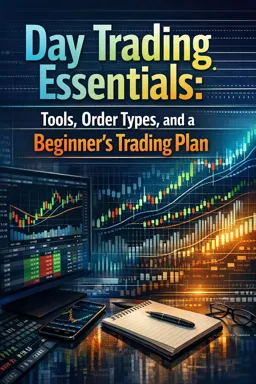

Free ebook on day trading tools, order types, risk management, trading plans, and performance tracking for new traders.
Free ebook content
-

Day Trading Essentials: Market Sessions, Instruments, and What “Tradable” Means
+ Exercise: Which situation best matches the course’s definition of a “tradable” instrument for day trading?
-
Liquidity, Volatility, and Spread: Reading the Conditions That Drive Day Trades
+ Exercise: A trader plans to scalp $0.10–$0.20 per trade. In fast moves, the spread expands from $0.02 to $0.08 and depth looks thin. What is the most appropriate adjustment according to the decision framework?
-
Day Trading Tools: Charts, Level 1/Level 2, Time & Sales, and Watchlists
+ Exercise: When using Level 2 and Time & Sales near a key resistance level, what is the most appropriate way for a beginner to use them?


-
Order Types for Day Trading: Market, Limit, Stop, Stop-Limit, and Bracket Orders
+ Exercise: In a fast-moving breakout, which choice best matches a trader who cares more about getting filled than controlling the exact entry price?
-
Slippage and Transaction Costs: The Hidden Math Behind Short-Term Trading
+ Exercise: A trader wants to estimate the expected total round-trip cost per trade before placing it. Which approach best matches the recommended method?
-
Risk Management Essentials for Day Trading: Position Sizing, Stops, and Daily Limits
+ Exercise: A trader sets a fixed max dollar risk per trade and chooses an entry and a stop. Which approach best reflects proper risk management for position sizing and stop placement?
-
A Beginner’s Day Trading Plan: Setup Rules, Entry Triggers, Exits, and No-Trade Conditions
+ Exercise: Which entry trigger is most objective for a beginner day trading plan?
-
Performance Tracking: Trading Journal, Metrics That Matter, and Reviewing for Edge
+ Exercise: When reviewing a trading setup’s performance, what is the best first step to estimate whether the setup has a real edge rather than results distorted by rule-breaking?
-
Risks and Lifestyle Demands of Day Trading: Psychology, Routine, and Capital Realities
+ Exercise: During a drawdown, which response best follows the recommended approach to reduce the chance of compounding mistakes?
About the free ebook
Day Trading Essentials: Tools, Order Types, and a Beginner’s Trading Plan
This free ebook introduces the practical foundations of day trading, from understanding market sessions and tradable instruments to evaluating liquidity, volatility, and bid-ask spreads. Learn how changing market conditions can affect trade execution and decision-making.
Build a practical trading workflow
Explore the core tools used by active traders, including charts, Level 1 and Level 2 quotes, Time & Sales data, and watchlists. The ebook explains what each tool can reveal and how to use information without confusing activity for opportunity.
Understand orders, costs, and risk
Learn the differences between market, limit, stop, stop-limit, and bracket orders, along with the potential effects of slippage, commissions, fees, and spreads. Clear risk-management concepts cover position sizing, protective stops, and daily loss limits.
Create rules before placing a trade
Develop a beginner-focused trading plan with defined setups, entry triggers, exit rules, and no-trade conditions. The ebook also covers trade journaling, meaningful performance metrics, review routines, and the psychological and lifestyle demands of short-term trading.
A realistic educational resource
Day trading involves substantial risk, and losses can occur quickly. This ebook is for education only and does not provide investment, legal, or tax advice.
- Assess market conditions before trading
- Match order types to a defined plan
- Measure risk and transaction costs
- Track results to improve process discipline
What is the difference between a market order and a limit order in day trading?
A market order prioritizes immediate execution, while a limit order sets the maximum buy price or minimum sell price.
How does slippage affect short-term trading results?
Slippage occurs when an order fills at a worse price than expected, reducing potential profits or increasing losses.
What should a day trading journal record?
Record the setup, entry and exit prices, position size, risk, market conditions, result, and notes about execution.
This ebook includes:

9 content chapters

Digital certificate of course completion (Free)

Exercises to train your knowledge

100% free, from content to certificate
Ready to get started?

 recommended
In the app you will also find...

Over 5,000 free courses
Programming, English, Digital Marketing and much more! Learn whatever you want, for free.

Study plan with AI
Our app's Artificial Intelligence can create a study schedule for the course you choose.

From zero to professional success
Improve your resume with our free Certificate and then use our Artificial Intelligence to find your dream job.
You can also use the QR Code or the links below.