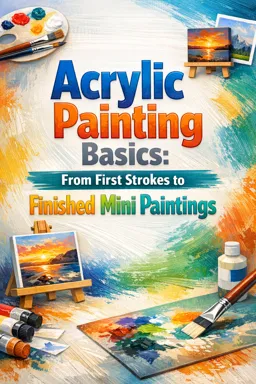


Free ebook on acrylic painting basics: tools, layering, blending, texture, glazing, and finishing mini paintings with confidence.
Free ebook content
-

Acrylic Painting Basics: Tools, Surfaces, and a Clean Painting Setup
+ Exercise: When setting up a tidy acrylic workspace, what is the main reason for using two water containers instead of one?
-
Acrylic Painting Basics: Paint Consistency, Water Control, and Acrylic Mediums
+ Exercise: You want to create a transparent glaze layer that stays strong and avoids weak, chalky drying. What is the best approach?
-
Acrylic Painting Basics: Brush Handling, Stroke Types, and Edges
+ Exercise: You need to paint a long, continuous, very thin line (such as a branch or grass). Which brush choice best matches this task?


-
Acrylic Painting Basics: Planning a Mini Painting with Values and Simple Composition
+ Exercise: When refining a mini painting plan from a 3-value map to a 5-value map, what is the best way to use the lightest light and darkest dark?
-
Acrylic Painting Basics: Underpainting Methods for Fast, Confident Start
+ Exercise: When using a tonal ground underpainting, what is the main purpose of wiping back certain areas while the wash is still wet?
-
Acrylic Painting Basics: Layering and Opaque Coverage Without Mud
+ Exercise: When trying to avoid muddy color while layering acrylics, which approach best supports clean, readable shapes?
-
Acrylic Painting Basics: Blending Techniques for Smooth Gradients and Soft Transitions
+ Exercise: When you want to soften a shadow edge in acrylics while keeping the shape readable, which approach is most reliable and why?
-
Acrylic Painting Basics: Dry-Brush, Scumbling, and Simple Texture Methods
+ Exercise: Which approach best helps keep texture from overwhelming a mini acrylic painting while still supporting the focal area?
-
Acrylic Painting Basics: Glazing and Transparent Color for Depth and Color Harmony
+ Exercise: Which approach best preserves the underlying value structure when using acrylic glazing to shift color?
-
Acrylic Painting Basics: Completing Mini Paintings with Crisp Details and Clean Finishing Passes
+ Exercise: In a mini acrylic painting, what is the most appropriate focus of a “clean finishing pass”?
-
Acrylic Painting Basics: Varnishing, Storage, and Long-Term Care of Acrylic Mini Paintings
+ Exercise: When preparing to varnish an acrylic mini painting, which situation best indicates it is truly ready (cured) rather than just dry to the touch?
About the free ebook
Acrylic Painting Basics: From First Strokes to Finished Mini Paintings
This free ebook introduces practical acrylic painting methods for creating small, polished artworks with confidence. Build a clean workspace, choose suitable tools and surfaces, and learn how paint consistency, water, and mediums affect every mark.
Paint with control and clarity
Explore brush handling, expressive stroke types, and edge control to make forms read clearly. Learn to plan mini paintings through simple composition and value structure before applying paint, helping you create focused images without overworking them.
Build color in effective layers
Practice underpainting, opaque coverage, layering, blending, dry-brush texture, scumbling, and glazing. Each technique is explained as a useful painting decision: create smooth transitions, preserve bright color, add depth, or suggest texture without turning mixtures muddy.
Finish and protect small artworks
Develop a reliable finishing process using crisp details, final value adjustments, and clean edges. The ebook also covers varnishing, storage, and long-term care so your acrylic mini paintings remain protected and ready to display.
What you will be able to do
- Set up acrylic materials for efficient, clean painting.
- Control paint thickness, opacity, and drying behavior.
- Plan a compact composition using simple values.
- Use layers, glazes, and textures with purpose.
- Finish and care for acrylic mini paintings.
Create small paintings that feel intentional, colorful, and complete.
How do I stop acrylic paint from becoming muddy?
Let layers dry when needed, limit repeated mixing, and keep brushes and water clean.
What is the difference between glazing and opaque layering in acrylics?
Glazing uses transparent paint to shift color or add depth; opaque layers cover what is underneath.
When should an acrylic mini painting be varnished?
Varnish only after the painting has fully cured, following the varnish manufacturer's instructions.
This ebook includes:

11 content chapters

Digital certificate of course completion (Free)

Exercises to train your knowledge

100% free, from content to certificate
Ready to get started?

 recommended
In the app you will also find...

Over 5,000 free courses
Programming, English, Digital Marketing and much more! Learn whatever you want, for free.

Study plan with AI
Our app's Artificial Intelligence can create a study schedule for the course you choose.

From zero to professional success
Improve your resume with our free Certificate and then use our Artificial Intelligence to find your dream job.
You can also use the QR Code or the links below.