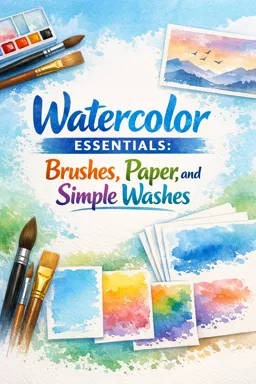

Free ebook on watercolor paper, brushes, pigment, water control, and simple washes for clean, confident painting.
Free ebook content
-

Watercolor Essentials: Building a Reliable Painting Setup
+ Exercise: What workspace setup best helps prevent dull, muddy watercolor mixes caused by contaminated water?
-
Watercolor Paper: Weight, Texture, and How Paper Changes Your Washes
+ Exercise: You want smoother, more predictable flat washes with fewer unintended streaks and more time to adjust the paint. Which paper fiber choice best supports that goal?
-
Watercolor Brushes: Shapes, Hair Types, and What Each One Is For
+ Exercise: You need to paint a long, uninterrupted thin line for branches without reloading often. Which brush choice best fits this task?
-
Paint and Pigment Handling: Mixing, Transparency, and Clean Color
+ Exercise: What is the best reason to keep separate warm and cool mixing pools on your watercolor palette?


-
Water Control Fundamentals: Ratios, Timing, and Bead Management
+ Exercise: While painting a flat wash, you pause to reload and notice the surface has shifted from a glossy/satin sheen to a damp stage (no shine). What is the best way to reload to avoid creating a hard edge or streaks?
-
Flat Wash Mastery: Even Color Across a Shape
+ Exercise: While painting a flat wash, you notice paint pooling along the pencil boundary and worry it will dry into a darker rim. What is the best action to prevent this while the wash is still wet?
-
Graded Washes: Smooth Transitions From Dark to Light
+ Exercise: While painting a graded wash, which approach best helps create a smooth transition from dark to light without visible bands?
-
Variegated Washes: Blending Two or More Colors Cleanly
+ Exercise: When blending two colors in a variegated wash, which approach best helps keep the transition clean and luminous (especially with higher-risk color pairs)?
-
Wet-on-Dry and Wet-on-Wet: Choosing the Right Surface State
+ Exercise: When painting a soft transition inside a shape, which approach best supports controlled diffusion without creating puddles?
-
Lifting and Corrections: Recovering Lights and Fixing Mistakes
+ Exercise: When trying to lighten a watercolor passage safely without damaging the paper, which approach best matches recommended lifting practices?
-
Glazing Basics: Layering Transparent Color With Control
+ Exercise: Which approach best describes proper watercolor glazing to deepen value while keeping the underlayer visible?
-
Edge Control: Hard, Soft, and Lost Edges in Simple Forms
+ Exercise: Which approach is most likely to create a deliberate lost edge in watercolor?
-
Capstone Practice: A Wash Sampler Sheet and a Simple Mini Painting
+ Exercise: In the mini painting, what is the main purpose of using a glaze step after earlier washes are fully dry?
About the free ebook
Watercolor Essentials: Brushes, Paper, and Simple Washes
Build a dependable watercolor practice with a clear understanding of the materials and techniques that shape every painting. This free ebook explains how paper, brushes, pigment, and water work together, so you can make intentional marks instead of relying on guesswork.
Paint with greater control
Learn how paper weight and texture affect absorption, drying time, and the appearance of a wash. Explore useful brush shapes and hair types, then develop practical habits for mixing clean color, loading a brush, and managing the moving bead of paint.
Step-by-step guidance focuses on essential wash techniques: flat, graded, and variegated washes. You will also practice choosing between wet-on-dry and wet-on-wet applications, preserving or lifting highlights, glazing transparent layers, and controlling hard, soft, and lost edges.
Turn simple exercises into confident paintings
Each concept supports expressive yet controlled watercolor work. By testing water-to-paint ratios and observing surface conditions, you can avoid common problems such as blooms, streaks, muddy mixtures, and unwanted backruns.
A practical foundation for watercolor
- Choose materials based on the result you want.
- Create smooth washes with deliberate timing.
- Correct small mistakes without overworking the paper.
- Combine core techniques in a wash sampler and mini painting.
Use this ebook as a focused reference while building a reliable setup and a repeatable painting process.
What watercolor paper weight is best for practicing washes?
300 gsm paper is a reliable choice because it resists buckling and stays workable during wet washes.
What brush should I use for a flat watercolor wash?
A large round, mop, or flat wash brush with a good water reservoir helps maintain an even moving bead.
Why do watercolor washes create blooms or backruns?
Blooms occur when wetter paint or water flows into a wash that is partly dry, pushing pigment outward.
This ebook includes:

13 content chapters

Digital certificate of course completion (Free)

Exercises to train your knowledge

100% free, from content to certificate
Ready to get started?

 recommended
In the app you will also find...

Over 5,000 free courses
Programming, English, Digital Marketing and much more! Learn whatever you want, for free.

Study plan with AI
Our app's Artificial Intelligence can create a study schedule for the course you choose.

From zero to professional success
Improve your resume with our free Certificate and then use our Artificial Intelligence to find your dream job.
You can also use the QR Code or the links below.