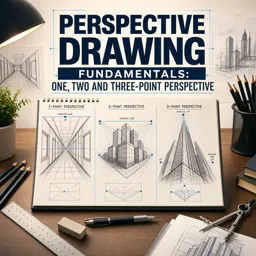
One-point perspective uses one vanishing point for depth, two-point uses two for angled forms, and three-point adds a third vanishing point for vertical convergence.

Duration of the online course: 2 hours and 57 minutes
New
Draw convincing spaces and objects with a free perspective drawing course—master 1, 2 & 3-point perspective and build skills with certificate-ready practice.
Learning to draw in perspective is the moment flat sketches start to feel like real spaces. This free online course helps you build that foundation step by step, so you can create drawings with believable depth, solid structure, and clear spatial logic—whether you’re sketching environments, product concepts, comics, or architectural ideas. You will train your eye to understand how the viewer’s position influences what you see, then translate that understanding into lines you can reliably construct, not guess.
You will begin by making sense of the horizon line and vanishing points and how they control the way edges recede. From there, you will practice one-point, two-point, and three-point perspective so you can choose the right setup for interiors, street scenes, and dramatic angles. The course emphasizes clean construction habits: dividing space accurately, scaling objects as they move away, and using measured methods to keep proportions consistent across a scene. These skills are essential for drawing believable boxes and turning them into more complex objects.
As you progress, you will work with practical tools for real-world drawing problems: rotating and mirroring forms without losing alignment, building perspective grids, and handling cases where vanishing points fall off the page. You will also learn to construct inclined planes and to place ellipses correctly in foreshortened squares—key for cylinders, holes, and rounded details. The course continues into constructing complex forms from simple structures, refining edges with fillets, drawing inside bounding boxes, and using contour lines to describe organic volume.
By the end, you’ll have a repeatable process for constructing forms and spaces with confidence, along with sharper visual judgment for errors in angle, convergence, and proportion. If you want a practical perspective toolkit you can apply to drawing and painting studies, design sketches, or creative projects, this course gives you a clear path from fundamentals to controlled, professional-looking results.

2 hours and 57 minutes of online video course

Digital certificate of course completion (Free)

Exercises to train your knowledge

100% free, from content to certificate
What is the difference between one-point, two-point, and three-point perspective drawing?
One-point perspective uses one vanishing point for depth, two-point uses two for angled forms, and three-point adds a third vanishing point for vertical convergence.
How do you draw objects at the correct scale as they recede in perspective?
Use converging guide lines, measured divisions, and reference heights to reduce an object's size consistently toward the horizon.
How can you draw a box when the vanishing points are off the page?
Use the Brewer method to establish and transfer perspective directions without needing to place distant vanishing points directly on the paper.
Ready to get started?Download the app and get started today.
Install the app now
to access the course
Over 5,000 free courses
Programming, English, Digital Marketing and much more! Learn whatever you want, for free.

Study plan with AI
Our app's Artificial Intelligence can create a study schedule for the course you choose.

From zero to professional success
Improve your resume with our free Certificate and then use our Artificial Intelligence to find your dream job.
You can also use the QR Code or the links below.



Free CourseHow to Draw on iPad
5

(3)

35m

6 exercises
Free CourseOil Painting techniques
5
(1)
23m
4 exercises
Free CourseArt Fundamentals
5
(3)
13h16m
29 exercises
Free CourseAcrylic Painting Course
5
(5)
135h55m
51 exercises
Free CoursePainting tutorials and lessons
4.9
(47)
5h26m
19 exercises
Free CourseContemporary Art Trends
4.9
(11)
24h51m
18 exercises
Free CourseBeginners Drawing course
4.9
(7)
72h50m
24 exercises
Free CourseDrawing tutorials and lessons
4.8
(124)
4h08m
18 exercises
Free CourseDraw class
4.7

(32)
11h14m
24 exercises
Free CourseDrawing Lessons for Beginners
4.7
(95)
6h22m
23 exercises
Carry knowledge in your pocket.
Download the Cursa app.
There are hundreds of free courses available, with a free certificate of completion that is saved in your mobile image gallery.
Download the app to access the Course Completion Certificate for Free.


+ 10 million
students

Free and Valid
Certificate

60 thousand free
exercises

4.8/5 rating in
app stores

Free courses in
video and ebooks