Free Course Image Art Fundamentals

Free online course Art Fundamentals

Duration of the online course: 13 hours and 16 minutes

5

StarStarStarStarStar

(3)

Build real drawing skills fast: learn shape, form, line, and shading in a free online course with practical exercises—perfect for beginners and creatives.

In this free course, learn about

  • Foundations: Shapes, Forms, and Sketching
  • Shape Language and Basic Form Construction
  • Simplification and Design with Forms
  • Light, Tone, and Form Rendering
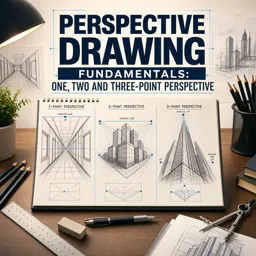
  • Construction, Depth, and Perspective
  • Pencil Shading Techniques and Common Mistakes

About the free online course

Strong art starts with strong fundamentals. This free online course helps you build the drawing mindset that makes everything else easier: seeing the world as simple, repeatable structures. Instead of guessing your way through sketches, you will learn to reduce objects into core forms and then rebuild them with confidence, clarity, and believable depth. It is ideal for beginners who want a clean starting point, and for creatives who feel stuck and need a reliable process.

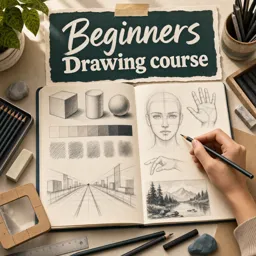
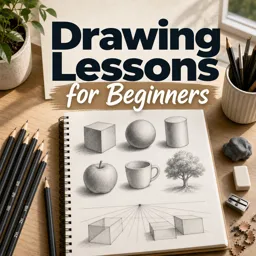
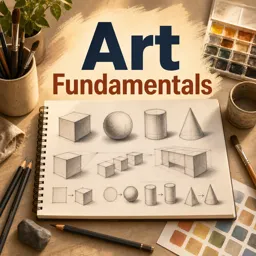
You will train your eye and hand to work with the essential three-dimensional building blocks that show up everywhere. By practicing cubes, spheres, and cylinders from different angles, you will understand how forms rotate in space, how to place them on the page, and how to keep proportions under control. Step-by-step demonstrations guide you through turning basic shapes into solid forms, improving your line quality, and developing sketchbook habits that make practice feel purposeful rather than random.

As you progress, the course strengthens your ability to design and simplify. You will learn how to break down complex subjects into primitive forms, how to use straights against curves to create more appealing silhouettes, and how to construct objects and characters with clearer structure. These skills translate directly to drawing and painting, product sketching, concept art, and visual communication in design.

To make your drawings feel three-dimensional, you will explore shading and light in a practical, beginner-friendly way. You will learn how light direction affects value, how shadows describe form, and how to define shapes clearly in grayscale studies. With focused exercises and quick self-check questions, you will reinforce what matters most: consistent practice, deliberate observation, and simple construction that scales to any subject you want to draw.

Course content

  • Video class: THE BASICS: Your three best friends-Cube, Sphere, Cylinder 2h08m
  • Exercise: Which of the following shapes is considered a three-dimensional form that serves as a foundational element in drawing?
  • Video class: THE BASICS: Sketchbook Techniques-Basic Form Sketching of Solids in Spatial Direction 47m
  • Exercise: What is the primary benefit of practicing basic form sketching exercises as described?
  • Video class: How to Draw Anything! The Basics Part 1 Shapes: Narrated Step by Step 22m
  • Exercise: What basic shapes can be used to start drawing objects?
  • Video class: THE BASICS: Rudiments of Cylinder Positions 11m
  • Video class: Beginner Drawing Course: Week 01 - Basics of Drawing and Line 34m
  • Exercise: What is a key principle to remember when learning to draw as emphasized in the beginner drawing course?
  • Video class: THE BASICS: Rudiments of Cylinder Positions #3 05m
  • Exercise: In the context of sketching and constructing forms, which of the following best describes the concept of 'open' and 'closed' as used in drawing cylindrical shapes?
  • Video class: Art Fundamentals: Shapes 16m
  • Exercise: Which of the following is not considered one of the primary forms when learning about shapes and forms in art fundamentals?
  • Exercise: Which of the following is NOT considered one of the primary forms in the art fundamentals?
  • Video class: Straights Against Curves Tutorial 08m
  • Exercise: What is one primary purpose of using the 'straights against curves' technique in character design?
  • Video class: How to Shade Basic Forms - Pencil Tutorial 09m
  • Exercise: Which of the following is a correct description of how to create the illusion of a three-dimensional form from a two-dimensional shape in drawing?
  • Video class: Drawing Fundamentals – Building Form 11m
  • Exercise: Which of the following sketching techniques can aid in developing creativity and improving brain function according to the text?
  • Video class: Drawing Fundamentals - Building Basic Forms 09m
  • Exercise: What is primarily emphasized as essential in the development of drawing skills?
  • Video class: Drawing Fundamentals - Form with Sections 11m
  • Exercise: What is the main purpose of starting with basic shapes and understanding their forms in art and design?
  • Video class: Freehand Drawing Fundamentals - Using Primitive Shapes to Draw Products 13m
  • Exercise: In the context of drawing and form development, what is the importance of using simple shapes?
  • Video class: STRUGGLING WITH CREATING COOL SHAPES? HERE's HOW TO SIMPLIFY 07m
  • Exercise: What is a beneficial strategy for simplifying the process of drawing complex shapes, such as a car, according to the text?
  • Video class: How to Draw Form 23m
  • Exercise: What is the purpose of practicing with simple forms like cylinders and cubes in art fundamentals?
  • Video class: Using Shapes to Create Appealing Designs 18m
  • Exercise: In character design, what is one of the attributed qualities of using circles as a dominant shape?
  • Video class: Shapes into Forms 03m
  • Video class: Elements of Art: Shape | KQED Arts 03m
  • Exercise: What are the two main categories of shapes in visual art?
  • Video class: How to Paint with a Lightsource--Light and Form 44m
  • Exercise: Which of the following factors primarily determines how a shadow is cast by an object in a scene?
  • Video class: Form Study Critique 30m
  • Exercise: When creating form in a grayscale painting, what is the essential element to define the shape?
  • Video class: How to Draw Form with Light and Tone (Part 4) for Figure Drawing 20m
  • Exercise: In the context of using light and tone in art, what is a conceptual light source?
  • Video class: How to Draw a Box 19m
  • Exercise: Which basic shape is useful to start understanding how to approximate perspective in drawing?
  • Video class: Live Shading Demo - Drawing Light on Form 2h05m
  • Video class: The Importance of Construction in Drawing 11m
  • Exercise: What is considered an essential practice for beginning artists to improve their drawing skills according to the tutorial?
  • Video class: Drawing using the construction method. 32m
  • Exercise: What is the purpose of using construction lines when drawing a face?
  • Video class: THE BASICS: Foreshortening 1 Taming The Beast 44m
  • Exercise: In art, 'foreshortening' is a technique used to create a sense of depth and dimension in a drawing. Which statement best describes the concept of foreshortening in art?
  • Video class: THE BASICS:: Rudiments of Linear Perspective 1-Pt. #1 11m
  • Exercise: What is the primary purpose of establishing a horizon line in one-point perspective drawing?
  • Video class: Drawing Fundamentals: CONSTRUCTION 21m
  • Exercise: What is the primary purpose of using construction lines in drawing?
  • Video class: Painting Fundamentals 09m
  • Exercise: What is considered a fundamental aspect to create a readable painting according to the discussion?
  • Video class: How to Shade with PENCIL for BEGINNERS 13m
  • Exercise: What is the most important aspect to understand in order to accurately shade a drawing?
  • Video class: Top 5 Shading Mistakes 14m
  • Exercise: What is a common mistake beginners make when trying to draw realistically?
  • Video class: Shading Lessons: Learn How to Draw Shades - How to Shade - Fine Art-Tips. 09m
  • Exercise: What is the purpose of creating a core shadow in shading techniques?

This free course includes:

Icon for learning via the audio course

13 hours and 16 minutes of online video course

Icon for the digital course completion certificate

Digital certificate of course completion (Free)

Icon for exercises to practice what you've learned

Exercises to train your knowledge

Icon for courses that are 100% free from start to finish

100% free, from content to certificate

How do cubes, spheres, and cylinders help you draw more accurately?

They provide simple 3D structures that help you construct objects with believable proportion, perspective, and volume.

What does “open” and “closed” mean when drawing a cylinder?

A closed cylinder has visible end caps, while an open cylinder shows an opening or hollow end, such as a tube or cup.

How can light and shadow make a flat shape look three-dimensional?

Using highlights, midtones, core shadows, and cast shadows describes how light falls across a form and creates the illusion of depth.

Ready to get started?Download the app and get started today.

Install the app now

to access the course
Icon representing technology and business courses

Over 5,000 free courses

Programming, English, Digital Marketing and much more! Learn whatever you want, for free.

Calendar icon with target representing study planning

Study plan with AI

Our app's Artificial Intelligence can create a study schedule for the course you choose.

Professional icon representing career and business

From zero to professional success

Improve your resume with our free Certificate and then use our Artificial Intelligence to find your dream job.

You can also use the QR Code or the links below.

QR Code - Download Cursa - Online Courses

Course comments: Art Fundamentals

BM

BouAli Mariem

StarStarStarStarStar

he explained very good

JF

James Fox

StarStarStarStar

Very good

JF

James Fox

StarStarStarStar

Good

More free courses at Drawing and Painting

Free Ebook + Audiobooks! Learn by listening or reading!