Use an Area3D with a CollisionShape3D to detect the player without creating physical collisions, then connect its body-entered signal to collection logic.

Duration of the online course: 11 hours and 59 minutes
New
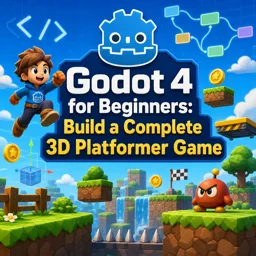
Build a complete 3D platformer with this free Godot 4 course—learn GDScript, levels, enemies, UI, and exporting to Windows or web.
Bring your game idea to life by building a complete 3D platformer from the ground up in Godot 4. This beginner-friendly course guides you through the full workflow of creating a playable project that feels like a real game: solid movement, responsive jumping, collectible items, a smooth camera, interactive hazards, win conditions, and a polished presentation. You will learn by doing, creating systems you can reuse in future projects instead of relying on disconnected examples.
Along the way, you will get comfortable inside the Godot editor and learn the practical foundations of GDScript, including how to structure logic, handle input cleanly, and work with constants and control flow for reliable behavior. You will also understand how physics-based characters are organized, why certain node types are best for reusable scenes, and how collision layers and masks keep complex interactions predictable as your project grows.
The course connects common 3D game development tasks into one coherent pipeline. You will move assets between Blender and Godot, import models in a production-friendly format, and set up collision correctly so environments feel solid without creating performance headaches. Visual quality is improved with sensible project settings, and the camera is tuned to follow the player smoothly for a more professional feel.
To make your world engaging, you will add animated collectibles, a coin counter with persistent tracking, and a HUD that stays fixed on-screen over a 3D scene. You will also introduce enemies with reliable collision detection, learn strategies for edge cases like cliffs and slopes, and build moving platforms that behave properly with other bodies. Finally, you will wrap everything up with menu screens, sound effects managed in a clean project structure, and export builds for Windows and the web so you can share your game with others.
elif (instead of a second separate if) help you do when checking left vs. right input?

11 hours and 59 minutes of online video course

Digital certificate of course completion (Free)

Exercises to train your knowledge

100% free, from content to certificate
How do I create a collectible coin in a Godot 4 3D platformer?
Use an Area3D with a CollisionShape3D to detect the player without creating physical collisions, then connect its body-entered signal to collection logic.
How can I make reusable 3D levels with GridMap in Godot 4?
Import your world-block models, create a MeshLibrary from them, and assign that MeshLibrary to a GridMap so you can paint level tiles.
Which renderer should I use when exporting a Godot 4 game for the web?
Switch to the Compatibility renderer before exporting, as it is designed for broader web browser support.
Ready to get started?Download the app and get started today.
Install the app now
to access the course
Over 5,000 free courses
Programming, English, Digital Marketing and much more! Learn whatever you want, for free.

Study plan with AI
Our app's Artificial Intelligence can create a study schedule for the course you choose.

From zero to professional success
Improve your resume with our free Certificate and then use our Artificial Intelligence to find your dream job.
You can also use the QR Code or the links below.



Free CourseUnreal Engine 5 Complete Tutorials
5

(1)

105h07m

53 exercises
Free CourseUnity - survival game
5
(13)
11h23m
38 exercises
Free CourseGame Environment Art
5
(3)
2h37m
7 exercises
Free CourseGame Design course
5
(1)
10h16m
38 exercises

Free CourseAndroid - LibGDX - Super Mario Bros
4.8
(18)
5h08m
22 exercises
Free CourseUnity game development for beginners
4.8

(4)
7h24m
Free CourseUnity 3D Game Development Course
4.8
(4)
11h44m
45 exercises
Free CourseRPG in Unity
4.7
(10)
2h27m
11 exercises
Free CourseBasic game in Unity
4.7
(53)
1h39m
11 exercises
Free CourseMultiplayer FPS in Unity
4.7
(15)
14h06m
24 exercises
Carry knowledge in your pocket.
Download the Cursa app.
There are hundreds of free courses available, with a free certificate of completion that is saved in your mobile image gallery.
Download the app to access the Course Completion Certificate for Free.


+ 10 million
students

Free and Valid
Certificate

60 thousand free
exercises

4.8/5 rating in
app stores

Free courses in
video and ebooks