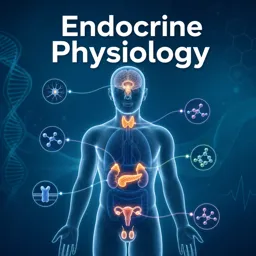
Physiology is the “how” behind the body’s “what.” Anatomy tells you what structures exist; physiology explains how those structures generate movement, perception, energy, and balance—minute by minute. When you study physiology as an integrated subject (instead of isolated chapters), you start seeing recurring patterns: gradients drive flow, membranes set boundaries, receptors translate signals, and feedback loops keep variables within workable ranges.
This systems-thinking approach is especially useful if you’re learning across multiple topics—Anatomy, Neuro, Cardiovascular, Respiratory, Renal, Gastrointestinal, and Endocrine—because it turns memorization into understanding. You’re not just collecting facts; you’re building a mental model of how the body coordinates function under changing demands.
Start with the cell: membranes, transport, and the logic of gradients
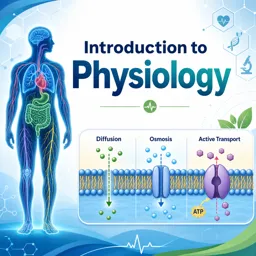
Nearly every physiological process can be traced back to cell membranes and gradients. Concentration gradients, electrical gradients, and pressure gradients are the “stored energy” that makes movement possible—whether it’s ions crossing a neuron’s membrane, oxygen diffusing in the lungs, or filtrate moving through the kidney. Understanding diffusion, osmosis, channels, pumps, and carriers gives you a universal toolkit for interpreting organ function.
Communication networks: fast wiring and slow messaging
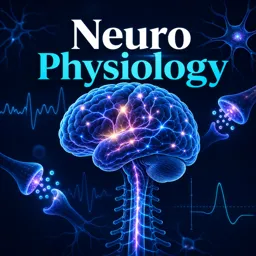
The body coordinates with two main communication strategies: rapid electrical signaling (nervous system) and slower chemical signaling (endocrine system). In practice, they work together. Stress, exercise, sleep, and digestion all involve combined neural reflexes and hormonal modulation. Recognizing which type of signal dominates in a given scenario helps you predict time course, specificity, and duration of effects.
If you want to go deeper into dedicated topics, you can explore subject tracks like https://cursa.app/free-online-courses/neuro-physiology and https://cursa.app/free-online-courses/endocrine-physiology to see how action potentials, synapses, receptors, and endocrine axes translate into real-world function.

Flow and pressure: why circulation is a physics problem (and a biology one)
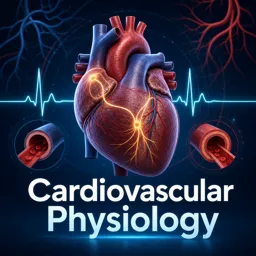
From air moving into alveoli to blood moving through arteries, physiology frequently reduces to relationships between pressure, resistance, and flow. The cardiovascular system isn’t only about the heart—it’s also about vessels, compliance, and how local tissues regulate their own supply. Learning basic hemodynamics (and the logic behind vasoconstriction vs. vasodilation) makes it easier to understand exercise responses, temperature regulation, and orthostatic changes.
To focus specifically on these mechanisms, visit https://cursa.app/free-online-courses/cardiovascular-physiology, where you can connect electrical activation, mechanical contraction, and vascular regulation into one coherent story.
Gas exchange and acid–base: the chemistry of staying alive
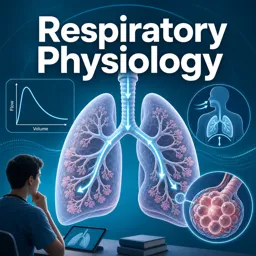
Respiratory physiology is more than breathing mechanics. It’s about optimizing gas exchange, matching ventilation to perfusion, and maintaining acid–base balance through CO₂ handling. Meanwhile, blood buffers and renal mechanisms cooperate to stabilize pH. When you learn these as a combined “gas + acid–base” theme, clinical and everyday situations—like altitude exposure, intense exercise, or anxiety-driven hyperventilation—become easier to interpret logically.
For a structured pathway into lung function concepts, explore https://cursa.app/free-online-courses/respiratory-physiology.
Regulation and balance: kidneys, fluids, and the “internal environment”
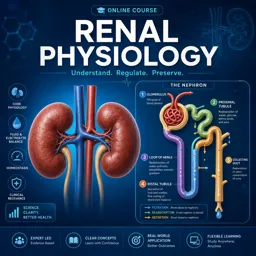
Renal physiology often feels complex until you organize it around a few core goals: maintain fluid volume, osmolarity, electrolyte balance, and long-term blood pressure control. Filtration is only the starting point—selective reabsorption and secretion are where regulation happens. Tie this to hormones (like aldosterone and ADH) and you’ll see how kidneys collaborate with cardiovascular and endocrine systems to keep the internal environment stable during dehydration, salt changes, or blood loss.
To study this system in detail, go to https://cursa.app/free-online-courses/renal-physiology.
Energy and absorption: turning food into usable physiology
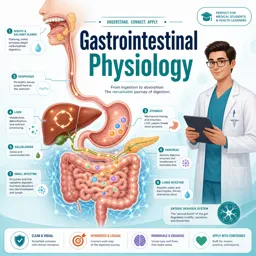
Gastrointestinal physiology is where external matter becomes internal fuel—through secretion, digestion, absorption, and coordinated motility. A useful way to learn it is by “function zones”: mouth and stomach for processing and preparation, small intestine for absorption, and large intestine for water and electrolyte recovery. Add in liver and pancreas function, and you get a full picture of how nutrients support every other system’s workload.
For topic-based learning on these mechanisms, see https://cursa.app/free-online-courses/gastrointestinal-physiology.
A practical way to study physiology: learn patterns, then apply them
If physiology feels like too many details, shift your strategy from memorizing to pattern recognition. Use this checklist as you study any organ system:
- What variable is being controlled? (e.g., pressure, pH, glucose, osmolarity)
- What sensors detect change? (receptors, stretch sensors, chemoreceptors)
- What integrator makes decisions? (brainstem, hypothalamus, endocrine glands)
- What effectors do the work? (muscle, glands, kidneys, vessels)
- What’s the time scale? (milliseconds vs. hours)
- What’s the trade-off? (e.g., conserving water vs. maintaining pressure)

Build your learning path across physiology topics
Physiology is easiest to master when you can move from foundational principles to specialized systems without losing the big picture. You can browse the broader health catalog at https://cursa.app/free-online-health-courses, then focus your learning with the dedicated https://cursa.app/free-courses-health-online collection. From there, branch into system-focused tracks—Neuro, Cardiovascular, Respiratory, Renal, Gastrointestinal, and Endocrine—so each new module reinforces the same core mechanisms in a different context.
Extend your understanding with reputable references
To complement course learning with high-quality background reading, explore open educational resources like https://openstax.org/subjects/science and https://www.physiology.org/. These can help you review core definitions, diagrams, and terminology while you practice applying concepts across systems.